Howard Hughes Medical Institute, University of Colorado at Boulder, CO, USA.
J Tissue Eng Regen Med. 2012 Apr;6(4):314-24. doi: 10.1002/term.435. Epub 2011 Jun 27.
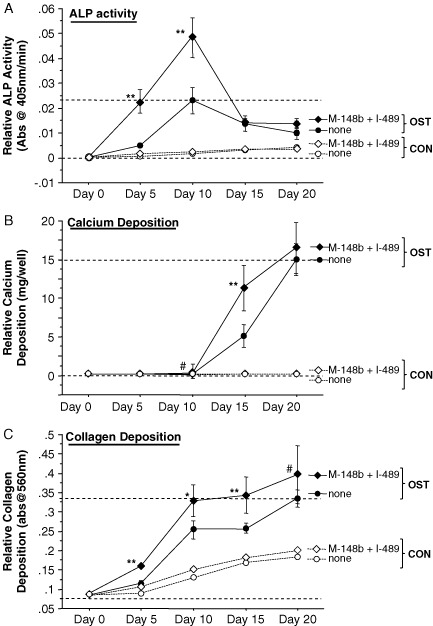
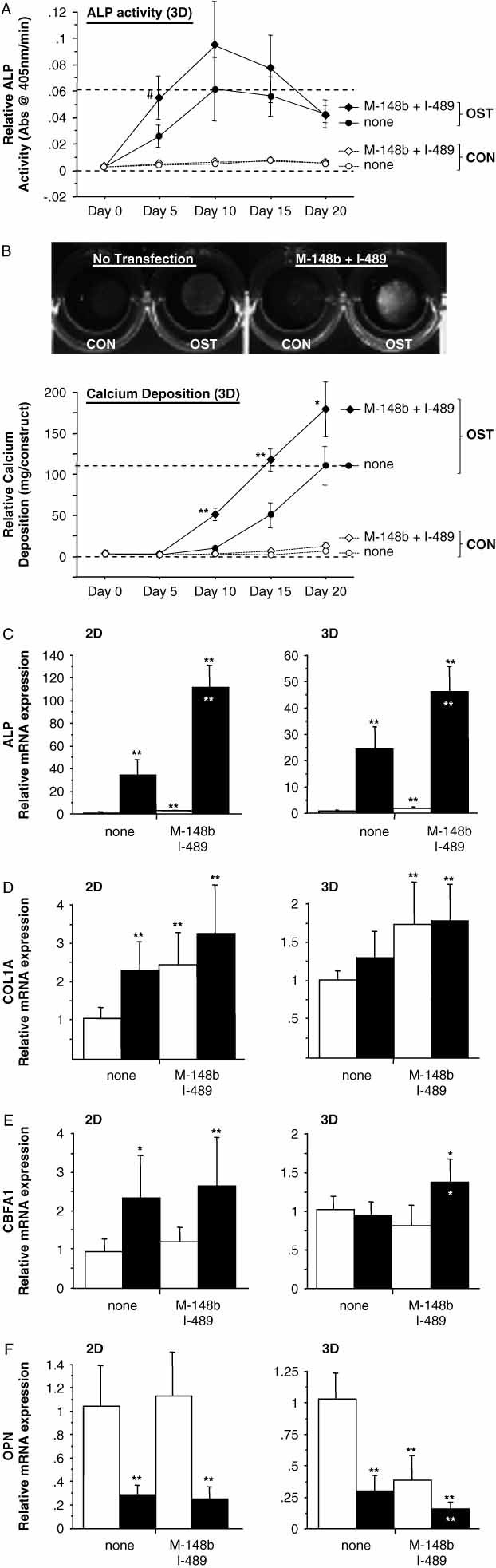
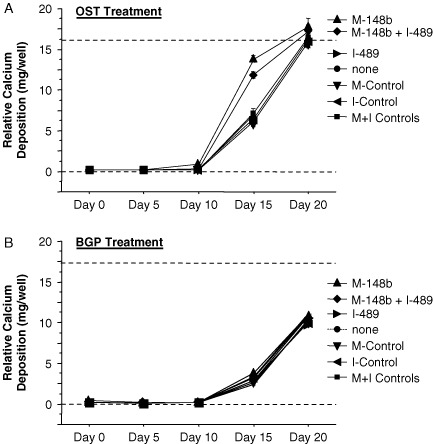
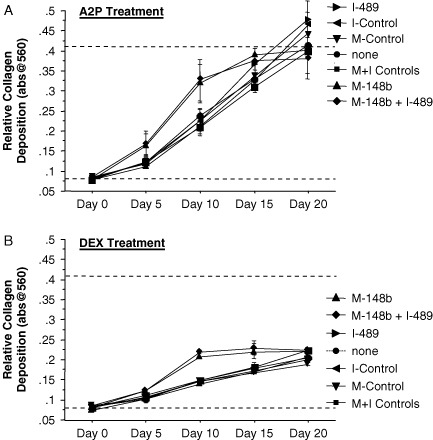
Cell-based tissue engineering strategies have shown tremendous promise for the repair of bone mass deficiencies, but the efficient and appropriate induction of stem cells down osteogenic pathways remains a significant roadblock to the effective implementation of cell-based therapies. When grown in culture, human Mesenchymal Stromal/Stem Cells (hMSCs) remain multipotent, requiring specific exogenous signals to induce osteogenic differentiation. hMSCs used in transplantations, therefore, must be presented with local signals, often provided by the host's own tissues, to be directed down bone-related lineages. This process is relatively inefficient and remains difficult to control. In an effort to enhance osteogenesis, hMSCs were transfected with specific miRNA mimics and inhibitors that had originally identified for their ability to increase Alkaline Phosphatase (ALP) activity. Transfection with miRNA reagents had the effect of sensitizing hMSCs to soluble osteogenic factors, resulting in a rapid and robust induction of bone-related markers, including ALP activity and calcium deposition. Synthetic 3D tissue constructs prepared with miRNA-transfected hMSCs demonstrated similar responses to soluble osteogenic signals, suggesting that controlling miRNA activity in hMSCs can be an effective tool for enhancing the induction of osteogenesis for tissue engineering purposes.
基于细胞的组织工程策略在修复骨量不足方面显示出巨大的潜力,但有效地诱导干细胞沿着成骨途径分化仍然是细胞治疗有效实施的一个重大障碍。在培养中生长时,人基质/干细胞(hMSCs)仍然具有多能性,需要特定的外源性信号来诱导成骨分化。因此,用于移植的 hMSCs 必须呈现局部信号,通常由宿主自身的组织提供,以指导与骨骼相关的谱系。这个过程相对低效,仍然难以控制。为了增强成骨作用,将特定的 miRNA 模拟物和抑制剂转染到 hMSCs 中,这些 miRNA 模拟物和抑制剂最初因其能够增加碱性磷酸酶(ALP)活性而被鉴定出来。miRNA 试剂的转染使 hMSCs 对可溶性成骨因子敏感,导致与骨骼相关的标志物的快速和强烈诱导,包括 ALP 活性和钙沉积。用 miRNA 转染的 hMSCs 制备的合成 3D 组织构建体对可溶性成骨信号表现出类似的反应,这表明控制 hMSCs 中的 miRNA 活性可能是增强组织工程中成骨诱导的有效工具。