State Key Laboratory of Emerging Infectious Diseases, Hong Kong.
Research Centre of Infection and Immunology, The University of Hong Kong, Hong Kong.
Cell Biosci. 2011 Jun 14;1(1):22. doi: 10.1186/2045-3701-1-22.
Laribacter hongkongensis is associated with community-acquired gastroenteritis and traveler's diarrhea and it can reside in human, fish, frogs and water. In this study, we performed an in-depth annotation of the genes in its genome related to adaptation to the various environmental niches.
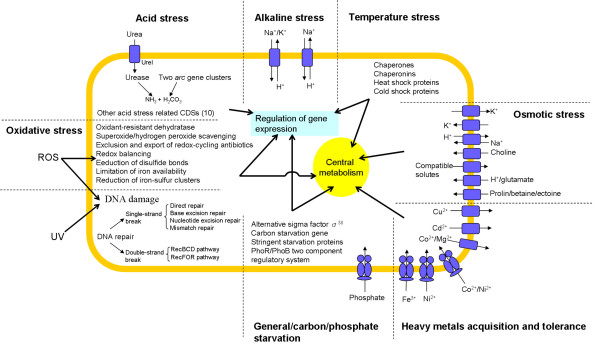
L. hongkongensis possessed genes for DNA repair and recombination, basal transcription, alternative σ-factors and 109 putative transcription factors, allowing DNA repair and global changes in gene expression in response to different environmental stresses. For acid stress, it possessed a urease gene cassette and two arc gene clusters. For alkaline stress, it possessed six CDSs for transporters of the monovalent cation/proton antiporter-2 and NhaC Na+:H+ antiporter families. For heavy metals acquisition and tolerance, it possessed CDSs for iron and nickel transport and efflux pumps for other metals. For temperature stress, it possessed genes related to chaperones and chaperonins, heat shock proteins and cold shock proteins. For osmotic stress, 25 CDSs were observed, mostly related to regulators for potassium ion, proline and glutamate transport. For oxidative and UV light stress, genes for oxidant-resistant dehydratase, superoxide scavenging, hydrogen peroxide scavenging, exclusion and export of redox-cycling antibiotics, redox balancing, DNA repair, reduction of disulfide bonds, limitation of iron availability and reduction of iron-sulfur clusters are present. For starvation, it possessed phosphorus and, despite being asaccharolytic, carbon starvation-related CDSs.
The L. hongkongensis genome possessed a high variety of genes for adaptation to acid, alkaline, temperature, osmotic, oxidative, UV light and starvation stresses and acquisition of and tolerance to heavy metals.
香港弧菌与社区获得性胃肠炎和旅行者腹泻有关,它可以存在于人类、鱼类、青蛙和水中。在这项研究中,我们对其基因组中与适应各种环境小生境相关的基因进行了深入注释。
香港弧菌拥有 DNA 修复和重组、基础转录、替代 σ 因子和 109 个潜在转录因子的基因,使 DNA 修复和基因表达的全局变化能够应对不同的环境压力。对于酸性应激,它拥有一个脲酶基因盒和两个 arc 基因簇。对于碱性应激,它拥有六个编码单价阳离子/质子反向转运体-2 和 NhaC Na+:H+反向转运体家族转运蛋白的 CDS。对于重金属的获取和耐受,它拥有铁和镍转运的 CDSs 以及其他金属的外排泵。对于温度应激,它拥有与伴侣蛋白和 chaperonins、热休克蛋白和冷休克蛋白相关的基因。对于渗透应激,观察到 25 个 CDSs,主要与钾离子、脯氨酸和谷氨酸转运的调节剂有关。对于氧化和 UV 应激,存在抗氧化剂抗性脱水酶、超氧化物清除、过氧化氢清除、氧化还原循环抗生素的排除和外排、氧化还原平衡、DNA 修复、二硫键还原、铁可用性限制和铁硫簇还原的基因。对于饥饿,它拥有磷,尽管是无碳分解代谢,但也拥有与碳饥饿相关的 CDSs。
香港弧菌基因组拥有多种适应酸、碱、温度、渗透压、氧化、UV 应激和饥饿以及获取和耐受重金属的基因。