Hib Initiative, London School of Hygiene and Tropical Medicine, London, United Kingdom.
PLoS One. 2011;6(6):e21472. doi: 10.1371/journal.pone.0021472. Epub 2011 Jun 24.
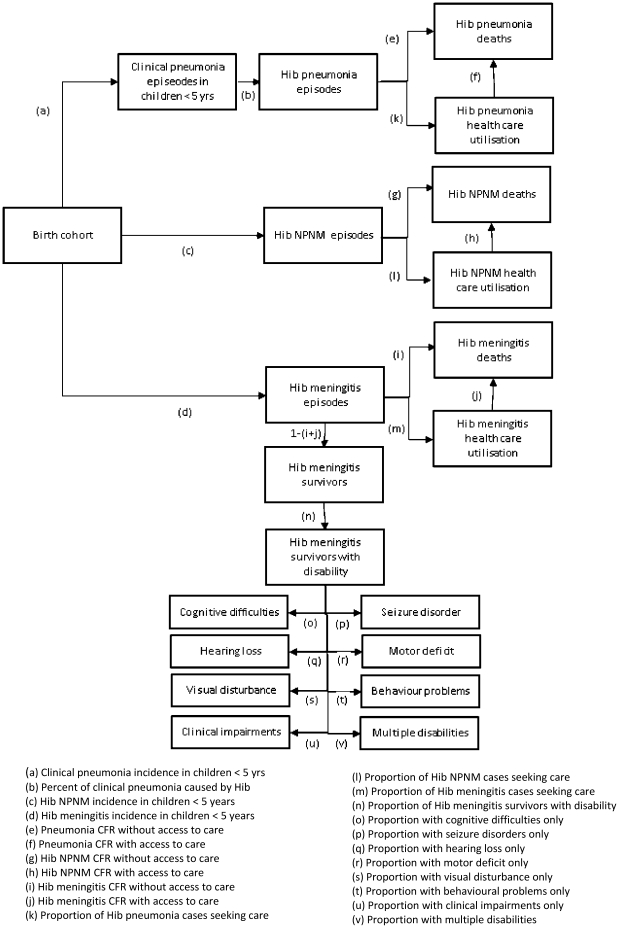
Hib vaccine has gradually been introduced into more and more countries during the past two decades, partly due to GAVI Alliance support to low-income countries. However, since Hib disease burden is difficult to establish in settings with limited diagnostic capacities and since the vaccine continues to be relatively expensive, some Governments remain doubtful about its value leading to concerns about financial sustainability. Similarly, several middle-income countries have not introduced the vaccine. The aim of this study is to estimate and compare the cost-effectiveness of Hib vaccination in a country relying on self-financing (Belarus) and a country eligible for GAVI Alliance support (Uzbekistan).
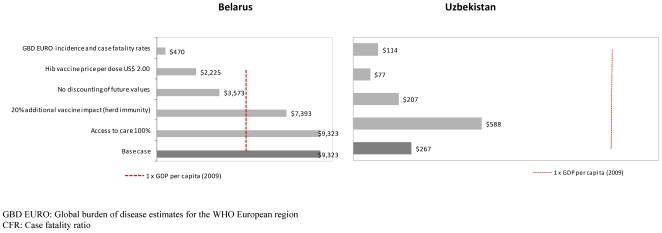
A decision analytic model was used to estimate morbidity and mortality from Hib meningitis, Hib pneumonia and other types of Hib disease with and without the vaccine. Treatment costs were attached to each disease event. Data on disease incidence, case fatality ratios and costs were primarily determined from national sources. For the Belarus 2009 birth cohort, Hib vaccine is estimated to prevent 467 invasive disease cases, 4 cases of meningitis sequelae, and 3 deaths, while in Uzbekistan 3,069 invasive cases, 34 sequelae cases and 341 deaths are prevented. Estimated costs per discounted DALY averted are US$ 9,323 in Belarus and US$ 267 in Uzbekistan.
The primary reason why the cost-effectiveness values are more favourable in Uzbekistan than in Belarus is that relatively more deaths are averted in Uzbekistan due to higher baseline mortality burden. Two other explanations are that the vaccine price is lower in Uzbekistan and that Uzbekistan uses a three dose schedule compared to four doses in Belarus. However, when seen in the context of the relative ability to pay for public health, the vaccine can be considered cost-effective in both countries.
在过去的二十年中,由于全球疫苗免疫联盟(GAVI Alliance)对低收入国家的支持, Hib 疫苗逐渐在越来越多的国家得到推广。然而,由于在诊断能力有限的情况下难以确定 Hib 疾病负担,并且疫苗仍然相对昂贵,一些国家的政府对其价值持怀疑态度,这导致人们对其财务可持续性产生了担忧。同样,一些中等收入国家也没有引入该疫苗。本研究旨在估算并比较依靠自筹资金的国家(白俄罗斯)和有资格获得 GAVI 联盟支持的国家(乌兹别克斯坦) Hib 疫苗接种的成本效益。
使用决策分析模型来估算 Hib 脑膜炎、Hib 肺炎和其他类型 Hib 疾病的发病率和死亡率,包括有无疫苗接种的情况。将每种疾病的治疗费用附加到每个疾病事件中。疾病发病率、病死率和成本的数据主要来自国家来源。对于白俄罗斯 2009 年出生的队列,Hib 疫苗预计可预防 467 例侵袭性疾病病例、4 例脑膜炎后遗症病例和 3 例死亡病例,而在乌兹别克斯坦可预防 3069 例侵袭性病例、34 例后遗症病例和 341 例死亡病例。预计每例经贴现残疾调整生命年(DALY)避免的成本分别为白俄罗斯 9323 美元和乌兹别克斯坦 267 美元。
乌兹别克斯坦的成本效益值比白俄罗斯更有利的主要原因是,由于基线死亡率负担较高,乌兹别克斯坦避免了更多的死亡。另外两个解释是,乌兹别克斯坦的疫苗价格较低,且其使用三剂接种方案,而白俄罗斯使用四剂接种方案。然而,从公共卫生支付能力的角度来看,疫苗在这两个国家都被认为是具有成本效益的。