Principal Lecturer, Public Services International Research Unit (PSIRU), The Business School, University of Greenwich, UK.
Global Health. 2011 Jul 1;7:19. doi: 10.1186/1744-8603-7-19.
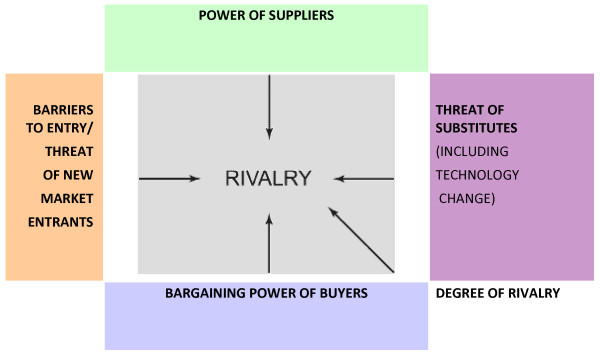
This paper discusses the findings of a study which developed five case studies of five multinational health care companies involved in public health care systems. Strategies were analysed in terms of attitude to marketing, pricing and regulation. The company strategies have been subjected to an analysis using Porter's Five Forces, a business strategy framework, which is unusual in health policy studies.
This paper shows how analysing company strategy using a business tool can contribute to understanding the strategies of global capital in national health systems. It shows how social science methodologies can draw from business methods to explain company strategies.
The five companies considered in this paper demonstrate that their strategies have many dimensions, which fit into Porter's Five Forces of comparative advantage. More importantly the Five Forces can be used to identify factors that influence company entry into public health care systems.
The process of examining the strategic objectives of five health care companies shows that a business tool can help to explain the actions and motives of health care companies towards public health care systems, and so contribute to a better understanding of the strategies of global capital in national health systems. Health service commissioners need to understand this dynamic process, which will evolve as the nature of public health care systems change.
本文讨论了一项研究的结果,该研究对五家涉及公共医疗保健系统的跨国医疗保健公司进行了五个案例研究。从营销态度、定价和监管等方面分析了策略。采用波特五力模型(一种商业战略框架)对公司战略进行了分析,这在卫生政策研究中并不常见。
本文展示了如何使用商业工具分析公司战略,以帮助理解全球资本在国家卫生系统中的战略。它展示了社会科学方法如何借鉴商业方法来解释公司战略。
本文中考虑的五家公司表明,它们的战略具有许多维度,这些维度符合波特的五种竞争力量的比较优势。更重要的是,五力模型可用于确定影响公司进入公共医疗保健系统的因素。
审查五家医疗保健公司的战略目标过程表明,商业工具可以帮助解释医疗保健公司对公共医疗保健系统的行为和动机,从而有助于更好地理解全球资本在国家卫生系统中的战略。医疗服务专员需要了解这一动态过程,因为公共医疗保健系统的性质正在发生变化,这一过程也将随之演变。