Valgepea Kaspar, Adamberg Kaarel, Vilu Raivo
Tallinn University of Technology, Department of Chemistry, Akadeemia tee 15, 12618 Tallinn, Estonia.
BMC Syst Biol. 2011 Jul 5;5:106. doi: 10.1186/1752-0509-5-106.
Growth substrates, aerobic/anaerobic conditions, specific growth rate (μ) etc. strongly influence Escherichia coli cell physiology in terms of cell size, biomass composition, gene and protein expression. To understand the regulation behind these different phenotype properties, it is useful to know carbon flux patterns in the metabolic network which are generally calculated by metabolic flux analysis (MFA). However, rarely is biomass composition determined and carbon balance carefully measured in the same experiments which could possibly lead to distorted MFA results and questionable conclusions. Therefore, we carried out both detailed carbon balance and biomass composition analysis in the same experiments for more accurate quantitative analysis of metabolism and MFA.
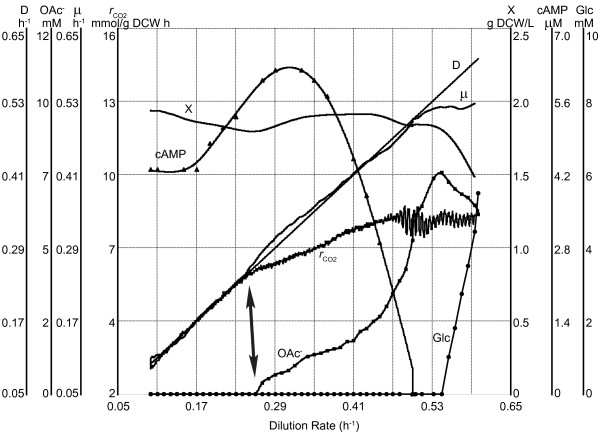
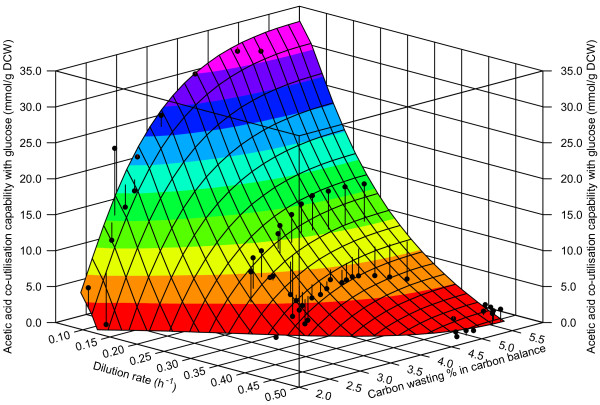
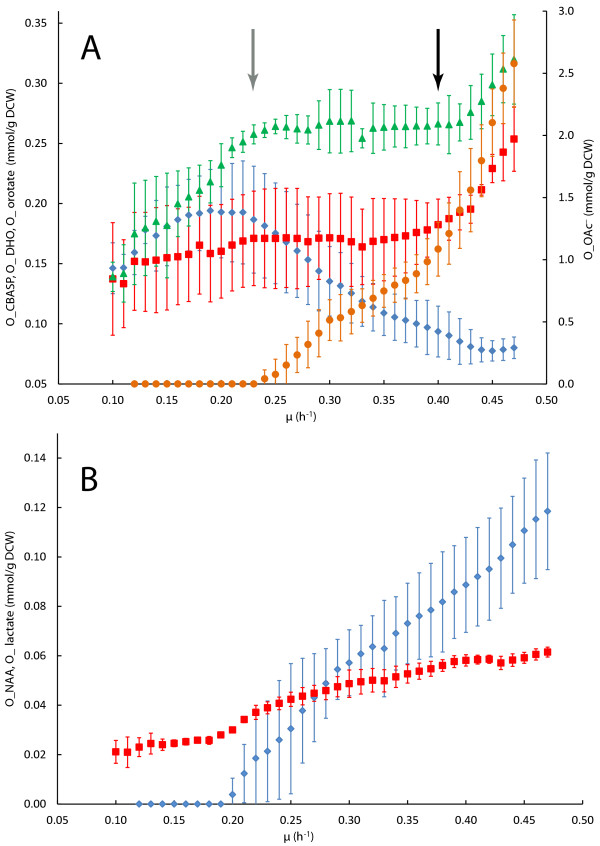
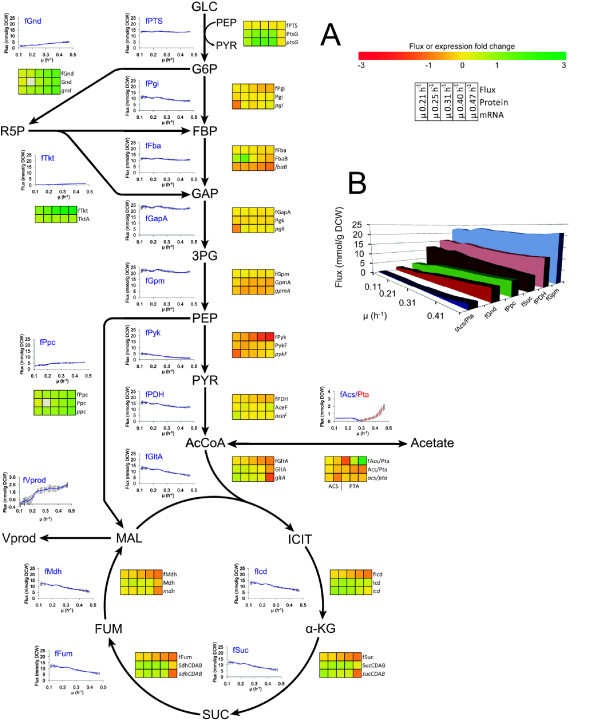
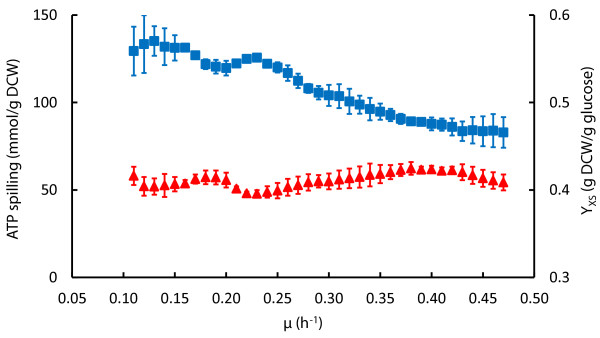
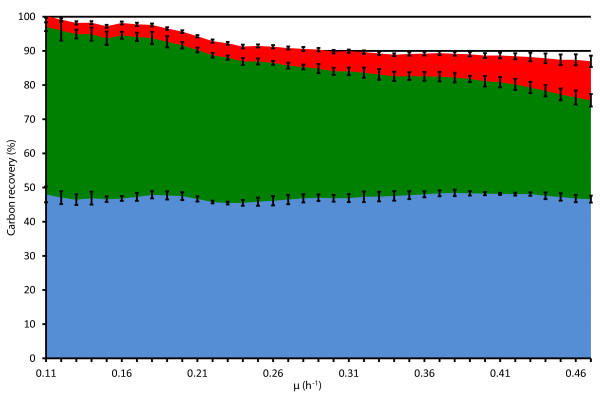
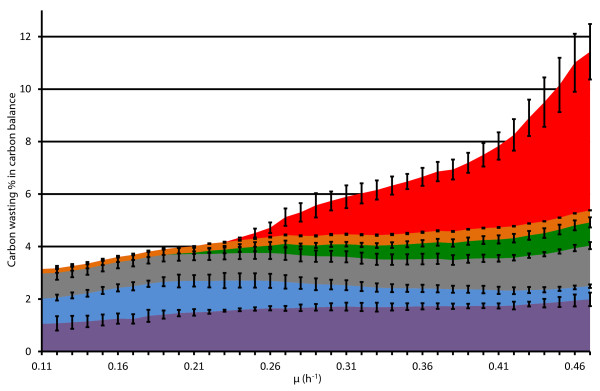
We applied advanced continuous cultivation methods (A-stat and D-stat) to continuously monitor E. coli K-12 MG1655 flux and energy metabolism dynamic responses to change of μ and glucose-acetate co-utilisation. Surprisingly, a 36% reduction of ATP spilling was detected with increasing μ and carbon wasting to non-CO2 by-products under constant biomass yield. The apparent discrepancy between constant biomass yield and decline of ATP spilling could be explained by the rise of carbon wasting from 3 to 11% in the carbon balance which was revealed by the discovered novel excretion profile of E. coli pyrimidine pathway intermediates carbamoyl-phosphate, dihydroorotate and orotate. We found that carbon wasting patterns are dependent not only on μ, but also on glucose-acetate co-utilisation capability. Accumulation of these compounds was coupled to the two-phase acetate accumulation profile. Acetate overflow was observed in parallel with the reduction of TCA cycle and glycolysis fluxes, and induction of pentose phosphate pathway.
It can be concluded that acetate metabolism is one of the major regulating factors of central carbon metabolism. More importantly, our model calculations with actual biomass composition and detailed carbon balance analysis in steady state conditions with -omics data comparison demonstrate the importance of a comprehensive systems biology approach for more advanced understanding of metabolism and carbon re-routing mechanisms potentially leading to more successful metabolic engineering.
生长底物、好氧/厌氧条件、比生长速率(μ)等在细胞大小、生物量组成、基因和蛋白质表达方面对大肠杆菌细胞生理有强烈影响。为了解这些不同表型特性背后的调控机制,了解代谢网络中的碳通量模式很有用,这些模式通常通过代谢通量分析(MFA)来计算。然而,在同一实验中很少同时测定生物量组成和仔细测量碳平衡,这可能导致MFA结果失真和结论存疑。因此,我们在同一实验中进行了详细的碳平衡和生物量组成分析,以更准确地定量分析代谢和MFA。
我们应用先进的连续培养方法(A-stat和D-stat)来连续监测大肠杆菌K-12 MG1655的通量以及能量代谢对μ变化和葡萄糖-乙酸盐共利用的动态响应。令人惊讶的是,在生物量产量恒定的情况下,随着μ的增加和碳向非二氧化碳副产物的浪费,检测到ATP溢出减少了36%。生物量产量恒定与ATP溢出下降之间的明显差异可以通过碳平衡中碳浪费从3%上升到11%来解释,这是由发现的大肠杆菌嘧啶途径中间产物氨甲酰磷酸、二氢乳清酸和乳清酸的新排泄谱揭示的。我们发现碳浪费模式不仅取决于μ,还取决于葡萄糖-乙酸盐共利用能力。这些化合物的积累与两阶段乙酸盐积累曲线相关。观察到乙酸盐溢出与三羧酸循环和糖酵解通量的减少以及磷酸戊糖途径的诱导同时发生。
可以得出结论,乙酸盐代谢是中心碳代谢的主要调节因素之一。更重要 的是,我们在稳态条件下结合实际生物量组成进行的模型计算以及详细的碳平衡分析与组学数据比较表明,全面的系统生物学方法对于更深入理解代谢和碳重新路由机制至关重要,这可能会带来更成功的代谢工程。