Sprenger Amber M, Dougherty Michael R, Atkins Sharona M, Franco-Watkins Ana M, Thomas Rick P, Lange Nicholas, Abbs Brandon
Decision Attention and Memory Lab, Department of Psychology, University of Maryland College Park, MD, USA.
Front Psychol. 2011 Jun 17;2:129. doi: 10.3389/fpsyg.2011.00129. eCollection 2011.
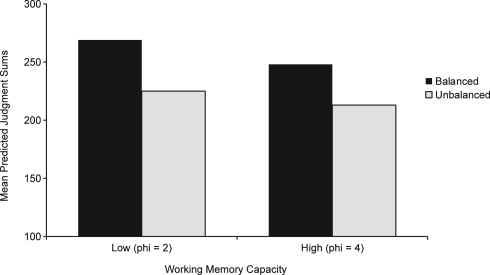
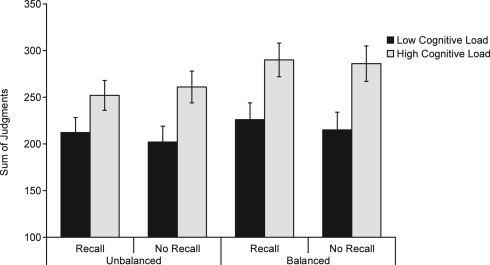
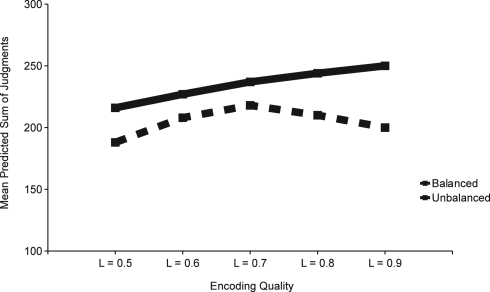
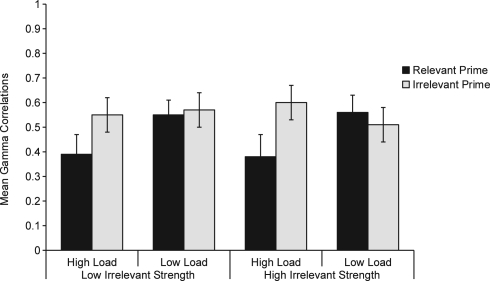
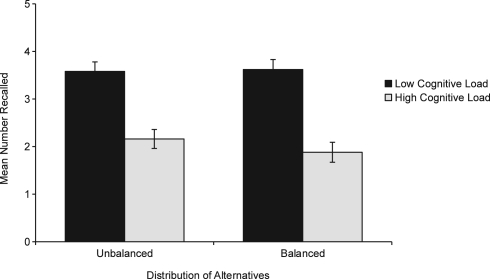
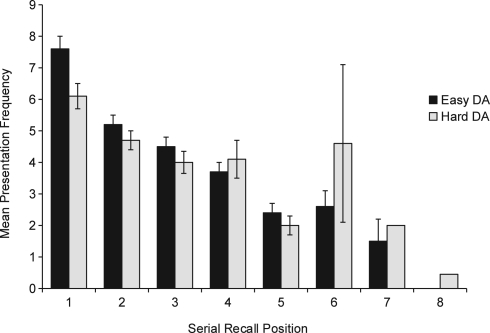
We tested the predictions of HyGene (Thomas et al., 2008) that both divided attention at encoding and judgment should affect the degree to which participants' probability judgments violate the principle of additivity. In two experiments, we showed that divided attention during judgment leads to an increase in subadditivity, suggesting that the comparison process for probability judgments is capacity limited. Contrary to the predictions of HyGene, a third experiment revealed that divided attention during encoding leads to an increase in later probability judgment made under full attention. The effect of divided attention during encoding on judgment was completely mediated by the number of hypotheses participants generated, indicating that limitations in both encoding and recall can cascade into biases in judgments.
我们检验了HyGene(Thomas等人,2008年)的预测,即在编码和判断过程中分散注意力均应影响参与者概率判断违反可加性原则的程度。在两项实验中,我们发现判断过程中的分散注意力会导致次可加性增加,这表明概率判断的比较过程存在容量限制。与HyGene的预测相反,第三个实验表明编码过程中的分散注意力会导致随后在全神贯注状态下做出的概率判断增加。编码过程中分散注意力对判断的影响完全由参与者生成的假设数量所介导,这表明编码和回忆方面的限制可能会级联导致判断偏差。