Banfield B W, Tufaro F
Department of Microbiology, University of British Columbia, Vancouver, Canada.
J Virol. 1990 Dec;64(12):5716-29. doi: 10.1128/JVI.64.12.5716-5729.1990.
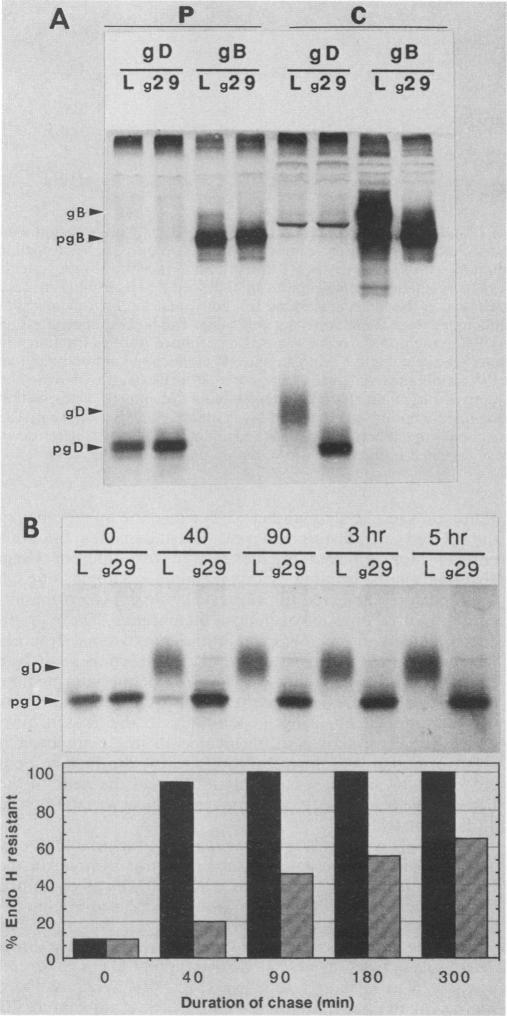
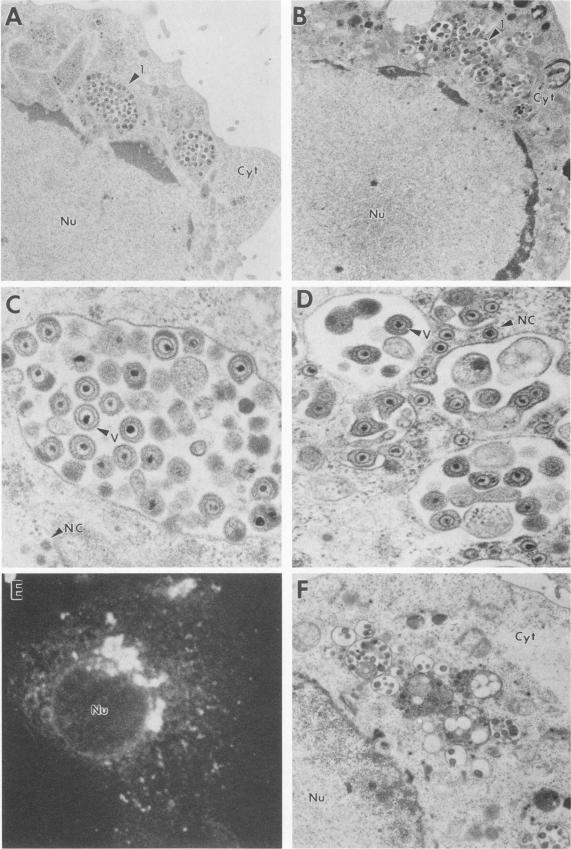
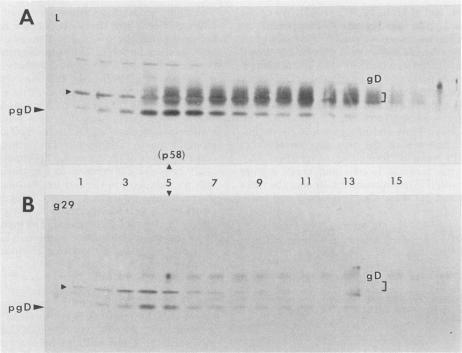
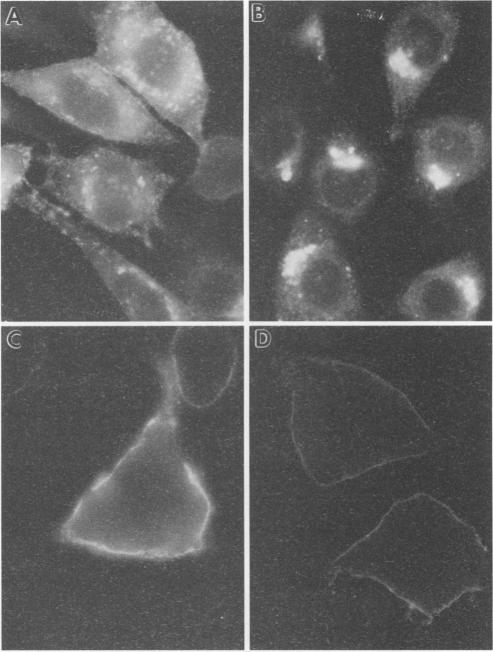
The mouse L-cell mutant gro29 was selected for its ability to survive infection by herpes simplex virus type 1 (HSV-1) and is defective in the propagation of HSV-1 and vesicular stomatitis virus (F. Tufaro, M. D. Snider, and S. L. McKnight, J. Cell Biol. 105:647-657, 1987). In this report, we show that gro29 cells harbor a lesion that inhibits the egress of HSV-1 virions during infection. We also found that HSV-1 glycoprotein D was slow to traverse the secretory pathway en route to the plasma membrane of infected gro29 cells. The movement of glycoproteins was not blocked entirely, however, and immunofluorescence experiments revealed that infected gro29 cells contained roughly 10% of the expected amount of glycoprotein D on their cell surface at 12 h postinfection. Furthermore, nucleocapsids and virions assembled inside the cells during infection, suggesting that the lesion in gro29 cells impinged on a late step in virion maturation. Electron micrographs of infected cells revealed that many of the intracellular virions were contained in irregular cytoplasmic vacuoles, similar to those that accumulate in HSV-1-infected cells treated with the ionophore monensin. We conclude from these results that gro29 harbors a defect that blocks the egress of HSV-1 virions from the infected cell without seriously impeding the flux of individual glycoproteins to the cell surface. We infer that HSV-1 maturation and egress require a host cell component that is either reduced or absent in gro29 cells and that this lesion, although not lethal to the host cell, cannot be tolerated by HSV-1 during its life cycle.
小鼠L细胞突变体gro29因其能够在1型单纯疱疹病毒(HSV-1)感染后存活而被筛选出来,它在HSV-1和水疱性口炎病毒的增殖方面存在缺陷(F. 图法罗、M. D. 斯奈德和S. L. 麦克奈特,《细胞生物学杂志》105:647 - 657,1987年)。在本报告中,我们表明gro29细胞存在一种损伤,该损伤在感染期间抑制了HSV-1病毒粒子的释放。我们还发现,HSV-1糖蛋白D在前往感染的gro29细胞的质膜的途中,在分泌途径中的移动速度较慢。然而,糖蛋白的移动并未完全受阻,免疫荧光实验显示,在感染后12小时,感染的gro29细胞在其细胞表面含有大约预期量10%的糖蛋白D。此外,感染期间核衣壳和病毒粒子在细胞内组装,这表明gro29细胞中的损伤影响了病毒粒子成熟的后期步骤。感染细胞的电子显微镜照片显示,许多细胞内病毒粒子包含在不规则的细胞质空泡中,类似于在用离子载体莫能菌素处理的HSV-1感染细胞中积累的空泡。从这些结果我们得出结论,gro29存在一种缺陷,该缺陷阻止了HSV-1病毒粒子从感染细胞中释放,而不会严重阻碍单个糖蛋白向细胞表面的运输。我们推断,HSV-1的成熟和释放需要一种宿主细胞成分,这种成分在gro29细胞中要么减少要么缺失,并且这种损伤虽然对宿主细胞不致命,但在其生命周期中HSV-1无法耐受。