
典型和异常生长中的空间密集型 3D 面部不对称评估。
Spatially-dense 3D facial asymmetry assessment in both typical and disordered growth.
机构信息
Melbourne Dental School, The University of Melbourne, Victoria, Australia.
出版信息
J Anat. 2011 Oct;219(4):444-55. doi: 10.1111/j.1469-7580.2011.01411.x. Epub 2011 Jul 11.
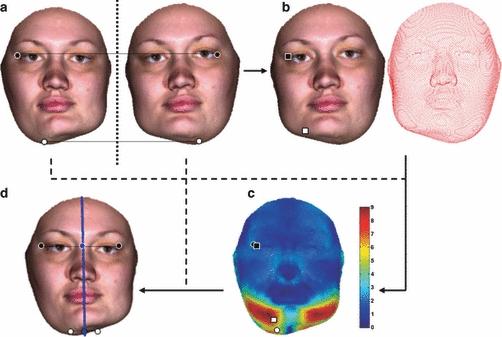
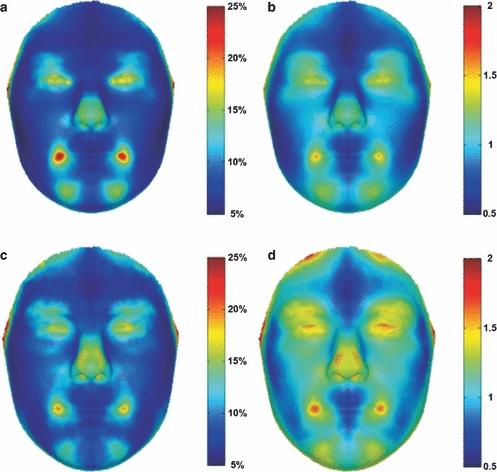
Mild facial asymmetries are common in typical growth patterns. Therefore, detection of disordered facial growth patterns in individuals characterized by asymmetries is preferably accomplished by reference to the typical variation found in the general population rather than to some ideal of perfect symmetry, which rarely exists. This presents a challenge in developing an asymmetry assessment tool that is applicable, without modification, to detect both mild and severe facial asymmetries. In this paper we use concepts from geometric morphometrics to obtain robust and spatially-dense asymmetry assessments using a superimposition protocol for comparison of a face with its mirror image. Spatially-dense localization of asymmetries was achieved using an anthropometric mask consisting of uniformly sampled quasi-landmarks that were automatically indicated on 3D facial images. Robustness, in the sense of an unbiased analysis under increasing asymmetry, was ensured by an adaptive, robust, least-squares superimposition. The degree of overall asymmetry in an individual was scored using a root-mean-squared-error, and the proportion was scored using a novel relative significant asymmetry percentage. This protocol was applied to a database of 3D facial images from 359 young healthy individuals and three individuals with disordered facial growth. Typical asymmetry statistics were derived and were mainly located on, but not limited to, the lower two-thirds of the face in males and females. The asymmetry in males was more extensive and of a greater magnitude than in females. This protocol and proposed scoring of asymmetry with accompanying reference statistics will be useful for the detection and quantification of facial asymmetry in future studies.
轻度的面部不对称在典型的生长模式中很常见。因此,对于具有不对称特征的个体,最好通过参考一般人群中发现的典型变化来检测面部生长模式是否存在紊乱,而不是参考几乎不存在的完美对称的理想状态。这给开发一种不对称评估工具带来了挑战,该工具无需修改即可适用于检测轻度和重度面部不对称。在本文中,我们使用几何形态测量学的概念,通过比较面部与其镜像的叠加协议,获得稳健且空间密集的不对称评估。使用由均匀采样的准地标组成的人体测量面具来实现不对称的空间密集定位,这些准地标自动显示在 3D 面部图像上。通过自适应、稳健、最小二乘叠加,确保了在不对称性增加的情况下进行无偏分析的稳健性。个体的整体不对称程度使用均方根误差进行评分,使用新的相对显著不对称百分比进行比例评分。该协议应用于 359 名年轻健康个体和 3 名面部生长紊乱个体的 3D 面部图像数据库。得出了典型的不对称统计数据,主要位于(但不限于)男性和女性面部的中下三分之二。男性的不对称性比女性更广泛且幅度更大。该协议和提出的伴随参考统计数据的不对称评分将有助于未来研究中对面部不对称的检测和量化。



 Zotero 插件