Unit of PharmacoEpidemiology & PharmacoEconomics (PE2), Department of Pharmacy, University of Groningen, Antonius Deusinglaan 1, 9713 AV, Groningen, the Netherlands.
BMC Med. 2011 Jul 8;9:84. doi: 10.1186/1741-7015-9-84.
This study aims to critically review available cost-effectiveness models for rotavirus vaccination, compare their designs using a standardized approach and compare similarities and differences in cost-effectiveness outcomes using a uniform set of input parameters.
We identified various models used to estimate the cost-effectiveness of rotavirus vaccination. From these, results using a standardized dataset for four regions in the world could be obtained for three specific applications.
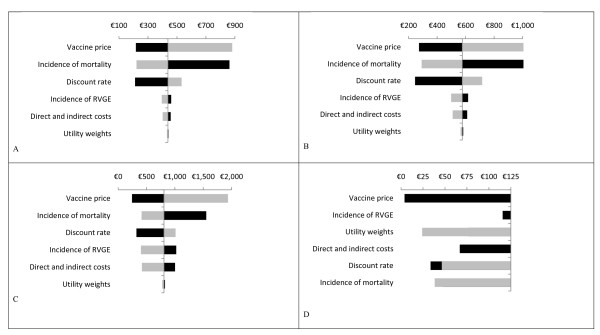
Despite differences in the approaches and individual constituting elements including costs, QALYs Quality Adjusted Life Years and deaths, cost-effectiveness results of the models were quite similar. Differences between the models on the individual components of cost-effectiveness could be related to some specific features of the respective models. Sensitivity analysis revealed that cost-effectiveness of rotavirus vaccination is highly sensitive to vaccine prices, rotavirus-associated mortality and discount rates, in particular that for QALYs.
The comparative approach followed here is helpful in understanding the various models selected and will thus benefit (low-income) countries in designing their own cost-effectiveness analyses using new or adapted existing models. Potential users of the models in low and middle income countries need to consider results from existing studies and reviews. There will be a need for contextualization including the use of country specific data inputs. However, given that the underlying biological and epidemiological mechanisms do not change between countries, users are likely to be able to adapt existing model designs rather than developing completely new approaches. Also, the communication established between the individual researchers involved in the three models is helpful in the further development of these individual models. Therefore, we recommend that this kind of comparative study be extended to other areas of vaccination and even other infectious disease interventions.
本研究旨在对已有的轮状病毒疫苗接种成本效益模型进行批判性评价,使用标准化方法比较它们的设计,并使用一套统一的输入参数比较成本效益结果的相似性和差异性。
我们确定了用于估计轮状病毒疫苗接种成本效益的各种模型。从中,我们可以获得世界四个地区使用标准化数据集的三个特定应用的结果。
尽管在方法和包括成本、质量调整生命年(QALYs)和死亡人数在内的个体构成要素方面存在差异,但模型的成本效益结果非常相似。模型在个体成本效益组成部分上的差异可能与各自模型的某些特定特征有关。敏感性分析表明,轮状病毒疫苗接种的成本效益对疫苗价格、轮状病毒相关死亡率和贴现率高度敏感,特别是对 QALYs 而言。
这里采用的比较方法有助于理解所选的各种模型,并将使(低收入)国家受益,使其能够使用新的或改编的现有模型进行自己的成本效益分析。低收入和中等收入国家的模型潜在用户需要考虑现有研究和综述的结果。需要进行背景化处理,包括使用国家特定的数据输入。然而,鉴于国家之间的基础生物学和流行病学机制不会改变,用户可能能够适应现有模型设计,而不是开发全新的方法。此外,三个模型的个别研究人员之间建立的沟通对于这些个别模型的进一步发展是有帮助的。因此,我们建议将这种比较性研究扩展到其他疫苗接种领域,甚至扩展到其他传染病干预措施。