Institute for Medical Informatics, Biometry, and Epidemiology, University Duisburg-Essen, Essen, Germany.
Environ Health Perspect. 2011 Nov;119(11):1556-61. doi: 10.1289/ehp.1003347. Epub 2011 Jul 8.
Secondhand smoke (SHS) consists of fine particulate matter, carcinogens, and various toxins that affect large parts of the population. SHS increases the risk for acute cardiovascular events and may contribute to the development of atherosclerosis.
We investigated the association of SHS with coronary artery calcification (CAC).
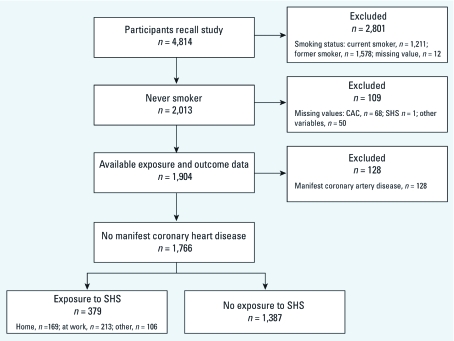
In this cross-sectional analysis, we used baseline data (2000-2003) from 1,766 never-smokers without clinically manifested coronary heart disease, 45-75 years of age, from the Heinz Nixdorf Recall Study, an ongoing, prospective, population-based cohort study in Germany. Self-reported frequent SHS at home, at work, and in other places was assessed by questionnaire. CAC scores were derived based on electron-beam computed tomography. We conducted multiple linear regression analysis using exposure to SHS as the explanatory variable and ln(CAC+1) as the response variable. We conducted logistic regression to estimate the odds ratio (OR) for presence of any CAC.
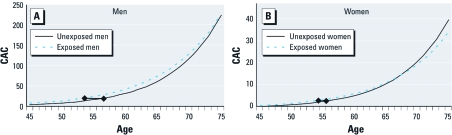
Frequent exposure to SHS was reported by 21.5% of participants. After adjustment for age, sex, and socioeconomic status, CAC + 1 was 21.1% [95% confidence interval (CI): -5.5%, 55.2%] higher in exposed than in unexposed participants. After adjusting for other cardiovascular risk factors, the association was attenuated (15.4%; 95% CI: -9.6%, 47.2%). SHS exposure was also associated with a CAC score > 0 (fully adjusted OR = 1.38; 95% CI: 1.03, 1.84).
Self-reported frequent exposure to SHS was associated with subclinical coronary atherosclerosis in our cross-sectional study population. Considering the widespread exposure and the clinical relevance of coronary atherosclerosis, this result, if confirmed, is of public health importance.
二手烟(SHS)由细颗粒物、致癌物和各种毒素组成,影响着很大一部分人群。SHS 会增加急性心血管事件的风险,并可能导致动脉粥样硬化的发展。
我们研究了 SHS 与冠状动脉钙化(CAC)之间的关联。
在这项横断面分析中,我们使用了来自德国一项正在进行的、前瞻性的、基于人群的队列研究——Heinz Nixdorf 回顾研究的基线数据(2000-2003 年)。该研究纳入了 1766 名年龄在 45-75 岁、无临床冠心病表现的从不吸烟者。通过问卷调查评估在家中、工作中和其他地方经常接触 SHS 的情况。根据电子束计算机断层扫描(CT)得出 CAC 评分。我们采用多元线性回归分析,将 SHS 暴露作为解释变量,ln(CAC+1)作为响应变量。我们采用 logistic 回归估计存在任何 CAC 的比值比(OR)。
21.5%的参与者报告经常接触 SHS。在校正年龄、性别和社会经济地位后,暴露组的 CAC+1 比未暴露组高 21.1%(95%置信区间:-5.5%,55.2%)。在校正其他心血管危险因素后,这种关联减弱(15.4%;95%置信区间:-9.6%,47.2%)。SHS 暴露与 CAC 评分>0 也有关联(完全校正后的 OR=1.38;95%置信区间:1.03,1.84)。
在我们的横断面研究人群中,自我报告的频繁接触 SHS 与亚临床冠状动脉粥样硬化有关。考虑到广泛的暴露和冠状动脉粥样硬化的临床相关性,如果这一结果得到证实,将具有重要的公共卫生意义。