Institute of Health and Society, Newcastle University, Newcastle Upon Tyne NE2 4AX, UK.
Curr Psychiatry Rep. 2011 Oct;13(5):422-9. doi: 10.1007/s11920-011-0219-x.
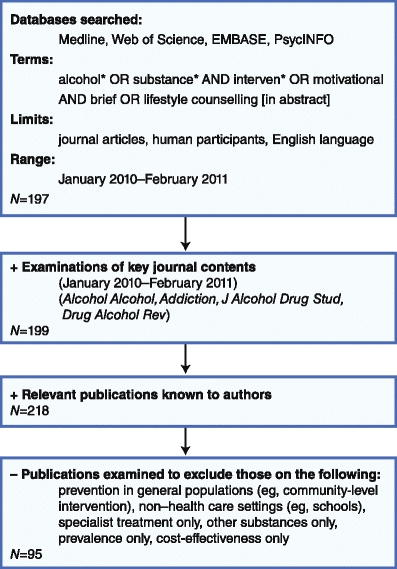
The delivery of brief interventions (BIs) in health care settings to reduce problematic alcohol consumption is a key preventive strategy for public health. However, evidence of effectiveness beyond primary care is inconsistent. Patient populations and intervention components are heterogeneous. Also, evidence for successful implementation strategies is limited. In this article, recent literature is reviewed covering BI effectiveness for patient populations and subgroups, and design and implementation of BIs. Support is evident for short-term effectiveness in hospital settings, but long-term effects may be confounded by changes in control groups. Limited evidence suggests effectiveness with young patients not admitted as a consequence of alcohol, dependent patients, and binge drinkers. Influential BI components include high-quality change plans and provider characteristics. Health professionals endorse BI and feel confident in delivering it, but training and support initiatives continue to show no significant effects on uptake, prompting calls for systematic approaches to implementing BI in health care.
在医疗保健环境中提供简短干预(BI)以减少问题性饮酒是公共卫生的一项重要预防策略。然而,超出初级保健的有效性证据并不一致。患者人群和干预成分存在异质性。此外,成功实施策略的证据也有限。本文回顾了最近的文献,涵盖了 BI 对患者人群和亚组的有效性,以及 BI 的设计和实施。在医院环境中,短期效果的证据确凿,但长期效果可能因对照组的变化而受到影响。有限的证据表明,对于非因酒精而入院的年轻患者、依赖患者和 binge drinkers 有效。有影响力的 BI 组成部分包括高质量的变更计划和提供者特征。卫生专业人员支持 BI 并对其实施充满信心,但培训和支持举措继续对采用 BI 没有显著影响,这促使人们呼吁采取系统方法在医疗保健中实施 BI。