• 文献检索
  • 文档翻译
  • 深度研究
  • 学术资讯
  • Suppr Zotero 插件Zotero 插件
  • 邀请有礼
  • 套餐&价格
  • 历史记录
应用&插件
Suppr Zotero 插件Zotero 插件浏览器插件Mac 客户端Windows 客户端微信小程序
定价
高级版会员购买积分包购买API积分包
服务
文献检索文档翻译深度研究API 文档MCP 服务
关于我们
关于 Suppr公司介绍联系我们用户协议隐私条款
关注我们

Suppr 超能文献

核心技术专利:CN118964589B侵权必究
粤ICP备2023148730 号-1Suppr @ 2026

文献检索

告别复杂PubMed语法,用中文像聊天一样搜索,搜遍4000万医学文献。AI智能推荐,让科研检索更轻松。

立即免费搜索

文件翻译

保留排版,准确专业,支持PDF/Word/PPT等文件格式,支持 12+语言互译。

免费翻译文档

深度研究

AI帮你快速写综述,25分钟生成高质量综述,智能提取关键信息,辅助科研写作。

立即免费体验

欧洲青少年关怀机构为不同人群的大麻使用障碍青少年提供服务。INCANT 试验的基线和转介数据。

European youth care sites serve different populations of adolescents with cannabis use disorder. Baseline and referral data from the INCANT trial.

机构信息

Centre Emergence, Institut Mutualiste Montsouris, Paris, France.

出版信息

BMC Psychiatry. 2011 Jul 12;11:110. doi: 10.1186/1471-244X-11-110.

DOI:10.1186/1471-244X-11-110
PMID:21749677
原文链接:https://pmc.ncbi.nlm.nih.gov/articles/PMC3142208/
Abstract

BACKGROUND

MDFT (Multidimensional Family Therapy) is a family based outpatient treatment programme for adolescent problem behaviour. MDFT has been found effective in the USA in adolescent samples differing in severity and treatment delivery settings. On request of five governments (Belgium, France, Germany, the Netherlands, and Switzerland), MDFT has now been tested in the joint INCANT trial (International Cannabis Need of Treatment) for applicability in Western Europe. In each of the five countries, study participants were recruited from the local population of youth seeking or guided to treatment for, among other things, cannabis use disorder. There is little information in the literature if these populations are comparable between sites/countries or not. Therefore, we examined if the study samples enrolled in the five countries differed in baseline characteristics regarding demographics, clinical profile, and treatment delivery setting.

METHODS

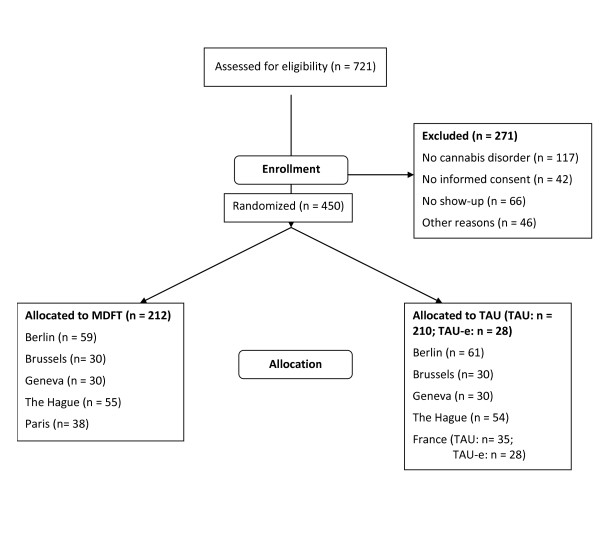
INCANT was a multicentre phase III(b) randomized controlled trial with an open-label, parallel group design. It compared MDFT with treatment as usual (TAU) at and across sites in Berlin, Brussels, Geneva, The Hague and Paris.Participants of INCANT were adolescents of either sex, from 13 through 18 years of age, with a cannabis use disorder (dependence or abuse), and at least one parent willing to take part in the treatment. In total, 450 cases/families were randomized (concealed) into INCANT.

RESULTS

We collected data about adolescent and family demographics (age, gender, family composition, school, work, friends, and leisure time). In addition, we gathered data about problem behaviour (substance use, alcohol and cannabis use disorders, delinquency, psychiatric co-morbidity).There were no major differences on any of these measures between the treatment conditions (MDFT and TAU) for any of the sites. However, there were cross-site differences on many variables. Most of these could be explained by variations in treatment culture, as reflected by referral policy, i.e., participants' referral source. We distinguished 'self-determined' referral (common in Brussels and Paris) and referral with some authority-related 'external' coercion (common in Geneva and The Hague). The two referral types were more equally divided in Berlin. Many cross-site baseline differences disappeared when we took referral source into account, but not all.

CONCLUSIONS

A multisite trial has the advantage of being efficient, but it also carries risks, the most important one being lack of equivalence between local study populations. Our site populations differed in many respects. This is not a problem for analyses and interpretations if the differences somehow can be accounted for. To a major extent, this appeared possible in INCANT. The most important factor underlying the cross-site variations in baseline characteristics was referral source. Correcting for referral source made most differences disappear. Therefore, we will use referral source as a covariate accounting for site differences in future INCANT outcome analyses.

TRIAL REGISTRATION NUMBER

ISRCTN: ISRCTN51014277.

https://cdn.ncbi.nlm.nih.gov/pmc/blobs/a893/3142208/2be720a7b56c/1471-244X-11-110-1.jpg
摘要

背景

MDFT(多维家庭治疗)是一种基于家庭的青少年问题行为门诊治疗方案。MDFT 已被证明在美国对不同严重程度和治疗提供环境的青少年样本有效。应五个政府(比利时、法国、德国、荷兰和瑞士)的要求,MDFT 现已在联合 INCANT 试验(国际大麻治疗需求)中进行了测试,以评估其在西欧的适用性。在这五个国家的每一个国家,研究参与者都是从当地寻求或被引导接受治疗的青少年人群中招募的,其中包括大麻使用障碍等问题。文献中关于这些人群在地点/国家之间是否可比的信息很少。因此,我们研究了五个国家的研究样本在人口统计学、临床特征和治疗提供环境方面是否存在差异。

方法

INCANT 是一项多中心 III(b) 随机对照试验,采用开放标签、平行组设计。它比较了 MDFT 与柏林、布鲁塞尔、日内瓦、海牙和巴黎各地的常规治疗 (TAU)。INCANT 的参与者是年龄在 13 至 18 岁之间的任何性别的青少年,患有大麻使用障碍(依赖或滥用),并且至少有一位愿意参加治疗的父母。共有 450 例/家庭被随机(隐蔽)分配到 INCANT。

结果

我们收集了关于青少年和家庭人口统计学(年龄、性别、家庭组成、学校、工作、朋友和休闲时间)的数据。此外,我们还收集了关于问题行为(药物使用、酒精和大麻使用障碍、犯罪、精神共病)的数据。对于任何地点,治疗条件(MDFT 和 TAU)之间在任何这些措施上都没有重大差异。然而,在许多变量上存在着跨地点的差异。这些差异中的大多数可以通过治疗文化的差异来解释,这反映在转诊政策上,即参与者的转诊来源。我们区分了“自我决定”的转诊(在布鲁塞尔和巴黎很常见)和带有一些权威相关的“外部”强制的转诊(在日内瓦和海牙很常见)。这两种转诊类型在柏林的分配更为平均。当我们考虑转诊来源时,许多跨地点的基线差异消失了,但并非全部。

结论

多地点试验具有效率高的优点,但也存在风险,最重要的是当地研究人群之间缺乏等效性。我们的现场人群在许多方面存在差异。如果这些差异以某种方式可以得到解释,那么对于分析和解释来说,这不是一个问题。在很大程度上,INCANT 中似乎有可能。导致基线特征跨地点差异的最重要因素是转诊来源。通过校正转诊来源,大多数差异消失了。因此,我们将在未来的 INCANT 结果分析中使用转诊来源作为协变量来解释现场差异。

试验注册号

ISRCTN: ISRCTN51014277。

相似文献

1
European youth care sites serve different populations of adolescents with cannabis use disorder. Baseline and referral data from the INCANT trial.欧洲青少年关怀机构为不同人群的大麻使用障碍青少年提供服务。INCANT 试验的基线和转介数据。
BMC Psychiatry. 2011 Jul 12;11:110. doi: 10.1186/1471-244X-11-110.
2
INCANT: a transnational randomized trial of multidimensional family therapy versus treatment as usual for adolescents with cannabis use disorder.INCANT:一项多维家庭治疗与常规治疗对照治疗青少年大麻使用障碍的跨国随机试验。
BMC Psychiatry. 2010 Apr 9;10:28. doi: 10.1186/1471-244X-10-28.
3
Multidimensional family therapy decreases the rate of externalising behavioural disorder symptoms in cannabis abusing adolescents: outcomes of the INCANT trial.多维家庭治疗可降低滥用大麻青少年外化行为障碍症状的发生率:INCANT 试验的结果。
BMC Psychiatry. 2014 Jan 31;14:26. doi: 10.1186/1471-244X-14-26.
4
Multidimensional family therapy lowers the rate of cannabis dependence in adolescents: a randomised controlled trial in Western European outpatient settings.多维家庭治疗降低青少年大麻依赖率:西欧门诊环境中的随机对照试验。
Drug Alcohol Depend. 2013 Jun 1;130(1-3):85-93. doi: 10.1016/j.drugalcdep.2012.10.013. Epub 2012 Nov 8.
5
[Multidimensional family therapy for adolescent clients with cannabis use disorders--Results and experience from the INCANT pilot study].[针对患有大麻使用障碍的青少年客户的多维家庭治疗——INCANT试点研究的结果与经验]
Prax Kinderpsychol Kinderpsychiatr. 2006;55(7):520-32.
6
[Comparison of European therapies for cannabis addiction among adolescents].[欧洲青少年大麻成瘾治疗方法的比较]
Encephale. 2015 Jun;41 Suppl 1:S21-8. doi: 10.1016/j.encep.2014.10.013. Epub 2014 Dec 16.
7
Treatment of adolescents with a cannabis use disorder: main findings of a randomized controlled trial comparing multidimensional family therapy and cognitive behavioral therapy in The Netherlands.治疗青少年大麻使用障碍:荷兰一项比较多维家庭治疗和认知行为治疗的随机对照试验的主要结果。
Drug Alcohol Depend. 2011 Dec 1;119(1-2):64-71. doi: 10.1016/j.drugalcdep.2011.05.021. Epub 2011 Jun 17.
8
Implementation fidelity of Multidimensional Family Therapy in an international trial.多维家庭治疗在国际试验中的实施保真度。
J Subst Abuse Treat. 2013 Apr;44(4):391-9. doi: 10.1016/j.jsat.2012.08.225. Epub 2012 Oct 22.
9
[Multidimensional family therapy: which influences, which specificities?].[多维家庭治疗:哪些影响因素,哪些独特之处?]
Encephale. 2014 Oct;40(5):408-15. doi: 10.1016/j.encep.2013.04.018. Epub 2013 Aug 28.
10
Matching adolescents with a cannabis use disorder to multidimensional family therapy or cognitive behavioral therapy: treatment effect moderators in a randomized controlled trial.为患有大麻使用障碍的青少年匹配多维家庭治疗或认知行为疗法:一项随机对照试验中的治疗效果调节因素。
Drug Alcohol Depend. 2012 Sep 1;125(1-2):119-26. doi: 10.1016/j.drugalcdep.2012.03.023. Epub 2012 May 4.

引用本文的文献

1
Systemic therapy in children and adolescents with mental disorders: a systematic review and meta-analysis.儿童和青少年精神障碍的系统治疗:系统评价和荟萃分析。
BMC Psychiatry. 2024 Feb 14;24(1):125. doi: 10.1186/s12888-024-05556-y.
2
Validation of a multisubstance online Timeline Followback assessment.多物质在线 Timeline Followback 评估的验证。
Brain Behav. 2020 Jan;10(1):e01486. doi: 10.1002/brb3.1486. Epub 2019 Dec 2.
3
The transformation of a gold standard in-person substance use assessment to a web-based, REDCap integrated data capture tool.

本文引用的文献

1
INCANT: a transnational randomized trial of multidimensional family therapy versus treatment as usual for adolescents with cannabis use disorder.INCANT:一项多维家庭治疗与常规治疗对照治疗青少年大麻使用障碍的跨国随机试验。
BMC Psychiatry. 2010 Apr 9;10:28. doi: 10.1186/1471-244X-10-28.
2
Sources of site differences in the efficacy of a multisite clinical trial: the Treatment of SSRI-Resistant Depression in Adolescents.多中心临床试验疗效中部位差异的来源:青少年对选择性5-羟色胺再摄取抑制剂耐药性抑郁症的治疗
J Consult Clin Psychol. 2009 Jun;77(3):439-50. doi: 10.1037/a0014834.
3
The generalizability of the Youth Self-Report syndrome structure in 23 societies.
将金标准的现场物质使用评估转变为基于网络的、与 REDCap 集成的数据采集工具。
J Biomed Inform. 2019 Jun;94:103186. doi: 10.1016/j.jbi.2019.103186. Epub 2019 Apr 22.
4
Multidimensional family therapy in adolescents with a cannabis use disorder: long-term effects on delinquency in a randomized controlled trial.多维家庭疗法对患有大麻使用障碍的青少年的影响:一项随机对照试验中对犯罪行为的长期影响
Child Adolesc Psychiatry Ment Health. 2018 Aug 17;12:44. doi: 10.1186/s13034-018-0248-x. eCollection 2018.
5
Multidimensional family therapy decreases the rate of externalising behavioural disorder symptoms in cannabis abusing adolescents: outcomes of the INCANT trial.多维家庭治疗可降低滥用大麻青少年外化行为障碍症状的发生率:INCANT 试验的结果。
BMC Psychiatry. 2014 Jan 31;14:26. doi: 10.1186/1471-244X-14-26.
6
Six years on: a prospective cohort study of male juvenile offenders in secure care.六年随访:男青少年犯在安保监管下的前瞻性队列研究。
Eur Child Adolesc Psychiatry. 2012 Jun;21(6):339-47. doi: 10.1007/s00787-012-0266-9. Epub 2012 Mar 17.
青少年自评综合征结构在23个社会中的可推广性。
J Consult Clin Psychol. 2007 Oct;75(5):729-38. doi: 10.1037/0022-006X.75.5.729.
4
Site matters: multisite randomized trial of motivational enhancement therapy in community drug abuse clinics.地点因素:社区药物滥用诊所中动机增强疗法的多地点随机试验。
J Consult Clin Psychol. 2007 Aug;75(4):556-67. doi: 10.1037/0022-006X.75.4.556.
5
Validity of the CBCL/YSR DSM-IV scales Anxiety Problems and Affective Problems.儿童行为检查表/青少年自我报告表(CBCL/YSR)DSM-IV量表中焦虑问题和情感问题的效度。
J Anxiety Disord. 2008;22(1):126-34. doi: 10.1016/j.janxdis.2007.01.008. Epub 2007 Feb 3.
6
Characteristics of substance abuse treatment programs providing services for HIV/AIDS, hepatitis C virus infection, and sexually transmitted infections: the National Drug Abuse Treatment Clinical Trials Network.为艾滋病毒/艾滋病、丙型肝炎病毒感染和性传播感染提供服务的药物滥用治疗项目的特点:国家药物滥用治疗临床试验网络
J Subst Abuse Treat. 2006 Jun;30(4):315-21. doi: 10.1016/j.jsat.2006.02.006.
7
Motivational interviewing to improve treatment engagement and outcome in individuals seeking treatment for substance abuse: a multisite effectiveness study.动机性访谈对改善寻求药物滥用治疗者的治疗参与度及治疗效果的影响:一项多中心有效性研究
Drug Alcohol Depend. 2006 Feb 28;81(3):301-12. doi: 10.1016/j.drugalcdep.2005.08.002. Epub 2005 Sep 28.
8
MET meets the real world: design issues and clinical strategies in the Clinical Trials Network.MET与现实世界接轨:临床试验网络中的设计问题与临床策略
J Subst Abuse Treat. 2002 Sep;23(2):73-80. doi: 10.1016/s0740-5472(02)00255-6.
9
Transporting a research-based adolescent drug treatment into practice.将基于研究的青少年药物治疗付诸实践。
J Subst Abuse Treat. 2002 Jun;22(4):231-43. doi: 10.1016/s0740-5472(02)00239-8.
10
Problems reported by parents of children in multiple cultures: the Child Behavior Checklist syndrome constructs.来自多种文化背景儿童的家长所报告的问题:儿童行为检查表综合征结构
Am J Psychiatry. 1999 Apr;156(4):569-74. doi: 10.1176/ajp.156.4.569.