van der Pol Thimo M, Hendriks Vincent, Rigter Henk, Cohn Moran D, Doreleijers Theo A H, van Domburgh Lieke, Vermeiren Robert R J M
1Department of Child and Adolescent Psychiatry, Curium-Leiden University Medical Center, Leiden, The Netherlands.
2Department of Child and Adolescent Psychiatry, VU University Medical Center, Meibergdreef 5, 1105 AZ Amsterdam, The Netherlands.
Child Adolesc Psychiatry Ment Health. 2018 Aug 17;12:44. doi: 10.1186/s13034-018-0248-x. eCollection 2018.
Substance use and delinquency are considered to be mutual risk factors. Previous studies have shown that multidimensional family therapy (MDFT) is effective in tackling both conditions on the short term. The current study examines the long-term effects of MDFT on criminal offending.
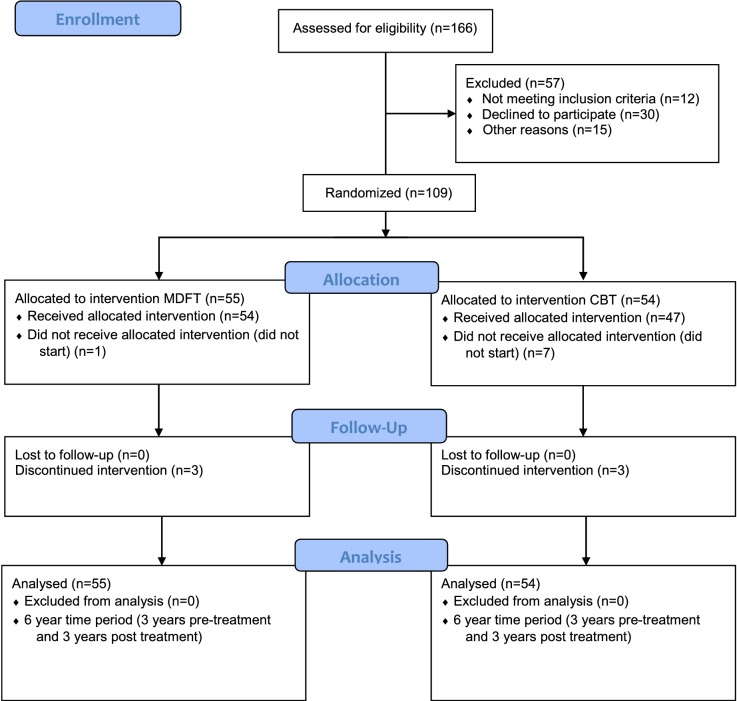
109 adolescents with cannabis use disorder and comorbid problem behavior were randomly assigned to either MDFT or cognitive behavioral therapy (CBT). Police arrest data were collected for 6 years: 3 years prior to and 3 years after treatment entry. Using survival analysis and repeated measure General Linear Models (rmGLM), the two treatment groups were compared on number of arrests, type of offence, and severity of offence. Moderator analyses looking at age, disruptive behavior disorders, history of crimes, family functioning, and (severe) cannabis use were conducted (rmGLM).
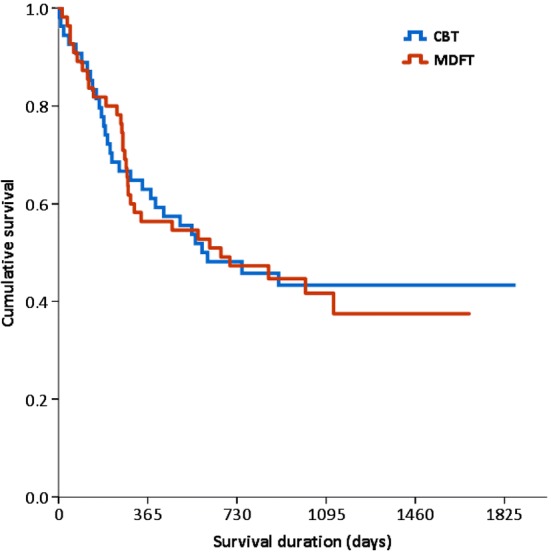
While police arrest rates increased in the 3 years before treatment, the rates decreased substantially after the start of both treatments. No differences were found between the treatment groups with respect to either time to first offence from the start of the treatment or changes in frequency or severity of offending over time. A treatment effect trend favoring MDFT was found for property offending in the subgroup of adolescents with high baseline-severity of cannabis use.
Across a follow-up period of 3 years, MDFT and CBT were similarly effective in reducing delinquency in adolescents with a cannabis use disorder. ISRCTN51014277, Registered 17 March 2010-Retrospectively registered, http://www.isrctn.com/ISRCTN51014277.
物质使用和犯罪行为被认为是相互的风险因素。先前的研究表明,多维家庭治疗(MDFT)在短期内对解决这两种情况均有效。本研究考察了MDFT对犯罪行为的长期影响。
109名患有大麻使用障碍及共病问题行为的青少年被随机分配至MDFT组或认知行为疗法(CBT)组。收集了6年的警方逮捕数据:治疗开始前3年和治疗开始后3年。使用生存分析和重复测量一般线性模型(rmGLM),比较了两个治疗组在逮捕次数、犯罪类型和犯罪严重程度方面的差异。进行了调节分析,考察年龄、破坏性行为障碍、犯罪史、家庭功能以及(重度)大麻使用情况(rmGLM)。
虽然治疗前3年警方逮捕率上升,但两种治疗开始后逮捕率均大幅下降。在从治疗开始到首次犯罪的时间、以及随时间推移犯罪频率或严重程度的变化方面,治疗组之间未发现差异。在大麻使用基线严重程度较高的青少年亚组中,发现MDFT在财产犯罪方面有更有利的治疗效果趋势。
在3年的随访期内,MDFT和CBT在减少患有大麻使用障碍青少年的犯罪行为方面效果相似。ISRCTN51014277,2010年3月17日注册——追溯注册,http://www.isrctn.com/ISRCTN51014277 。