Sofaer Neema, Strech Daniel
Wellcome Trust Research Fellow, Centre of Medical Law and Ethics, School of Law, King's College London.
Public Health Ethics. 2011 Jul;4(2):160-184. doi: 10.1093/phe/phr013. Epub 2011 Jul 11.
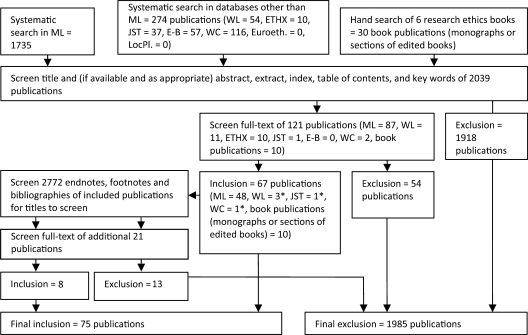
Background: researchers and sponsors increasingly confront the issue of whether participants in a clinical trial should have post-trial access (PTA) to the trial drug. Legislation and guidelines are inconsistent, ambiguous or silent about many aspects of PTA. Recent research highlights the potential importance of systematic reviews (SRs) of reason-based literatures in informing decision-making in medicine, medical research and health policy. PURPOSE: to systematically review reasons why drug trial participants should, or need not be ensured PTA to the trial drug and the uses of such reasons. DATA SOURCES: databases in science/medicine, law and ethics, thesis databases, bibliographies, research ethics books and included publications' notes/bibliographies. Publication selection: a publication was included if it included a reason as above. See article for detailed inclusion conditions. Data extraction and analysis: two reviewers extracted and analyzed data on publications and reasons. RESULTS: of 2060 publications identified, 75 were included. These mentioned reasons based on morality, legality, interests/incentives, or practicality, comprising 36 broad (235 narrow) types of reason. None of the included publications, which included informal reviews and reports by official bodies, mentioned more than 22 broad (59 narrow) types. For many reasons, publications differed about the reason's interpretation, implications and/or persuasiveness. Publications differed also regarding costs, feasibility and legality of PTA. LIMITATIONS: reason types could be applied differently. The quality of reasons was not measured. CONCLUSION: this review captured a greater variety of reasons and of their uses than any included publication. Decisions based on informal reviews or sub-sets of literature are likely to be biased. Research is needed on PTA ethics, costs, feasibility and legality and on assessing the quality of reason-based literature.
研究人员和赞助商日益面临临床试验参与者是否应在试验结束后获得试验药物的问题。立法和指南在试验后获得药物的许多方面不一致、含糊不清或未作规定。最近的研究强调了基于理由的文献的系统评价(SRs)在医学、医学研究和卫生政策决策中的潜在重要性。目的:系统评价药物试验参与者应被确保或不应被确保在试验结束后获得试验药物的理由以及这些理由的用途。数据来源:科学/医学、法律和伦理数据库、论文数据库、参考文献、研究伦理书籍以及纳入出版物的注释/参考文献。出版物选择:如果一篇出版物包含上述理由,则将其纳入。详细的纳入条件见文章。数据提取与分析:两名评审员提取并分析了关于出版物和理由的数据。结果:在识别出的2060篇出版物中,75篇被纳入。这些出版物提到了基于道德、法律、利益/激励或实用性的理由,包括36种宽泛(235种狭义)的理由类型。纳入的出版物(包括官方机构的非正式综述和报告)中,没有一篇提到超过22种宽泛(59种狭义)的理由类型。对于许多理由,出版物在理由的解释、影响和/或说服力方面存在差异。在试验后获得药物的成本、可行性和合法性方面,出版物也存在差异。局限性:理由类型的应用可能不同。未对理由的质量进行衡量。结论:本综述涵盖的理由及其用途比任何纳入的出版物都更为多样。基于非正式综述或文献子集做出的决策可能存在偏差。需要对试验后获得药物的伦理、成本、可行性和合法性以及基于理由的文献质量评估进行研究。