Wiley Lindsay, Cheek Mattison, LaFar Emily, Ma Xiaolu, Sekowski Justin, Tanguturi Nikki, Iltis Ana
Wake Forest University Center for Bioethics, Health and Society, Winston-Salem, USA.
Department of Communication Studies, University of Minnesota, Minneapolis, USA.
HEC Forum. 2025 Jun;37(2):267-303. doi: 10.1007/s10730-024-09538-1. Epub 2024 Sep 20.
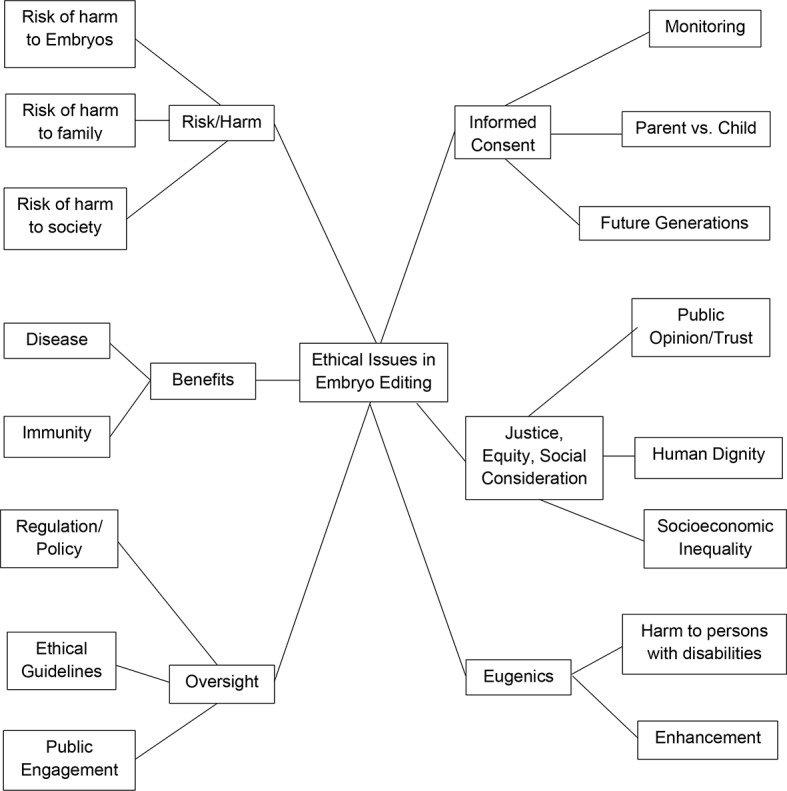
The possibility of editing the genomes of human embryos has generated significant discussion and interest as a matter of science and ethics. While it holds significant promise to prevent or treat disease, research on and potential clinical applications of human embryo editing also raise ethical, regulatory, and safety concerns. This systematic review included 223 publications to identify the ethical arguments, reasons, and concerns that have been offered for and against the editing of human embryos using CRISPR-Cas9 technology. We identified six major themes: risk/harm; potential benefit; oversight; informed consent; justice, equity, and other social considerations; and eugenics. We explore these themes and provide an overview and analysis of the critical points in the current literature.
编辑人类胚胎基因组的可能性引发了科学界和伦理学界的广泛讨论与关注。尽管它在预防或治疗疾病方面具有巨大潜力,但人类胚胎编辑的研究及其潜在的临床应用也引发了伦理、监管和安全方面的担忧。本系统综述纳入了223篇出版物,以确定支持和反对使用CRISPR-Cas9技术编辑人类胚胎的伦理观点、理由和担忧。我们确定了六个主要主题:风险/危害;潜在益处;监督;知情同意;正义、公平及其他社会考量;以及优生学。我们探讨了这些主题,并对当前文献中的关键点进行了概述和分析。