Institute of Immunology, Center for Pathophysiology, Infectiology and Immunology, Medical University of Vienna, Borschkegasse 8a, 1090 Vienna, Austria.
Immunol Lett. 2011 Oct 30;140(1-2):74-80. doi: 10.1016/j.imlet.2011.06.010. Epub 2011 Jul 2.
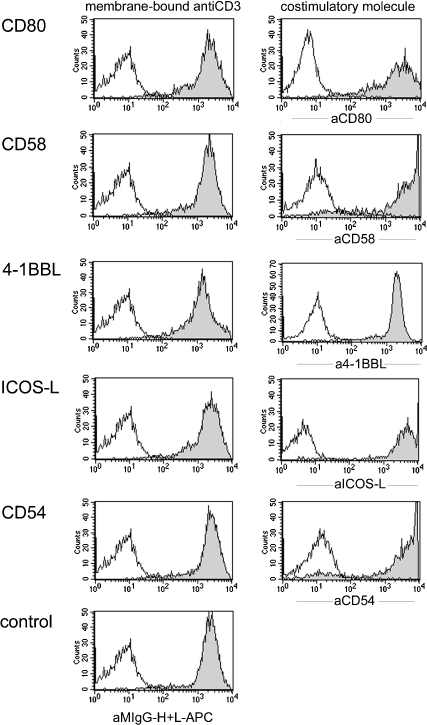
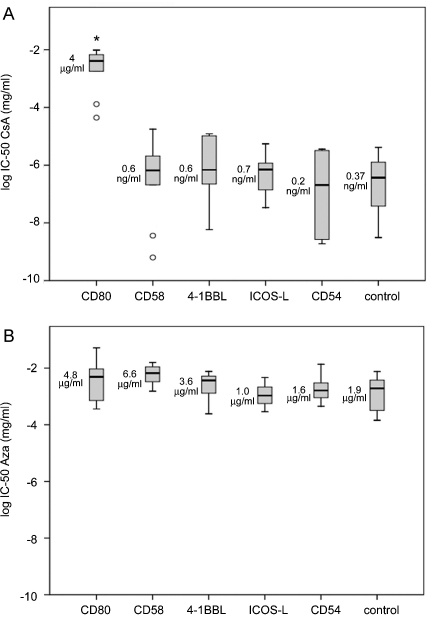
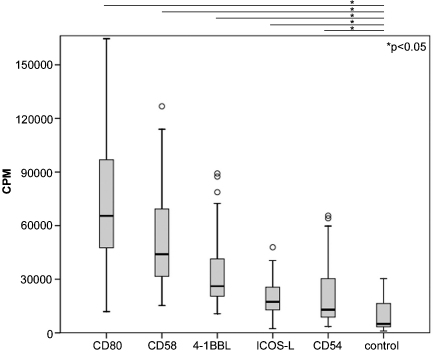
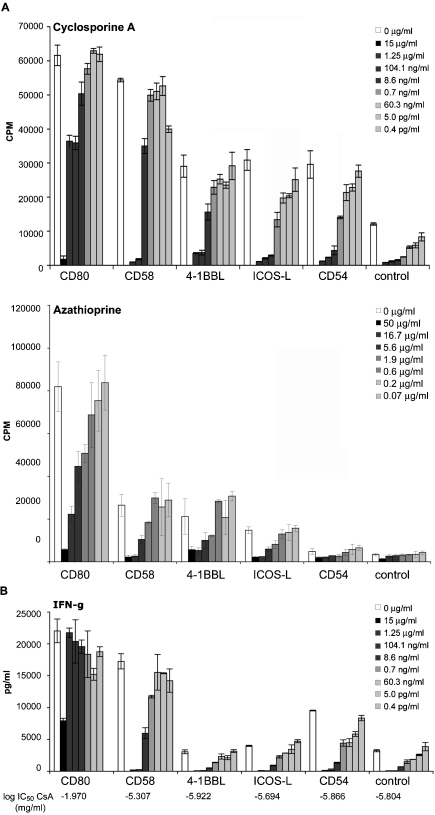
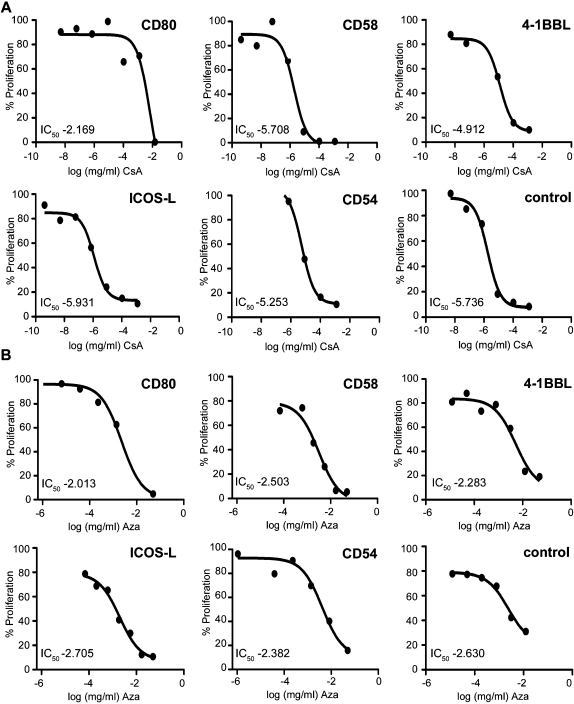
Immunosuppression is an important treatment modality in transplantation and human diseases that are associated with aberrant T cell activation. There are considerable differences regarding the cellular processes targeted by the immunosuppressive drugs that are in clinical use. Drugs like azathioprine (Aza) mainly act by halting proliferation of fast dividing cells, whereas others like cyclosporine A (CsA) specifically target signaling pathways in T cells. Since the outcome of T cell responses critically depends on the quality and strength of costimulatory signals, this study has addressed the interplay between costimulation and the immunosuppressive agents CsA and Aza during the in vitro activation of human T cells. We used an experimental system that allows analyzing T cells activated in the presence of selected costimulatory ligands to study T cells stimulated via CD28, CD2, LFA-1, ICOS or 4-1BB. The mean inhibitory concentrations (IC(50)) for Aza and CsA were determined for the proliferation of T cells receiving different costimulatory signals as well as for T cells activated in the absence of costimulation. CD28 signals but not costimulation via CD2, 4-1BB, ICOS or LFA-1 greatly increased the IC(50) for CsA. By contrast, the inhibitory effects of Aza were not influenced by T cell costimulatory signals. Our results might have implications for combining standard immunosuppressive drugs with CTLA-4Ig fusion proteins, which act by blocking CD28 costimulation.
免疫抑制是移植和与异常 T 细胞激活相关的人类疾病的重要治疗方式。在临床使用的免疫抑制药物中,针对的细胞过程存在相当大的差异。像硫唑嘌呤 (Aza) 这样的药物主要通过阻止快速分裂细胞的增殖来发挥作用,而像环孢素 A (CsA) 这样的药物则专门针对 T 细胞中的信号通路。由于 T 细胞反应的结果在很大程度上取决于共刺激信号的质量和强度,因此本研究探讨了共刺激和免疫抑制药物 CsA 和 Aza 在体外激活人 T 细胞过程中的相互作用。我们使用了一种实验系统,该系统允许分析在选定的共刺激配体存在下激活的 T 细胞,以研究通过 CD28、CD2、LFA-1、ICOS 或 4-1BB 刺激的 T 细胞。对于接收不同共刺激信号的 T 细胞增殖以及在没有共刺激的情况下激活的 T 细胞,确定了 Aza 和 CsA 的平均抑制浓度 (IC(50))。CD28 信号而不是通过 CD2、4-1BB、ICOS 或 LFA-1 的共刺激大大增加了 CsA 的 IC(50)。相比之下,Aza 的抑制作用不受 T 细胞共刺激信号的影响。我们的研究结果可能对将标准免疫抑制药物与 CTLA-4Ig 融合蛋白联合使用具有重要意义,因为后者通过阻断 CD28 共刺激发挥作用。