Laboratory of Molecular Pharmacology, Centre Hospitalier Universitaire de Québec Research Center and the Faculty of Pharmacy, Laval University, Québec, Canada.
PLoS One. 2011;6(7):e22094. doi: 10.1371/journal.pone.0022094. Epub 2011 Jul 8.
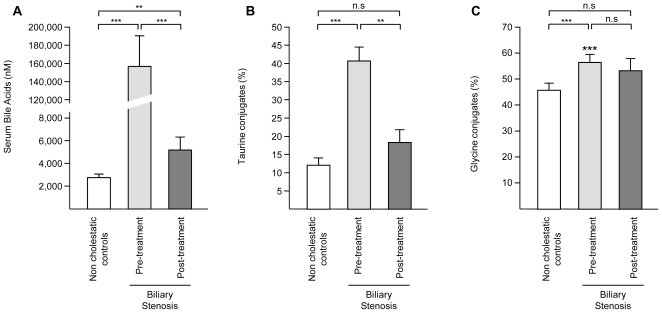
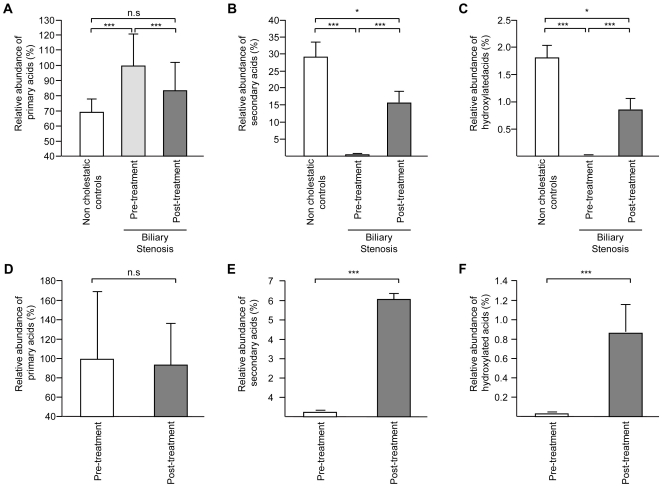
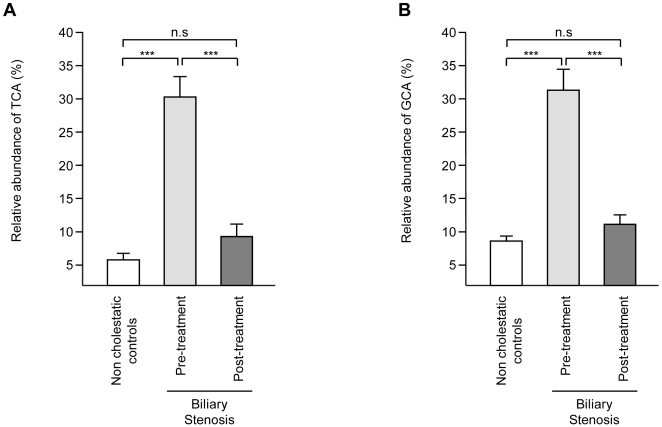
Bile acids are considered as extremely toxic at the high concentrations reached during bile duct obstruction, but each acid displays variable cytotoxic properties. This study investigates how biliary obstruction and restoration of bile flow interferes with urinary and circulating levels of 17 common bile acids. Bile acids (conjugated and unconjugated) were quantified by liquid chromatography coupled with tandem mass spectrometry in serum and urine samples from 17 patients (8 men and 9 women) with biliary obstruction, before and after biliary stenting. Results were compared with serum concentrations measured in 40 age- and sex-paired control donors (20 men and 20 women). The total circulating bile acid concentration increases from 2.7 µM in control donors to 156.9 µM in untreated patients with biliary stenosis. Serum taurocholic and glycocholic acids exhibit 304- and 241-fold accumulations in patients with biliary obstruction compared to controls. The enrichment in chenodeoxycholic acid species reached a maximum of only 39-fold, while all secondary and 6α-hydroxylated species--except taurolithocholic acids--were either unchanged or significantly reduced. Stenting was efficient in restoring an almost normal circulating profile and in reducing urinary bile acids.
These results demonstrate that biliary obstruction affects differentially the circulating and/or urinary levels of the various bile acids. The observation that the most drastically affected acids correspond to the less toxic species supports the activation of self-protecting mechanisms aimed at limiting the inherent toxicity of bile acids in face of biliary obstruction.
胆汁酸在胆管阻塞时达到的高浓度下被认为具有极强的毒性,但每种酸显示出不同的细胞毒性。本研究调查了胆汁阻塞和胆汁流动恢复如何干扰尿和循环中 17 种常见胆汁酸的水平。通过液相色谱-串联质谱法在 17 名胆管阻塞患者(8 名男性和 9 名女性)的血清和尿液样本中定量测定胆汁酸(结合型和非结合型),在胆道支架置入术之前和之后进行。结果与 40 名年龄和性别匹配的对照供体(20 名男性和 20 名女性)的血清浓度进行了比较。总循环胆汁酸浓度从对照供体的 2.7µM 增加到未经治疗的胆管狭窄患者的 156.9µM。与对照相比,血清牛磺胆酸和甘氨胆酸在胆管阻塞患者中分别积累了 304 倍和 241 倍。鹅脱氧胆酸的富集最高仅达到 39 倍,而所有次级和 6α-羟化产物 - 除了牛磺胆酸 - 要么不变,要么显著减少。支架置入术有效地恢复了几乎正常的循环特征,并减少了尿胆汁酸。
这些结果表明,胆管阻塞会以不同的方式影响各种胆汁酸的循环和/或尿水平。观察到受影响最严重的酸对应于毒性较小的种类,这支持了激活自我保护机制的观点,该机制旨在限制胆汁酸在面对胆管阻塞时固有的毒性。