School of Life Sciences, University of Warwick, Coventry CV4 7AL, UK.
Vaccine. 2011 Sep 2;29(38):6584-91. doi: 10.1016/j.vaccine.2011.06.114. Epub 2011 Jul 14.
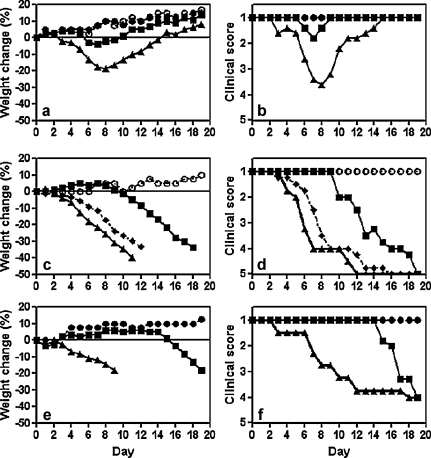
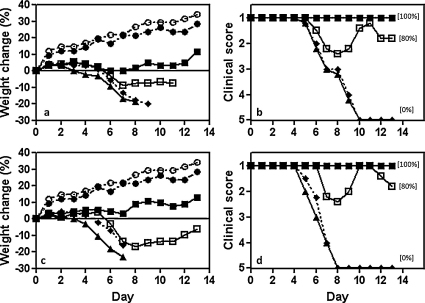
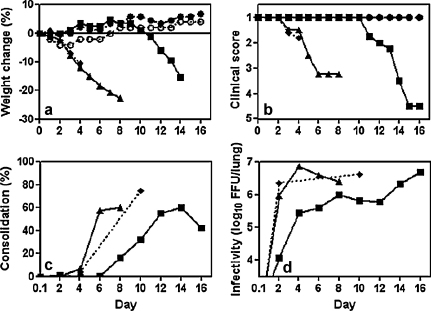
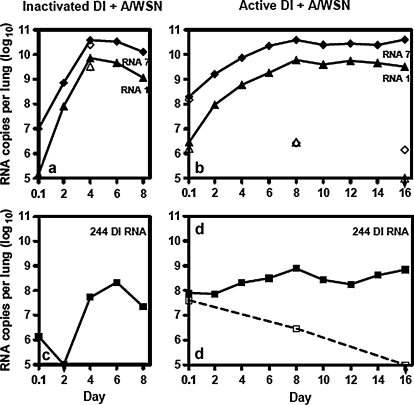
We have shown earlier that a single dose of cloned defective interfering (DI) influenza A virus strongly protects mice from disease following a lethal challenge with different subtypes of influenza A virus. These animals suffered no clinical disease but experienced a subclinical infection which rendered them immune to reinfection with the same challenge virus. However, little is known about how DI virus achieves such protection. Here we investigated the role of adaptive immunity in DI virus-mediated protection using severe-combined immunodeficient (SCID) mice, which lack competence in both B- and T-cell compartments but retain NK cell activity. SCID mice which were treated with DI virus and infected with influenza virus initially remained completely well, while infected litter mates that received UV-inactivated DI virus became seriously ill and died. However, after 10 days of good health, the DI virus-protected SCID mice developed a clinical disease that was similar, but not completely identical, to the acute influenza disease. Disease was delayed longer by a higher dose of DI virus. We excluded the possibilities that the DI virus load in the lungs had declined, that the DI RNA sequence had changed so that it no longer interfered with the infectious genome, or that infectious virus had become resistant to the DI virus. These data show that while DI virus provides full protection from the acute disease in the absence of adaptive immunity, that same immunity is essential for clearing the infection. This indicates that the conventional view that DI virus-induced protection is mediated solely by competition for replication with the challenge virus is incorrect for influenza virus.
我们之前已经证明,单次剂量的克隆缺陷型干扰(DI)流感病毒能够强烈保护小鼠免受不同亚型流感病毒致死性攻击的侵害。这些动物没有出现临床疾病,但经历了亚临床感染,从而对相同挑战病毒的再感染产生了免疫力。然而,对于 DI 病毒如何实现这种保护,我们知之甚少。在这里,我们使用严重联合免疫缺陷(SCID)小鼠研究了适应性免疫在 DI 病毒介导的保护中的作用,这些小鼠缺乏 B 细胞和 T 细胞两个亚群的功能,但保留 NK 细胞活性。接受 DI 病毒处理并感染流感病毒的 SCID 小鼠最初完全健康,而接受紫外线灭活 DI 病毒处理的感染同窝小鼠则病情严重并死亡。然而,在 10 天的健康期后,DI 病毒保护的 SCID 小鼠出现了类似于急性流感疾病的临床疾病,但不完全相同。较高剂量的 DI 病毒延迟了疾病的发作。我们排除了以下可能性:肺部的 DI 病毒载量下降、DI RNA 序列发生变化以至于不再干扰感染性基因组、或传染性病毒对 DI 病毒产生了抗性。这些数据表明,虽然 DI 病毒在缺乏适应性免疫的情况下能够完全预防急性疾病,但同样的免疫对于清除感染是必不可少的。这表明,DI 病毒诱导的保护完全是通过与挑战病毒竞争复制来介导的传统观点对于流感病毒是不正确的。