District Health Directorate, Ghana Health Service, Volta Region, Ghana.
Glob Health Action. 2011;4. doi: 10.3402/gha.v4i0.5527. Epub 2011 Jul 13.
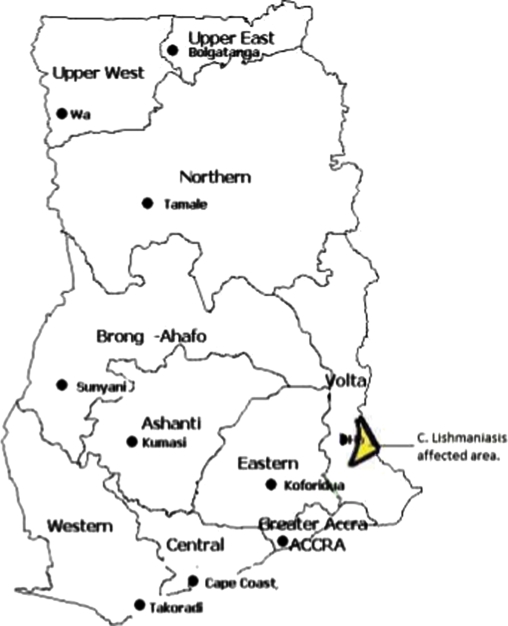
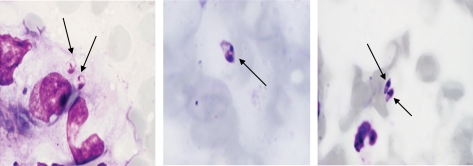
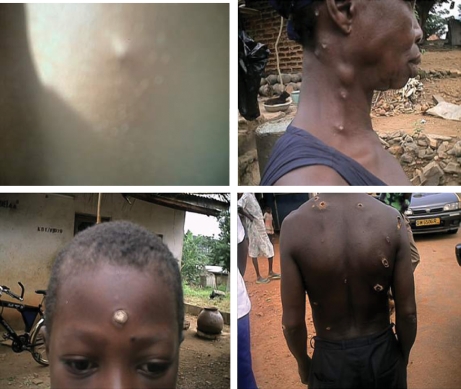
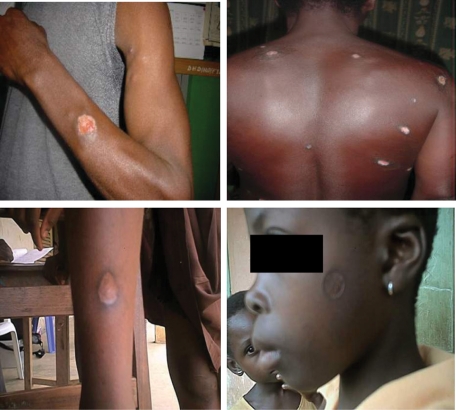
Human cutaneous leishmaniasis (CL) has previously been reported in West Africa, but more recently, sporadic reports of CL have increased. Leishmania major has been identified from Mauritania, Senegal, Mali, and Burkina Faso. Three zymodemes (MON-26, MON-117, and MON-74, the most frequent) have been found. The geographic range of leishmaniasis is limited by the sand fly vector, its feeding preferences, and its capacity to support internal development of specific species of Leishmania. The risk of acquiring CL has been reported to increase considerably with human activity and epidemics of CL have been associated with deforestation, road construction, wars, or other activities where humans intrude the habitat of the vector. In the Ho Municipality in the Volta Region of Ghana, a localised outbreak of skin ulcers, possibly CL, was noted in 2003 without any such documented activity. This outbreak was consistent with CL as evidenced using various methods including parasite identification, albeit, in a small number of patients with ulcers. This paper reports the outbreak in Ghana. The report does not address a single planned study but rather a compilation of data from a number of ad-hoc investigations in response to the outbreak plus observations and findings made by the authors. It acknowledges that a number of the observations need to be further clarified. What is the detailed epidemiology of the disease? What sparked the epidemic? Can it happen again? What was the causative agent of the disease, L. major or some other Leishmania spp.? What were the main vectors and animal reservoirs? What are the consequences for surveillance of the disease and the prevention of its reoccurrence when the communities see a self-healing disease and may not think it is important?
人类皮肤利什曼病(CL)以前曾在西非报道过,但最近,CL 的散发病例有所增加。从毛里塔尼亚、塞内加尔、马里和布基纳法索鉴定出了利什曼原虫。发现了 3 种生物型(最常见的 MON-26、MON-117 和 MON-74)。利什曼病的地理范围受到沙蝇媒介、其摄食偏好及其支持特定利什曼物种内部发育的能力的限制。据报道,获得 CL 的风险会随着人类活动的增加而大大增加,并且 CL 的流行与森林砍伐、道路建设、战争或其他人类侵入媒介栖息地的活动有关。在加纳沃尔特地区的 Ho 市,2003 年注意到局部皮肤溃疡爆发,可能是 CL,但没有任何此类记录的活动。这种爆发与 CL 一致,证据是使用包括寄生虫鉴定在内的各种方法,尽管只有少数溃疡患者。本文报告了加纳的疫情。该报告没有解决单个计划研究,而是对疫情做出反应的多个特别调查的数据汇编,以及作者的观察和发现。它承认,一些观察结果需要进一步澄清。疾病的详细流行病学是什么?引发疫情的原因是什么?它还会再次发生吗?疾病的病原体是什么,是利什曼原虫还是其他利什曼物种?主要媒介和动物宿主是什么?当社区看到一种自行愈合的疾病,并且可能认为它不重要时,疾病监测和预防其再次发生的后果是什么?