Rosso Andrea L, Auchincloss Amy H, Michael Yvonne L
Department of Epidemiology and Biostatistics, Drexel University School of Public Health, 1505 Race Street, Mail Stop 1033, Bellet 6th Floor, Philadelphia, PA 19102, USA.
J Aging Res. 2011;2011:816106. doi: 10.4061/2011/816106. Epub 2011 Jun 30.
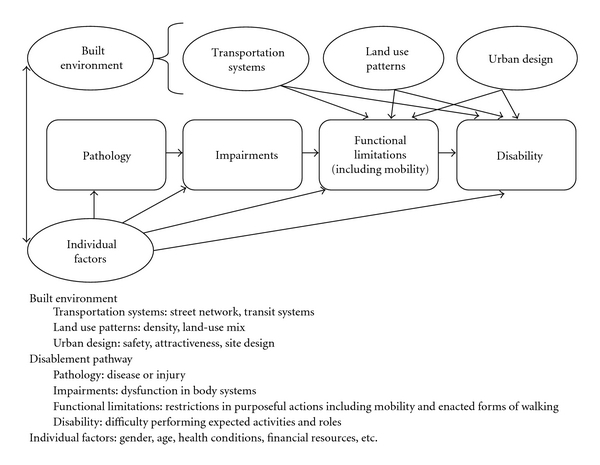
Mobility restrictions in older adults are common and increase the likelihood of negative health outcomes and premature mortality. The effect of built environment on mobility in older populations, among whom environmental effects may be strongest, is the focus of a growing body of the literature. We reviewed recent research (1990-2010) that examined associations of objective measures of the built environment with mobility and disability in adults aged 60 years or older. Seventeen empirical articles were identified. The existing literature suggests that mobility is associated with higher street connectivity leading to shorter pedestrian distances, street and traffic conditions such as safety measures, and proximity to destinations such as retail establishments, parks, and green spaces. Existing research is limited by differences in exposure and outcome assessments and use of cross-sectional study designs. This research could lead to policy interventions that allow older adults to live more healthy and active lives in their communities.
老年人的行动受限情况很常见,这会增加负面健康结果和过早死亡的可能性。建成环境对老年人群体行动能力的影响是越来越多文献关注的焦点,在这一群体中环境影响可能最为显著。我们回顾了近期(1990 - 2010年)研究,这些研究探讨了建成环境的客观指标与60岁及以上成年人行动能力和残疾之间的关联。共识别出17篇实证文章。现有文献表明,行动能力与更高的街道连通性相关,这会带来更短的步行距离,还与街道和交通状况(如安全措施)以及靠近零售场所、公园和绿地等目的地有关。现有研究受到暴露和结果评估差异以及横断面研究设计使用的限制。这项研究可能会促成政策干预措施,使老年人能够在其社区中过上更健康、更积极的生活。