Developmental Psychology, VU University Amsterdam, Van der Boechorststraat 1, 1081 BT Amsterdam, The Netherlands.
J Autism Dev Disord. 2012 Jun;42(6):1001-10. doi: 10.1007/s10803-011-1331-9.
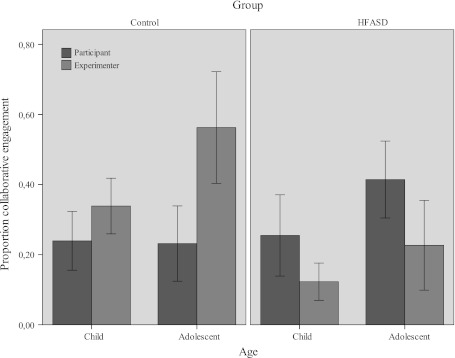
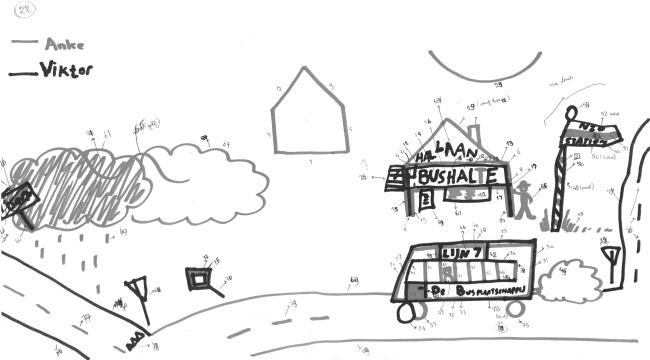
Few instruments have been developed that measure impairments in reciprocity, a defining feature of autism. We introduce a new test assessing the quality of reciprocal behaviour: the interactive drawing test (IDT). Children and adolescents (n = 49) with and without high functioning autism spectrum disorders (HFASD) were invited to collaborate with an experimenter in making a joint drawing. Within both groups the performance on collaborative reciprocity improved with age. However, compared to the control group, HFASD participants showed less collaborative and more basic reciprocal behaviour and preferred to draw their own objects. They were less tolerant of the experimenter's input as well. Performance on the IDT was independent of estimated verbal IQ. Reciprocal behaviour in self-initiated objects corresponded with more parental reported autistic traits, while reciprocal behaviour in other-initiated objects corresponded with less autistic traits. The findings of this study suggest that IDT is a promising instrument to assess reciprocity.
目前尚未开发出多少种能够衡量自闭症核心特征——互惠性障碍的工具。我们引入了一种新的测试,用于评估互惠行为的质量:互动绘画测试(IDT)。我们邀请了患有和不患有高功能自闭症谱系障碍(HFASD)的儿童和青少年(n = 49)与实验者一起合作完成一幅联合画作。在这两个群体中,合作互惠的表现都随着年龄的增长而提高。然而,与对照组相比,HFASD 参与者表现出较少的合作和更基本的互惠行为,并且更倾向于画自己的物体。他们对实验者的输入也不太容忍。IDT 的表现与估计的言语智商无关。在自发物体上的互惠行为与更多的父母报告的自闭症特征相对应,而在其他发起物体上的互惠行为则与较少的自闭症特征相对应。本研究的结果表明,IDT 是一种很有前途的评估互惠性的工具。