Interdepartmental Neuroscience Program, Northwestern University, 320 E Superior St, Searle 5-474, Chicago, IL 60611, USA.
Neuroimage. 2011 Oct 15;58(4):1150-7. doi: 10.1016/j.neuroimage.2011.06.090. Epub 2011 Jul 12.
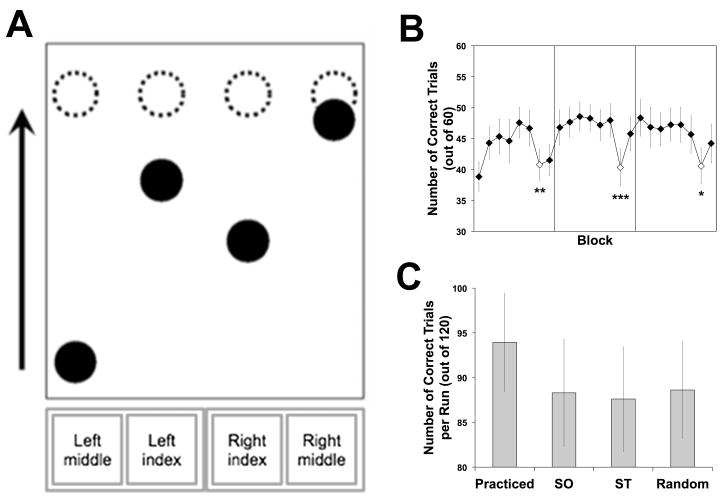
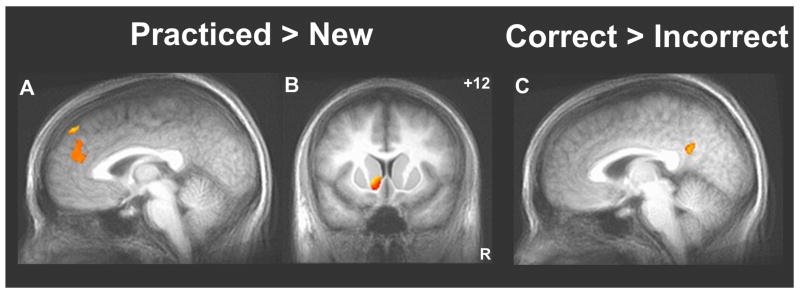
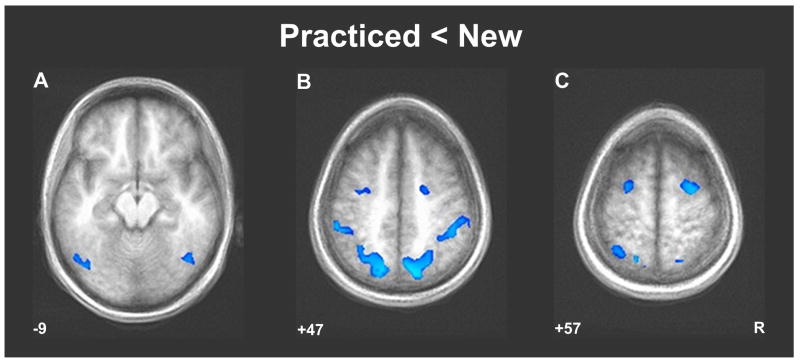
Learning of complex motor skills requires learning of component movements as well as the sequential structure of their order and timing. Using a Serial Interception Sequence Learning (SISL) task, participants learned a sequence of precisely timed interception responses through training with a repeating sequence. Following initial implicit learning of the repeating sequence, functional MRI data were collected during performance of that known sequence and compared with activity evoked during novel sequences of actions, novel timing patterns, or both. Reduced activity was observed during the practiced sequence in a distributed bilateral network including extrastriate occipital, parietal, and premotor cortical regions. These reductions in evoked activity likely reflect improved efficiency in visuospatial processing, spatio-motor integration, motor planning, and motor execution for the trained sequence, which is likely supported by nondeclarative skill learning. In addition, the practiced sequence evoked increased activity in the left ventral striatum and medial prefrontal cortex, while the posterior cingulate was more active during periods of better performance. Many prior studies of perceptual-motor skill learning have found increased activity in motor areas of the frontal cortex (e.g., motor and premotor cortex, SMA) and striatal areas (e.g., the putamen). The change in activity observed here (i.e., decreased activity across a cortical network) may reflect skill learning that is predominantly expressed through more accurate performance rather than decreased reaction time.
学习复杂的运动技能需要学习组成动作以及它们的顺序和时间安排的顺序结构。使用序列拦截序列学习 (SISL) 任务,参与者通过重复序列的训练来学习精确定时拦截反应的序列。在初步隐含学习重复序列之后,在执行该已知序列期间收集功能磁共振成像数据,并将其与在新动作序列、新定时模式或两者的活动进行比较。在包括枕叶外侧、顶叶和运动前皮质区域的分布式双侧网络中,在练习序列期间观察到活动减少。这种诱发活动的减少可能反映了针对训练序列的视觉空间处理、空间运动整合、运动规划和运动执行的效率提高,这可能得到非陈述性技能学习的支持。此外,练习序列在左侧腹侧纹状体和内侧前额叶皮层中引起更多的活动,而在后扣带回中在表现更好的时期更为活跃。许多先前的感知运动技能学习研究发现,额皮质(例如,运动和运动前皮质、SMA)和纹状体区域(例如,壳核)中的运动区域的活动增加。这里观察到的活动变化(即皮质网络中的活动减少)可能反映了主要通过更准确的表现而不是减少反应时间来表达的技能学习。