Department of Cardiac and Vascular Diseases, John Paul II Hospital, Jagiellonian University Medical College, Pradnicka Str 80, 31-202 Krakow, Poland.
Arthritis Res Ther. 2011 Jul 20;13(4):R117. doi: 10.1186/ar3402.
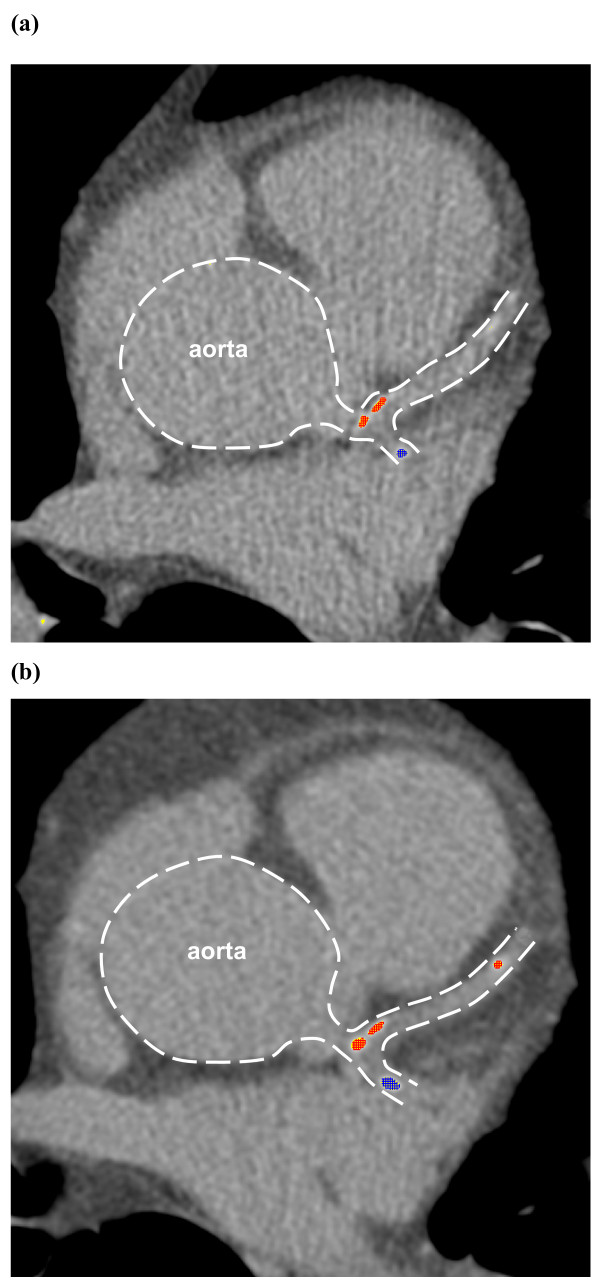
Mortality in systemic lupus erythematosus (SLE) patients is influenced by an increased occurrence of severe cardiovascular complications. Statins have been proven to protect a wide spectrum of SLE patients from these complications. This study was conducted to determine the possible efficacy of atorvastatin in SLE patients as assessed by multi-detector computed tomography (MDCT)-based coronary calcium scoring and single photon emission computed tomography (SPECT) of the myocardium.
Sixty SLE patients in stable clinical conditions were randomized to receive either atorvastatin (40 mg daily; n = 28) or placebo (n = 32). Clinical and biochemical evaluation together with MDCT-based coronary calcium scoring and SPECT studies (Tc-99 m sestamibi) were performed at the time of randomization and after 1 year of treatment.
At randomization, SPECT revealed perfusion defects at rest in 22 (36.7%) patients and exercise-induced defects in 8 (13.3%), whereas MDCT revealed coronary calcifications in 15 subjects (25%). Coronary calcium deposits increased after 1 year in the placebo group (plaque volume change from 35.2 ± 44.9 to 62.9 ± 72.4, P < 0.05; calcium score from 32.1 ± 39.1 to 59.5 ± 64.4; P < 0.05), but not in the atorvastatin group (plaque volume 54.5 ± 62.4 vs. 51.0 ± 47.6, P not significant; calcium score 44.8 ± 50.6 vs. 54.9 ± 62.5, P not significant). The atorvastatin group showed a decrease in total serum cholesterol (from 5.1 ± 1.2 to 4.4 ± 0.7 mmol/L, P < 0.05), LDL cholesterol (2.9 ± 1.0 to 2.3 ± 0.6 mmol/L, P < 0.05), triglycerides (1.6 ± 0.6 to 1.2 ± 0.5 mmol/L, P < 0.05), and C-reactive protein (CRP) (4.4 ± 4.1 to 2.7 ± 1.7 mg/L, P < 0.05). There was no change in the mean Systemic Lupus Erythematosus Disease Activity Index (SLEDAI) score in patients from both groups. Perfusion defects observed at randomization showed no change after one year treatment with atorvastatin.
In SLE patients 40 mg of atorvastatin daily for 1 year led to a decrease in serum lipids and CRP levels. Additionally the progression of atherosclerosis, as assessed by MDCT-based coronary calcium scoring, is restrained by atorvastatin treatment. The value of statin treatment in patients with SLE free from cardiovascular disease clinical symptoms should be addressed in large, prospective clinical trials.
系统性红斑狼疮(SLE)患者的死亡率受到严重心血管并发症发生率增加的影响。他汀类药物已被证明可广泛保护各种 SLE 患者免受这些并发症的影响。本研究旨在通过多探测器计算机断层扫描(MDCT)冠状动脉钙评分和心肌单光子发射计算机断层扫描(SPECT)来确定阿托伐他汀在 SLE 患者中的可能疗效。
60 名处于稳定临床状况的 SLE 患者被随机分为阿托伐他汀(40 mg/天;n = 28)或安慰剂(n = 32)组。在随机分组时以及治疗 1 年后进行临床和生化评估以及 MDCT 冠状动脉钙评分和 SPECT 研究(Tc-99m sestamibi)。
在随机分组时,SPECT 在 22 名(36.7%)患者中显示静息时灌注缺陷,8 名(13.3%)患者显示运动诱导的缺陷,而 MDCT 显示 15 名患者(25%)存在冠状动脉钙化。在安慰剂组中,1 年后冠状动脉钙沉积物增加(斑块体积从 35.2 ± 44.9 增加到 62.9 ± 72.4,P < 0.05;钙评分从 32.1 ± 39.1 增加到 59.5 ± 64.4;P < 0.05),但在阿托伐他汀组中没有增加(斑块体积 54.5 ± 62.4 与 51.0 ± 47.6,P 不显著;钙评分 44.8 ± 50.6 与 54.9 ± 62.5,P 不显著)。阿托伐他汀组的总血清胆固醇(从 5.1 ± 1.2 降至 4.4 ± 0.7 mmol/L,P < 0.05)、LDL 胆固醇(2.9 ± 1.0 降至 2.3 ± 0.6 mmol/L,P < 0.05)、甘油三酯(1.6 ± 0.6 降至 1.2 ± 0.5 mmol/L,P < 0.05)和 C 反应蛋白(CRP)(4.4 ± 4.1 降至 2.7 ± 1.7 mg/L,P < 0.05)均降低。两组患者的平均系统性红斑狼疮疾病活动指数(SLEDAI)评分均无变化。阿托伐他汀治疗 1 年后,随机时观察到的灌注缺陷无变化。
SLE 患者每天服用 40 mg 阿托伐他汀 1 年可降低血清脂质和 CRP 水平。此外,阿托伐他汀治疗可抑制 MDCT 冠状动脉钙评分评估的动脉粥样硬化进展。他汀类药物治疗无心血管疾病临床症状的 SLE 患者的价值应在大型前瞻性临床试验中得到解决。