Division of Nutritional Sciences, Cornell University, Ithaca, NY 14853, USA.
Mol Biol Cell. 2011 Sep;22(18):3277-88. doi: 10.1091/mbc.E11-05-0388. Epub 2011 Jul 20.
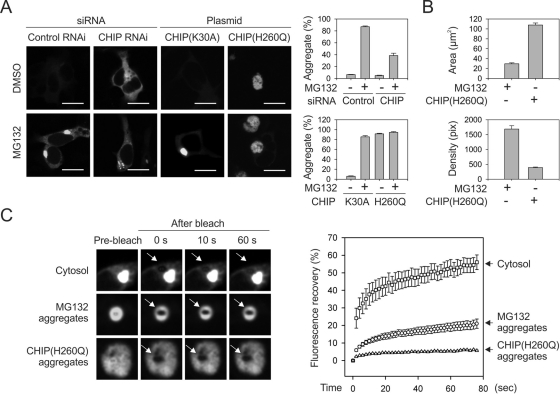
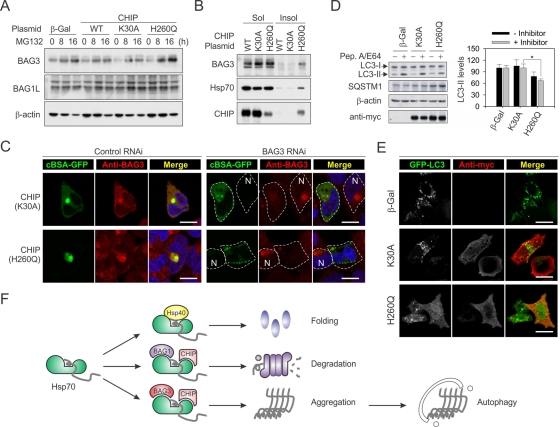
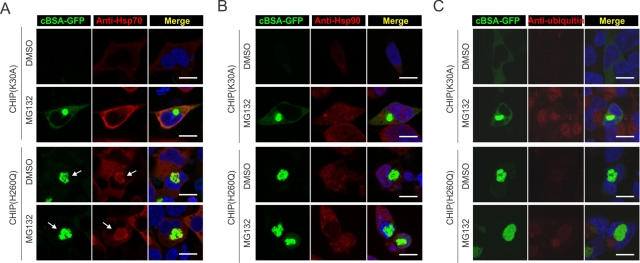
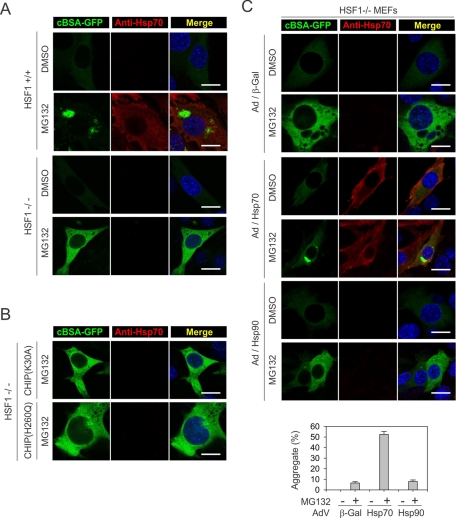
Protein misfolding is a common event in living cells. Molecular chaperones not only assist protein folding; they also facilitate the degradation of misfolded polypeptides. When the intracellular degradative capacity is exceeded, juxtanuclear aggresomes are formed to sequester misfolded proteins. Despite the well-established role of chaperones in both protein folding and degradation, how chaperones regulate the aggregation process remains controversial. Here we investigate the molecular mechanisms underlying aggresome formation in mammalian cells. Analysis of the chaperone requirements for the fate of misfolded proteins reveals an unexpected role of heat shock protein 70 (Hsp70) in promoting aggresome formation. This proaggregation function of Hsp70 relies on the interaction with the cochaperone ubiquitin ligase carboxyl terminal of Hsp70/Hsp90 interacting protein (CHIP). Disrupting Hsp70-CHIP interaction prevents the aggresome formation, whereas a dominant-negative CHIP mutant sensitizes the aggregation of misfolded protein. This accelerated aggresome formation also relies on the stress-induced cochaperone Bcl2-associated athanogene 3. Our results indicate that a hierarchy of cochaperone interaction controls different aspects of the intracellular protein triage decision, extending the function of Hsp70 from folding and degradation to aggregation.
蛋白质错误折叠是活细胞中的常见事件。分子伴侣不仅协助蛋白质折叠,还促进错误折叠多肽的降解。当细胞内的降解能力超过时,核周聚集物会形成以隔离错误折叠的蛋白质。尽管伴侣在蛋白质折叠和降解中都有明确的作用,但伴侣如何调节聚集过程仍存在争议。在这里,我们研究了哺乳动物细胞中聚集物形成的分子机制。对错误折叠蛋白命运的伴侣需求分析揭示了热休克蛋白 70(Hsp70)在促进聚集物形成中的意外作用。Hsp70 的这种促进聚集的功能依赖于与共伴侣泛素连接酶羧基末端的 HSP70/HSP90 相互作用蛋白(CHIP)的相互作用。破坏 Hsp70-CHIP 相互作用可防止聚集物形成,而显性失活的 CHIP 突变体会使错误折叠蛋白的聚集敏感化。这种加速的聚集物形成也依赖于应激诱导的共伴侣 Bcl2 相关的 Athanogene 3。我们的结果表明,共伴侣相互作用的层次控制了细胞内蛋白质分拣决策的不同方面,将 Hsp70 的功能从折叠和降解扩展到聚集。