Office of Environmental Justice, U.S. Environmental Protection Agency, MC 2201A, 1200 Pennsylvania Avenue NW, Washington, DC 20460, USA.
Int J Environ Res Public Health. 2011 Jun;8(6):2366-85. doi: 10.3390/ijerph8062366. Epub 2011 Jun 22.
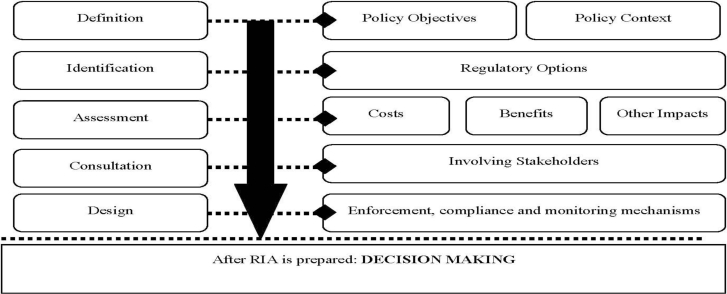
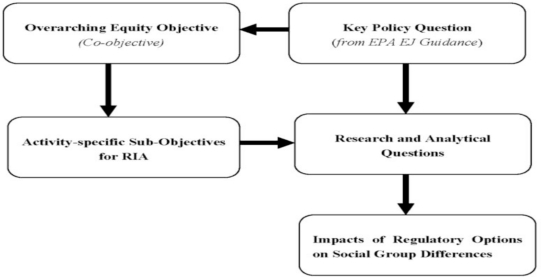
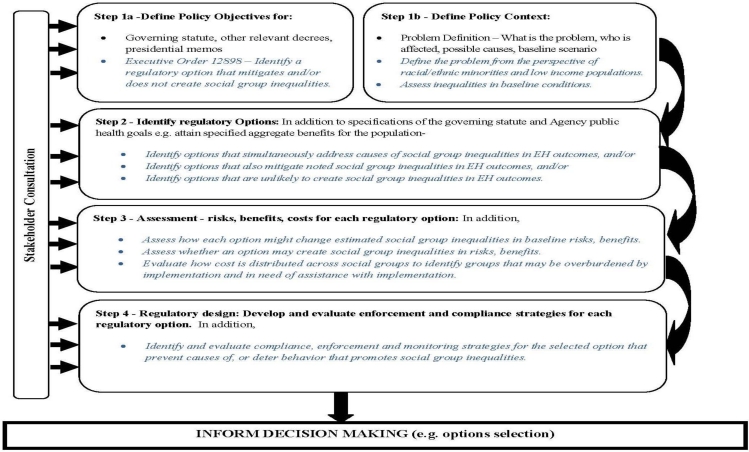
With increased interest in integrating environmental justice into the process for developing environmental regulations in the United States, analysts and decision makers are confronted with the question of what methods and data can be used to assess disproportionate environmental health impacts. However, as a first step to identifying data and methods, it is important that analysts understand what information on equity impacts is needed for decision making. Such knowledge originates from clearly stated equity objectives and the reflection of those objectives throughout the analytical activities that characterize Regulatory Impact Analysis (RIA), a process that is traditionally used to inform decision making. The framework proposed in this paper advocates structuring analyses to explicitly provide pre-defined output on equity impacts. Specifically, the proposed framework emphasizes: (a) defining equity objectives for the proposed regulatory action at the onset of the regulatory process, (b) identifying specific and related sub-objectives for key analytical steps in the RIA process, and (c) developing explicit analytical/research questions to assure that stated sub-objectives and objectives are met. In proposing this framework, it is envisioned that information on equity impacts informs decision-making in regulatory development, and that this is achieved through a systematic and consistent approach that assures linkages between stated equity objectives, regulatory analyses, selection of policy options, and the design of compliance and enforcement activities.
随着人们对将环境正义纳入美国制定环境法规过程的兴趣日益浓厚,分析人员和决策者面临着这样一个问题,即可以使用哪些方法和数据来评估不成比例的环境健康影响。然而,作为确定数据和方法的第一步,分析人员了解决策所需的公平影响信息是很重要的。这些知识源自明确规定的公平目标,并贯穿于监管影响分析(RIA)这一分析活动中,RIA 是传统上用于为决策提供信息的过程。本文提出的框架主张对分析进行结构化,以明确提供关于公平影响的预定义输出。具体来说,拟议的框架强调:(a)在监管过程开始时为拟议的监管行动定义公平目标,(b)确定 RIA 过程中关键分析步骤的具体和相关的次级目标,以及 (c)制定明确的分析/研究问题,以确保满足规定的次级目标和目标。通过提出这一框架,预计有关公平影响的信息将为监管发展中的决策提供信息,并且这是通过一种系统和一致的方法实现的,该方法确保了既定公平目标、监管分析、政策选择的选择以及合规和执行活动的设计之间的联系。