Department of Psychology, University of Connecticut, Storrs, Connecticut, United States of America.
PLoS One. 2011;6(7):e21688. doi: 10.1371/journal.pone.0021688. Epub 2011 Jul 14.
Amnestic mild cognitive impairment (aMCI) is a putative prodromal stage of Alzheimer's disease (AD) characterized by deficits in episodic verbal memory. Our goal in the present study was to determine whether executive dysfunction may also be detectable in individuals diagnosed with aMCI.
This study used a hidden maze learning test to characterize component processes of visuospatial executive function and learning in a sample of 62 individuals with aMCI compared with 94 healthy controls.
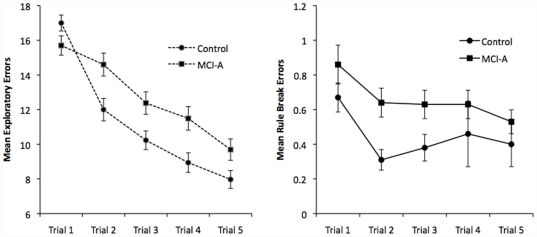
Relative to controls, individuals with aMCI made more exploratory/learning errors (Cohen's d = .41). Comparison of learning curves revealed that the slope between the first two of five learning trials was four times as steep for controls than for individuals with aMCI (Cohen's d = .64). Individuals with aMCI also made a significantly greater number of rule-break/error monitoring errors across learning trials (Cohen's d = .21).
These results suggest that performance on a task of complex visuospatial executive function is compromised in individuals with aMCI, and likely explained by reductions in initial strategy formulation during early visual learning and "on-line" maintenance of task rules.
遗忘型轻度认知障碍(aMCI)是阿尔茨海默病(AD)的一个假定前驱阶段,其特征是情景性口头记忆缺陷。我们本研究的目的是确定在诊断为 aMCI 的个体中是否也可以检测到执行功能障碍。
本研究使用隐藏迷宫学习测试来描述 62 名 aMCI 个体与 94 名健康对照者的视觉空间执行功能和学习的组成过程。
与对照组相比,aMCI 个体犯了更多的探索/学习错误(Cohen's d = 0.41)。对学习曲线的比较表明,在五个学习试验的前两个之间的斜率对于对照组比 aMCI 个体陡峭四倍(Cohen's d = 0.64)。在整个学习试验中,aMCI 个体还犯了更多的规则破坏/错误监测错误(Cohen's d = 0.21)。
这些结果表明,在 aMCI 个体中,复杂视觉空间执行功能的表现受损,这可能是由于在早期视觉学习过程中初始策略制定减少以及任务规则的“在线”维持所致。