Department of Psychology, San Diego State University, CA, USA.
Drug Alcohol Depend. 2011 Dec 15;119(3):216-23. doi: 10.1016/j.drugalcdep.2011.06.019. Epub 2011 Jul 22.
Problems inhibiting non-adaptive behaviors have been linked to an increased risk for substance use and other risk taking behaviors in adolescence. This study examines the hypothesis that abnormalities in neural activation during inhibition in early adolescence may predict subsequent substance involvement.
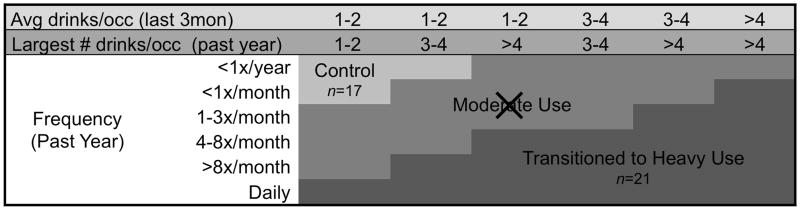
Thirty eight adolescents from local area middle schools, ages 12-14, with very limited histories of substance use, underwent functional magnetic resonance imaging (fMRI) as they performed a go/no-go task of response inhibition and response selection. Adolescents and their parents were then followed annually with interviews covering substance use and other behaviors. Based on follow-up data, youth were classified as transitioning to heavy use of alcohol (TU; n=21), or as healthy controls (CON; n=17).
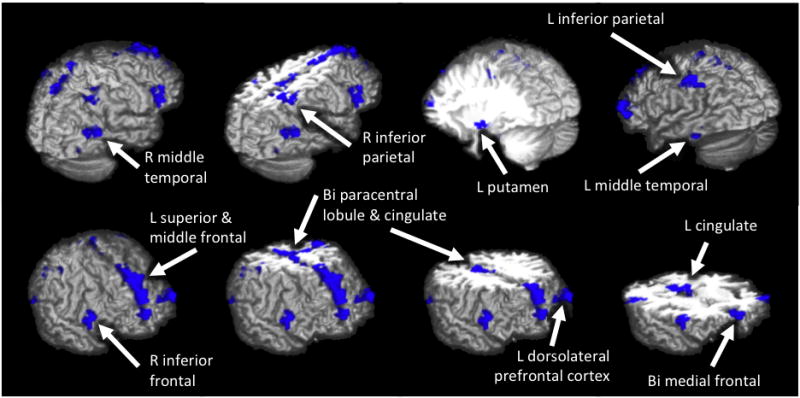
At baseline, prior to the onset of use, youth who later transitioned into heavy use of alcohol showed significantly less activation than those who went on to remain non to minimal users throughout adolescence. Activation reductions in TU at baseline were seen on no-go trials in 12 brain regions, including right inferior frontal gyrus, left dorsal and medial frontal areas, bilateral motor cortex, cingulate gyrus, left putamen, bilateral middle temporal gyri, and bilateral inferior parietal lobules (corrected p<.01, each cluster ≥32 contiguous voxels).
These results support the hypothesis that less neural activity during response inhibition demands predicts future involvement with problem behaviors such as alcohol and other substance use.
抑制非适应性行为的问题与青少年时期物质使用和其他冒险行为的风险增加有关。本研究检验了这样一种假设,即在青少年早期抑制过程中神经激活的异常可能预测随后的物质参与。
38 名来自当地中学的青少年,年龄在 12-14 岁之间,有非常有限的物质使用史,在执行反应抑制和反应选择的 Go/No-Go 任务时接受了功能磁共振成像 (fMRI)。然后,青少年及其父母每年接受一次访谈,涵盖物质使用和其他行为。根据随访数据,将青少年分为过渡到大量饮酒(TU;n=21)或健康对照组(CON;n=17)。
在基线时,在使用开始之前,后来过渡到大量饮酒的青少年的激活程度明显低于整个青春期继续保持非或最小使用者的青少年。在基线时,TU 组在 12 个大脑区域的无反应试验中观察到激活减少,包括右侧额下回、左侧背侧和内侧额区、双侧运动皮层、扣带回、左侧壳核、双侧颞中回和双侧顶下小叶(校正后 p<.01,每个簇≥32 个连续体素)。
这些结果支持了这样一种假设,即反应抑制需求的神经活动减少预测未来与酒精和其他物质使用等问题行为的参与。