Mori Hirohito, Kobara Hideki, Muramatsu Akemi, Inoue Hideyuki, Kobayashi Mitsuyoshi, Nomura Takako, Hagiike Masanobu, Izuishi Kunihiko, Suzuki Yasuyuki, Gong Jian, Masaki Tsutomu
Department of Gastroenterology and Neurology, Kagawa Medical University School of Medicine, 1750-1 Ikenobe, Miki-cho, Kita-gun, Kagawa 761-0793, Japan.
Diagn Ther Endosc. 2011;2011:709237. doi: 10.1155/2011/709237. Epub 2011 Jul 7.
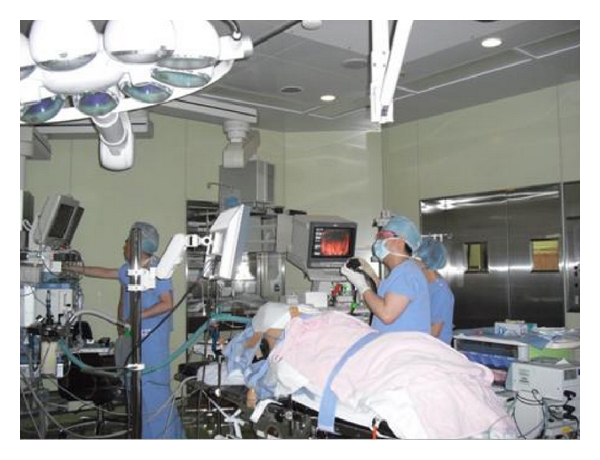
Endoscopic submucosal dissection (ESD) has enabled the collective resection and increased the accuracy of pathological diagnosis. However, ESD requires a long operation time, which results in increased doses of analgesics/sedatives, and causes worsening of respiratory and hemodynamic statuses. To reduce postoperative complications, we have applied ESD with CO(2) insufflation and general anesthesia. This study included 50 patients who underwent ESD for early gastric cancer, 25 with air insufflation and intravenous anesthesia (Air/IV group), and the remaining 25 with CO(2) insufflation and general anesthesia (CO(2)/GA group). Postoperative enlarged feeling of the abdomen was observed only in 1 of 25 patients in the CO(2)/GA group (P = 0.0416). Postoperative severe unrest was observed in none of the patients in the CO(2)/GA group and in 4 of 25 (16%) patients in the Air/IV group (P = 0.0371). CO(2) insufflation and general anesthesia are useful in stabilizing intraoperative conditions and reducing postoperative complications.
内镜黏膜下剥离术(ESD)已能够实现整块切除并提高病理诊断的准确性。然而,ESD需要较长的手术时间,这导致镇痛剂/镇静剂剂量增加,并引起呼吸和血流动力学状态恶化。为减少术后并发症,我们采用了二氧化碳注入联合全身麻醉的ESD。本研究纳入了50例行早期胃癌ESD的患者,其中25例采用空气注入联合静脉麻醉(空气/静脉组),其余25例采用二氧化碳注入联合全身麻醉(二氧化碳/全身麻醉组)。二氧化碳/全身麻醉组25例患者中仅1例出现术后腹部胀满感(P = 0.0416)。二氧化碳/全身麻醉组患者均未出现术后严重不适,而空气/静脉组25例患者中有4例(16%)出现术后严重不适(P = 0.0371)。二氧化碳注入联合全身麻醉有助于稳定术中情况并减少术后并发症。