Department of Neurobiology and Behavior, State University of New York (SUNY), Life Science Building Rm 546, Stony Brook, NY 11794, USA.
Neural Plast. 2011;2011:254724. doi: 10.1155/2011/254724. Epub 2011 Jul 21.
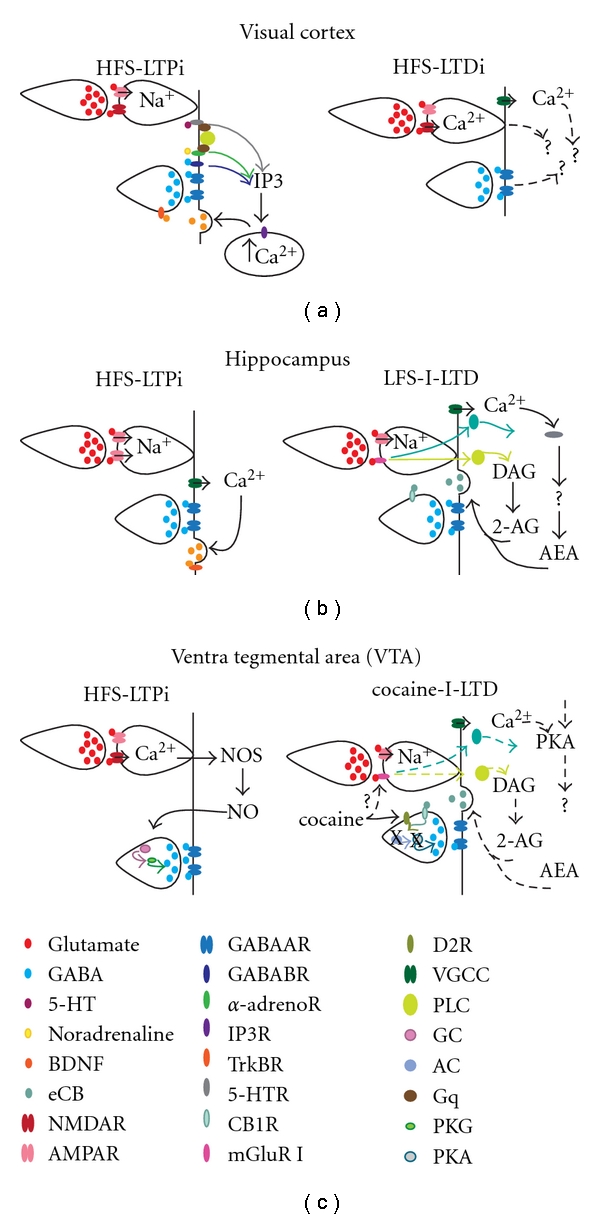
On February 12th 1973, Bliss and Lomo submitted their findings on activity-dependent plasticity of glutamatergic synapses. After this groundbreaking discovery, long-term potentiation (LTP) and depression (LTD) gained center stage in the study of learning, memory, and experience-dependent refinement of neural circuits. While LTP and LTD are extensively studied and their relevance to brain function is widely accepted, new experimental and theoretical work recently demonstrates that brain development and function relies on additional forms of plasticity, some of which occur at nonglutamatergic synapses. The strength of GABAergic synapses is modulated by activity, and new functions for inhibitory synaptic plasticity are emerging. Together with excitatory neurons, inhibitory neurons shape the excitability and dynamic range of neural circuits. Thus, the understanding of inhibitory synaptic plasticity is crucial to fully comprehend the physiology of brain circuits. Here, I will review recent findings about plasticity at GABAergic synapses and discuss how it may contribute to circuit function.
1973 年 2 月 12 日, Bliss 和 Lomo 提交了他们关于谷氨酸能突触活动依赖性可塑性的发现。在这一开创性的发现之后,长时程增强(LTP)和长时程抑制(LTD)成为学习、记忆和经验依赖性神经回路精细化研究的中心。尽管 LTP 和 LTD 已经得到了广泛的研究,其与大脑功能的相关性也得到了广泛的认可,但最近的新实验和理论工作表明,大脑发育和功能依赖于其他形式的可塑性,其中一些发生在非谷氨酸能突触上。GABA 能突触的强度受活动调节,抑制性突触可塑性的新功能正在出现。兴奋性神经元和抑制性神经元共同塑造神经回路的兴奋性和动态范围。因此,理解抑制性突触可塑性对于全面理解大脑回路的生理学至关重要。在这里,我将回顾最近关于 GABA 能突触可塑性的发现,并讨论它如何有助于回路功能。