Department of Integrative Biology, University of South Florida, Tampa, Florida, United States of America.
PLoS One. 2011;6(7):e22162. doi: 10.1371/journal.pone.0022162. Epub 2011 Jul 20.
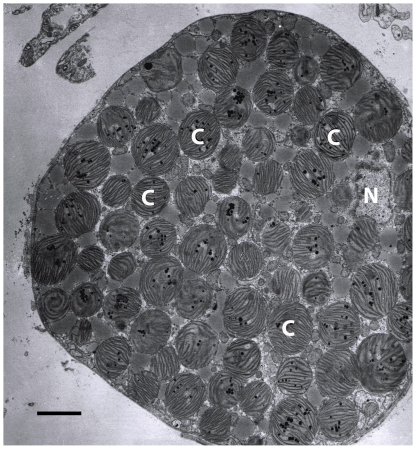
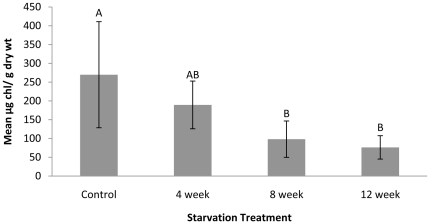
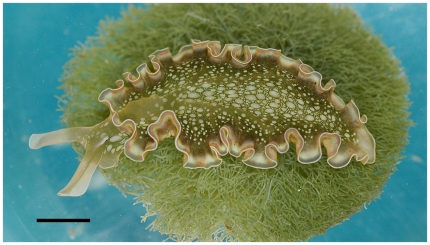
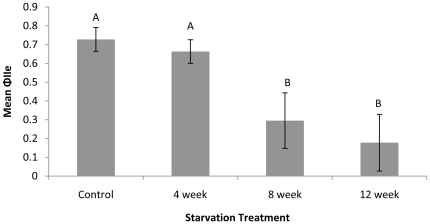
It has been well documented that nutritional state can influence the foraging behavior of animals. However, photosynthetic animals, those capable of both heterotrophy and symbiotic photosynthesis, may have a delayed behavioral response due to their ability to photosynthesize. To test this hypothesis we subjected groups of the kleptoplastic sea slug, Elysia clarki, to a gradient of starvation treatments of 4, 8, and 12 weeks plus a satiated control. Compared to the control group, slugs starved 8 and 12 weeks displayed a significant increase in the proportion of slugs feeding and a significant decrease in photosynthetic capability, as measured in maximum quantum yield and [chl a]. The 4 week group, however, showed no significant difference in feeding behavior or in the metrics of photosynthesis compared to the control. This suggests that photosynthesis in E. clarki, thought to be linked to horizontally-transferred algal genes, delays a behavioral response to starvation. This is the first demonstration of a link between photosynthetic capability in an animal and a modification of foraging behavior under conditions of starvation.
已有大量文献表明,营养状况会影响动物的觅食行为。然而,那些既能异养又能共生光合作用的光合动物,由于其光合作用的能力,可能会有延迟的行为反应。为了验证这一假设,我们将一组掠夺性海蛞蝓(Elysia clarki)置于 4、8 和 12 周的饥饿处理梯度以及一个饱食对照组中。与对照组相比,饥饿 8 周和 12 周的蛞蝓摄食比例显著增加,光合作用能力显著下降,如最大量子产量和叶绿素 a 所示。然而,与对照组相比,4 周组在摄食行为或光合作用指标方面没有表现出显著差异。这表明,E. clarki 中的光合作用与水平转移的藻类基因有关,这可能会延迟其对饥饿的行为反应。这是首次证明动物的光合作用能力与饥饿条件下觅食行为的改变之间存在联系。