Department of Biomedical Engineering, 312 Church Street SE, University of Minnesota, Minneapolis, Minnesota 55455, USA.
Langmuir. 2011 Sep 6;27(17):10523-37. doi: 10.1021/la202103v. Epub 2011 Aug 15.
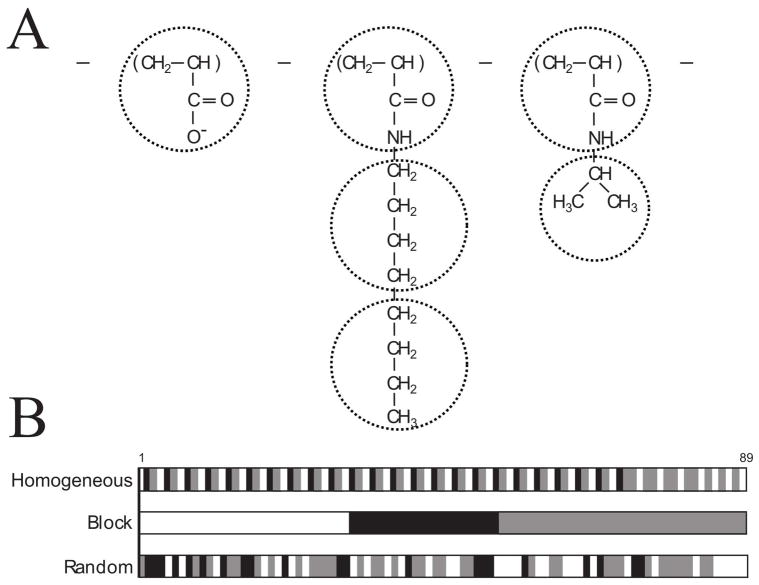
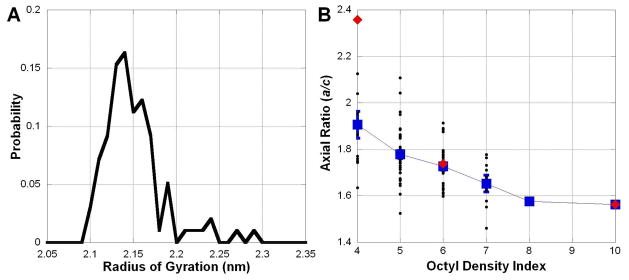
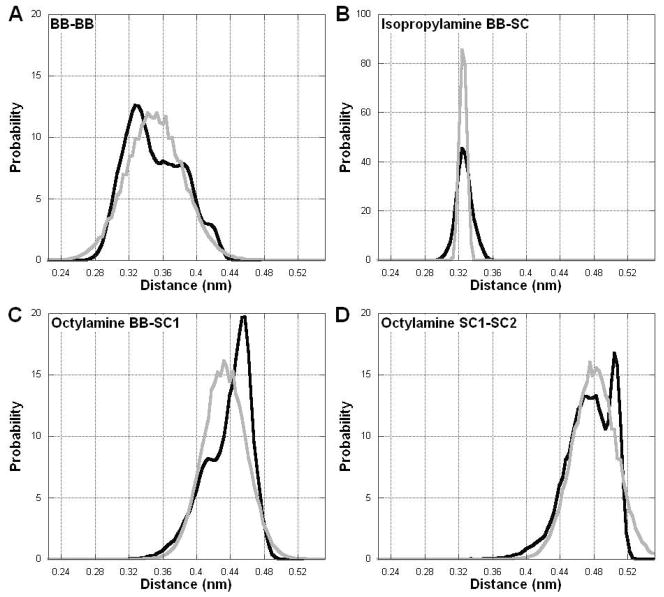
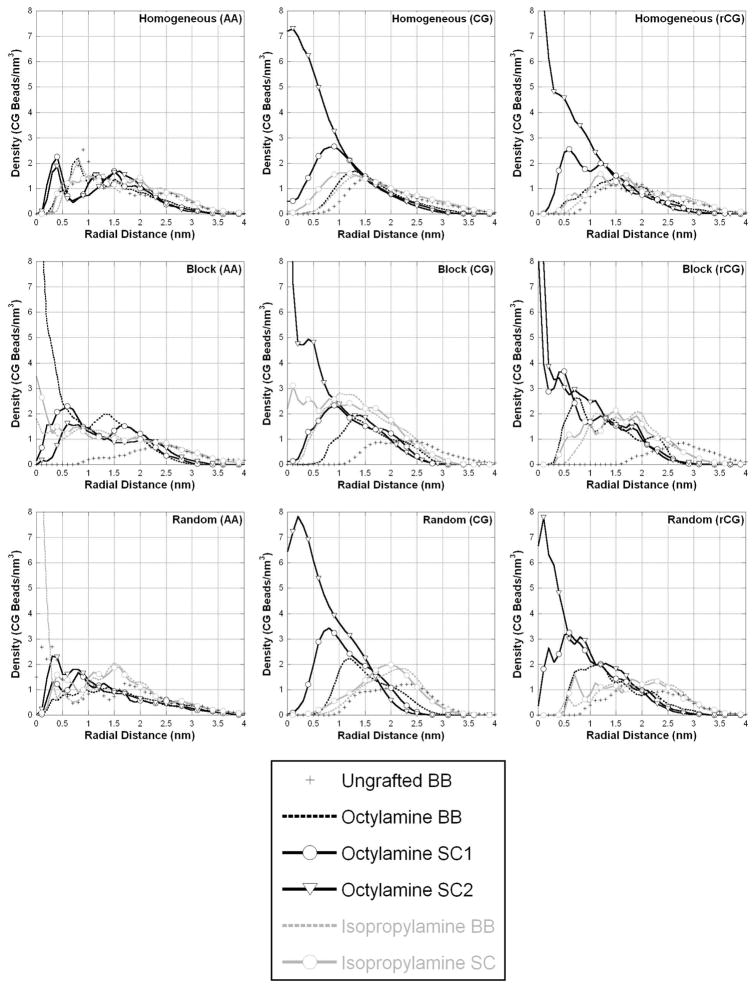
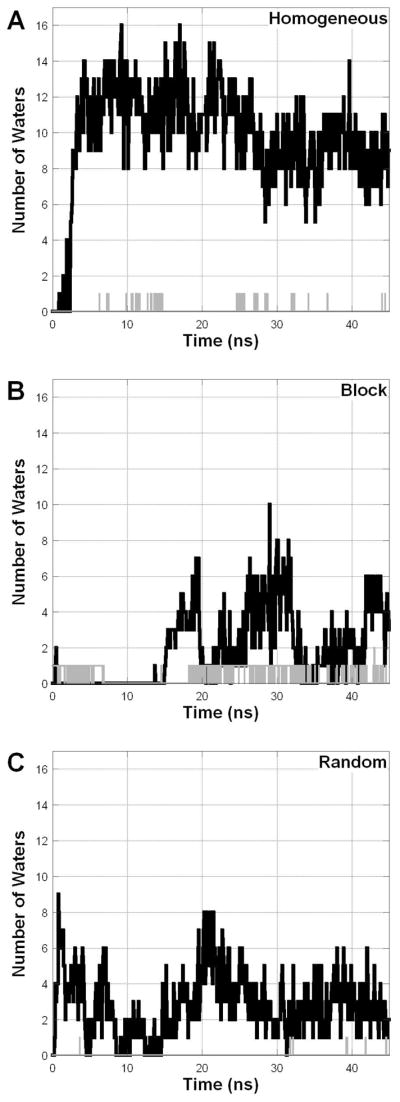
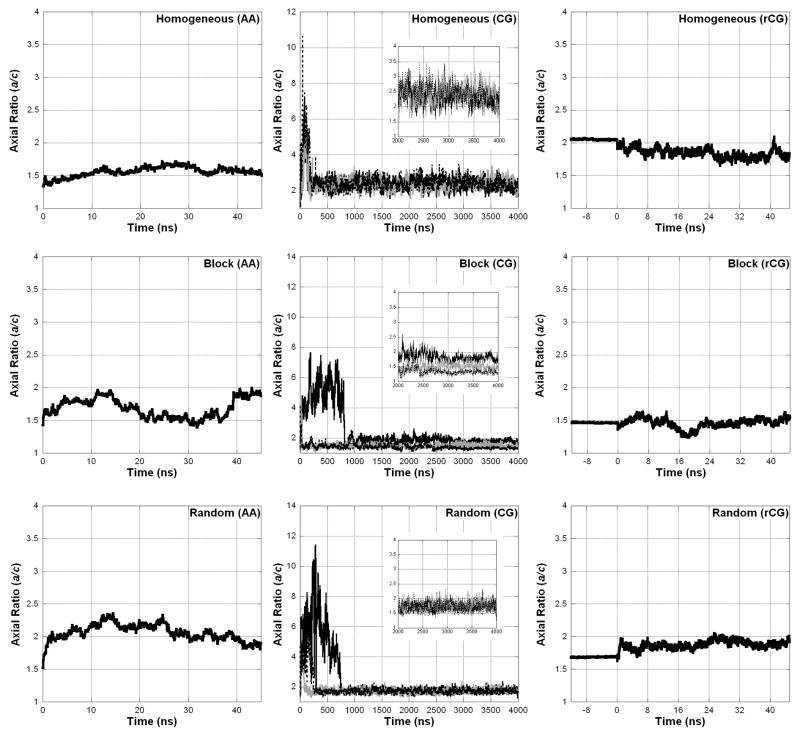
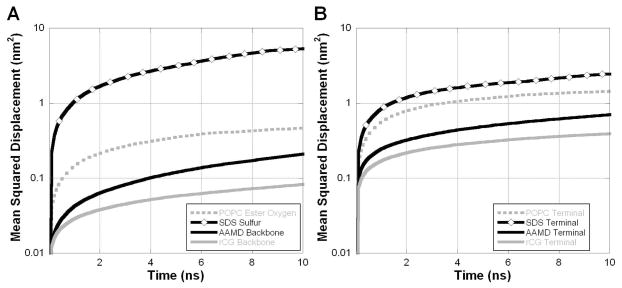
Amphipathic polymers called amphipols (APols) have been developed as an alternative to detergents for stabilizing membrane proteins (MPs) in aqueous solutions. APols provide MPs with a particularly mild environment and, as a rule, keep them in a native functional state for longer periods than do detergents. Amphipol A8-35, a derivative of polyacrylate, is widely used and has been particularly well studied experimentally. In aqueous solutions, A8-35 molecules self-assemble into well-defined globular particles with a mass of ∼40 kDa and a R(g) of ∼2.4 nm. As a first step towards describing MP/A8-35 complexes by molecular dynamics (MD), we present three sets of simulations of the pure APol particle. First, we performed a series of all-atom MD (AAMD) simulations of the particle in solution, starting from an arbitrary initial configuration. Although AAMD simulations result in stable cohesive particles over a 45 ns simulation, the equilibration of the particle organization is limited. This motivated the use of coarse-grained MD (CGMD), allowing us to investigate processes on the microsecond time scale, including de novo particle assembly. We present a detailed description of the parametrization of the CGMD model from the AAMD simulations and a characterization of the resulting CGMD particles. Our third set of simulations utilizes reverse coarse-graining (rCG), through which we obtain all-atom coordinates from a CGMD simulation. This allows a higher-resolution characterization of a configuration determined by a long-timescale simulation. Excellent agreement is observed between MD models and experimental, small-angle neutron scattering data. The MD data provides new insight into the structure and dynamics of A8-35 particles, which is possibly relevant to the stabilizing effects of APols on MPs, as well as a starting point for modeling MP/A8-35 complexes.
两亲聚合物,又称两亲聚合物胶束(Ampolymers),已被开发为替代去污剂,用于稳定水溶液中的膜蛋白(MP)。Ampols 为 MPs 提供了一种特别温和的环境,并且通常比去污剂更能使它们保持更长时间的天然功能状态。聚丙烯酸酯衍生物 Amphipol A8-35 被广泛使用,并进行了特别深入的实验研究。在水溶液中,A8-35 分子自组装成具有约 40 kDa 质量和约 2.4 nm R(g)的明确定义的球形颗粒。作为通过分子动力学(MD)描述 MP/A8-35 复合物的第一步,我们提出了三组纯 APol 颗粒的模拟。首先,我们从任意初始构象开始,对溶液中的颗粒进行了一系列全原子 MD(AAMD)模拟。尽管 AAMD 模拟导致稳定的粘性颗粒在 45 ns 模拟中,但颗粒组织的平衡是有限的。这促使我们使用粗粒 MD(CGMD),允许我们研究微秒时间尺度上的过程,包括从头组装颗粒。我们详细描述了从 AAMD 模拟到 CGMD 模型的参数化,并对所得 CGMD 颗粒进行了表征。我们的第三组模拟利用反向粗粒化(rCG),通过该模拟,我们从 CGMD 模拟中获得全原子坐标。这允许对长时间尺度模拟确定的构型进行更高分辨率的表征。在 MD 模型和实验、小角中子散射数据之间观察到极好的一致性。MD 数据为 A8-35 颗粒的结构和动力学提供了新的见解,这可能与 Ampols 对 MPs 的稳定作用有关,也是对 MP/A8-35 复合物进行建模的起点。