Pandve Harshal T, Raut Atul
Department of Community Medicine, Smt. Kashibai Navale Medical College, Narhe, Pune, Maharashtra, India.
Indian J Occup Environ Med. 2011 Jan;15(1):42-5. doi: 10.4103/0019-5278.82999.
Climate change has emerged as one of the most devastating environmental threat and there is overwhelming evidence of wide range of implications for human health. To mitigate this, well-prepared medical man power is required.
The objectives of this study were (1) to assess the awareness regarding climate change and its health hazards among the medical students and (2) to recommend the awareness campaigns regarding climate change and its health hazards for students based on the results.
This observational study was conducted at the Medical College in Pune city.
Medical students from all years of M.B.B.S. (Bachelor of Medicine and Bachelor of Surgery) who had given the written consent were included in this study. A self-administered, pre-tested, questionnaire was used. Responses were evaluated.
Proportions, percentage, and Chi-square test.
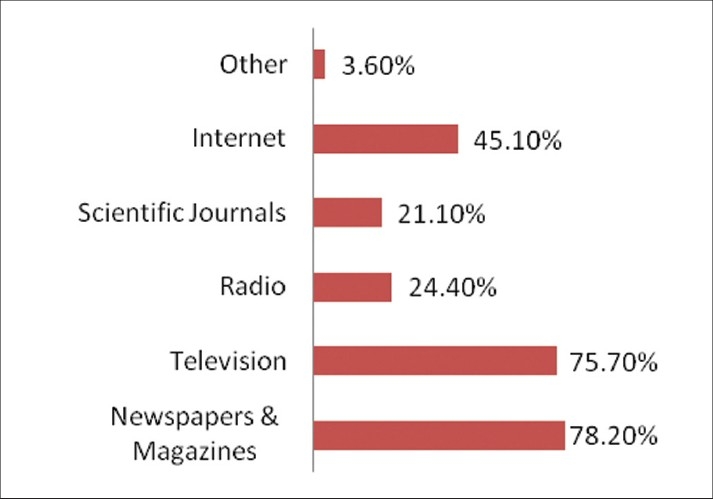
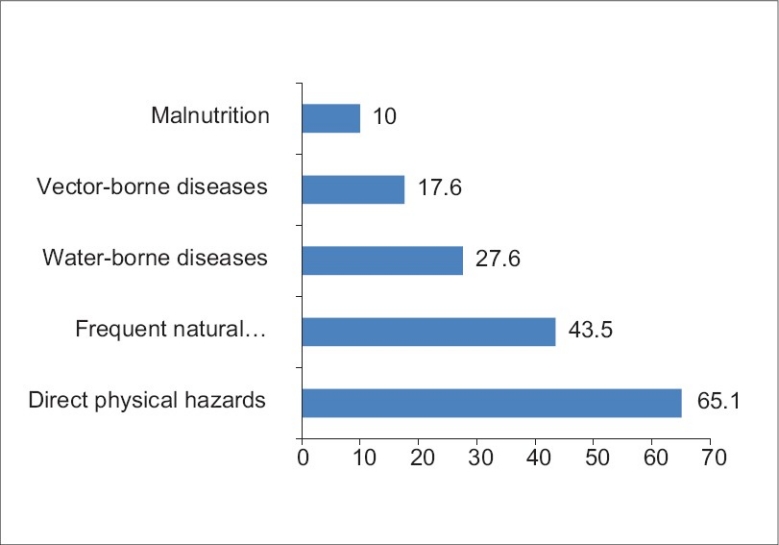
A total of 250 medical students were included in this study. In all, 246 (98.40%) students commented that global climate is changing, while 245 (98%) students opined that human activities are contributing to climate change. The commonest source of information about climate change was newspaper and magazines (78.20%). Majority commented that deforestation and industrial and vehicular pollution contribute most to climate change. According to 47.50% of the students, health-related issues are priority for climate change prevention strategy. According to 65.10% students, direct physical hazards of extreme climatic events are most important health-related impact of climate change, followed by natural disaster-related health hazards (43.50%), waterborne diseases (27.60%), vector-borne diseases (17.60%), and malnutrition (10%). There was statistically significant difference found between year of MBBS of the students and the awareness regarding United Nations Federation on Climate Change, Kyoto protocol (χ(2) = 7.85, P = 0.02), and Intergovernmental Panel on Climate Change (χ(2) = 12.77, P = 0.002). A significant difference was found between the awareness about health impact of climate change at different places (χ(2) = 11.25, P = 0.001).
Students had awareness regarding health hazards of the climate change, but improvement for mitigation is required. It is suggested that a large nation-wide awareness survey regarding climate change and its health hazards is necessary to determine the preparedness of medical students and also to suggest any changes in the current curriculum.
气候变化已成为最具破坏性的环境威胁之一,有大量证据表明其对人类健康有着广泛影响。为缓解这一情况,需要有充分准备的医学人才。
本研究的目的是(1)评估医学生对气候变化及其健康危害的认识,(2)根据结果为学生推荐有关气候变化及其健康危害的宣传活动。
本观察性研究在浦那市的医学院进行。
纳入所有已签署书面同意书的医学学士(医学与外科学士)各年级的医学生。使用了一份自行设计、预先测试过的问卷。对回答进行评估。
比例、百分比和卡方检验。
本研究共纳入250名医学生。总计246名(98.40%)学生表示全球气候正在变化,而245名(98%)学生认为人类活动正在导致气候变化。关于气候变化的最常见信息来源是报纸和杂志(78.20%)。大多数人认为森林砍伐以及工业和车辆污染对气候变化的影响最大。47.50%的学生认为与健康相关的问题是气候变化预防策略的重点。65.10%的学生认为极端气候事件的直接身体危害是气候变化对健康最重要的影响,其次是与自然灾害相关的健康危害(43.50%)、水传播疾病(27.60%)、媒介传播疾病(17.60%)和营养不良(10%)。在医学生的医学学士年级与对联合国气候变化框架公约、京都议定书的认识(χ(2)=7.85,P = 0.02)以及政府间气候变化专门委员会的认识(χ(2)=12.77,P = 0.002)之间发现有统计学显著差异。在不同地点对气候变化健康影响的认识之间发现有显著差异(χ(2)=11.25,P = 0.001)。
学生对气候变化的健康危害有认识,但仍需要改进以减轻影响。建议进行一次大规模的全国性关于气候变化及其健康危害的认识调查,以确定医学生的准备情况,并建议对当前课程进行任何调整。