Université de Strasbourg, Institut Pluridisciplinaire Hubert Curien, Département Ecologie, Physiologie et Ethologie, Strasbourg, France.
PLoS One. 2011;6(7):e21110. doi: 10.1371/journal.pone.0021110. Epub 2011 Jul 19.
Birds may allocate a significant part of time to comfort behavior (e.g., preening, stretching, shaking, etc.) in order to eliminate parasites, maintain plumage integrity, and possibly reduce muscular ankylosis. Understanding the adaptive value of comfort behavior would benefit from knowledge on the energy costs animals are willing to pay to maintain it, particularly under situations of energy constraints, e.g., during fasting. We determined time and energy devoted to comfort activities in freely breeding king penguins (Aptenodytes patagonicus), seabirds known to fast for up to one month during incubation shifts ashore.
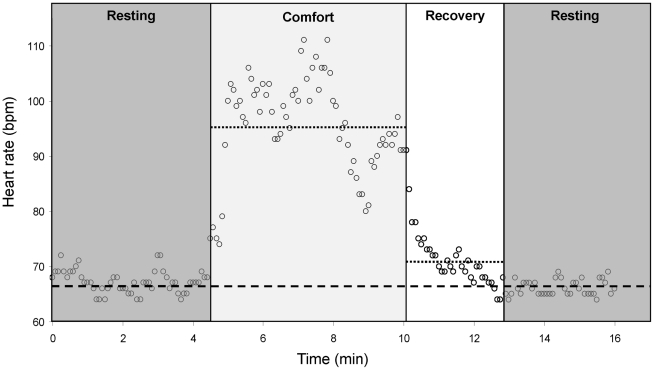
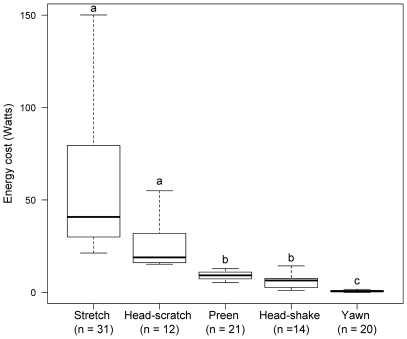
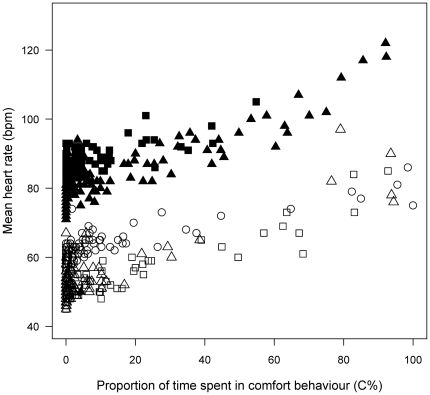
METHODOLOGY/PRINCIPAL FINDINGS: A time budget was estimated from focal and scan sampling field observations and the energy cost of comfort activities was calculated from the associated increase in heart rate (HR) during comfort episodes, using previously determined equations relating HR to energy expenditure. We show that incubating birds spent 22% of their daily time budget in comfort behavior (with no differences between day and night) mainly devoted to preening (73%) and head/body shaking (16%). During comfort behavior, energy expenditure averaged 1.24 times resting metabolic rate (RMR) and the corresponding energy cost (i.e., energy expended in excess to RMR) was 58 kJ/hr. Energy expenditure varied greatly among various types of comfort behavior, ranging from 1.03 (yawning) to 1.78 (stretching) times RMR. Comfort behavior contributed 8.8-9.3% to total daily energy expenditure and 69.4-73.5% to energy expended daily for activity. About half of this energy was expended caring for plumage.
CONCLUSION/SIGNIFICANCE: This study is the first to estimate the contribution of comfort behavior to overall energy budget in a free-living animal. It shows that although breeding on a tight energy budget, king penguins devote a substantial amount of time and energy to comfort behavior. Such findings underline the importance of comfort behavior for the fitness of colonial seabirds.
鸟类可能会花费大量时间进行舒适行为(例如梳理、伸展、摇晃等),以消除寄生虫、保持羽毛完整,并可能减少肌肉僵硬。了解舒适行为的适应价值将有助于了解动物为维持舒适行为而愿意付出的能量成本,特别是在能量受限的情况下,例如禁食期间。我们确定了自由繁殖的王企鹅(Aptenodytes patagonicus)的舒适活动所花费的时间和能量,这些海鸟在孵卵期上岸时,已知会禁食长达一个月。
方法/主要发现:通过焦点和扫描采样野外观察来估计时间预算,并根据舒适事件中心率(HR)的相应增加来计算舒适活动的能量成本,使用先前确定的将 HR 与能量消耗相关联的方程。我们表明,孵卵的鸟类将 22%的日常时间预算用于舒适行为(白天和晚上没有差异),主要用于梳理(73%)和头部/身体摇晃(16%)。在舒适行为期间,能量消耗平均为静息代谢率(RMR)的 1.24 倍,相应的能量成本(即超过 RMR 的能量消耗)为 58 kJ/hr。各种舒适行为的能量消耗差异很大,范围从 1.03(打哈欠)到 1.78(伸展)倍 RMR。舒适行为对总日能量消耗的贡献为 8.8-9.3%,对每日活动能量消耗的贡献为 69.4-73.5%。其中一半的能量用于护理羽毛。
结论/意义:这项研究首次估计了自由生活动物中舒适行为对整体能量预算的贡献。它表明,尽管在紧张的能量预算下繁殖,王企鹅仍然会花费大量时间和能量进行舒适行为。这些发现强调了舒适行为对群居海鸟适应性的重要性。