Van Houtven Courtney H, Drake Connor, Malo Teri L, Decosimo Kasey, Tucker Matthew, Sullivan Caitlin, D'Adolf Josh, Hughes Jaime M, Christensen Leah, Grubber Janet M, Coffman Cynthia J, Sperber Nina R, Wang Virginia, Allen Kelli D, Hastings S Nicole, Shea Christopher M, Zullig Leah L
Center of Innovation to Accelerate Discovery and Practice Transformation, Durham VA Health Care System (152), 508 Fulton Street, Durham, NC, 27705, USA.
Department of Population Health Sciences, Duke University, Durham, NC, USA.
Implement Sci Commun. 2023 Jun 19;4(1):69. doi: 10.1186/s43058-023-00447-x.
Caregivers FIRST is an evidence-based program addressing gaps in caregivers' skills. In 2020, the Veterans Health Administration Caregiver Support Program (CSP) nationally endorsed Caregivers FIRST, offering credit in leadership performance plans to encourage all VA medical centers (VAMCs) to implement locally. This study examines the association of organizational readiness with VAMC adoption of Caregivers FIRST.
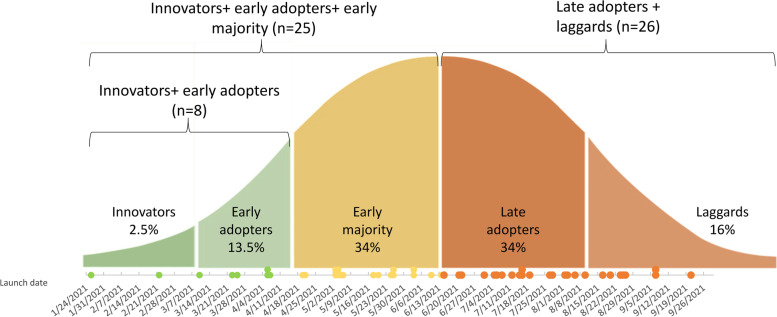
In a cohort observational study, we surveyed CSP managers about their facilities' readiness to implement using the Organizational Readiness for Implementing Change (ORIC) instrument and compared change commitment and change efficacy domains among VAMCs "adopters" defined as delivering Caregivers FIRST within 1 year of the national announcement to those that did not ("non-adopters"). Within "adopters," we categorized time to adoption based on Rogers' diffusion of innovation theory including "innovators," "early adopters," "early majority," "late adopters," and "laggards." Organizational readiness and site characteristics (facility complexity, staffing levels, volume of applications for caregiver assistance services) were compared between "adopters," "non-adopters," and between time to adoption subcategories. Separate logistic regression models were used to assess whether ORIC and site characteristics were associated with early adoption among "adopters."
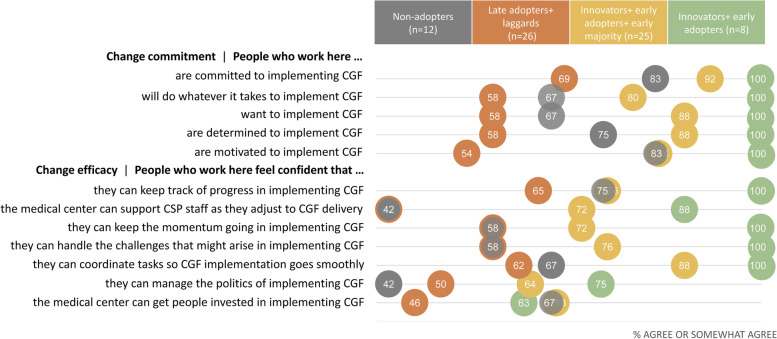
Fifty-one of 63 (81%) VAMCs with CSP manager survey respondents adopted Caregivers FIRST during the first year. ORIC change commitment and efficacy were similar for "adopters" and "non-adopters." However, sites that adopted earlier (innovators and early adopters) had higher ORIC change commitment and efficacy scores than the rest of the "adopters." Logistic regression results indicated that higher ORIC change commitment (odds ratio [OR] = 2.57; 95% confidence interval [CI], 1.11-5.95) and ORIC change efficacy (OR = 2.60; 95% CI, 1.12-6.03) scores were associated with increased odds that a VAMC was an early adopter (categorized as an "innovator," "early adopter", or "early majority"). Site-level characteristics were not associated with Caregivers FIRST early adoption.
To our knowledge, this study is the first to prospectively assess organizational readiness and the timing of subsequent program adoption. Early adoption was associated with higher ORIC change commitment and change efficacy and not site-level characteristics. These findings yield insights into the role of organizational readiness to accelerate program adoption.
ClinicalTrials.gov, NCT03474380. Registered on March 22, 2018.
“护理者优先”(Caregivers FIRST)是一项基于证据的项目,旨在弥补护理者技能方面的差距。2020年,退伍军人健康管理局护理者支持项目(CSP)在全国范围内认可了“护理者优先”项目,在领导力绩效计划中给予学分,以鼓励所有退伍军人医疗中心(VAMC)在当地实施该项目。本研究探讨了组织准备度与退伍军人医疗中心采用“护理者优先”项目之间的关联。
在一项队列观察性研究中,我们使用实施变革的组织准备度(ORIC)工具对CSP管理人员进行调查,了解他们所在机构实施该项目的准备情况,并比较了在全国宣布后的1年内实施“护理者优先”项目的VAMC(“采用者”)和未实施的VAMC(“非采用者”)在变革承诺和变革效能方面的差异。在“采用者”中,我们根据罗杰斯的创新扩散理论对采用时间进行分类,包括“创新者”“早期采用者”“早期多数”“晚期采用者”和“落后者”。比较了“采用者”“非采用者”以及采用时间子类别之间的组织准备度和机构特征(机构复杂性、人员配备水平、护理者援助服务申请量)。使用单独的逻辑回归模型评估ORIC和机构特征是否与“采用者”中的早期采用相关。
在63个有CSP管理人员参与调查的VAMC中,有51个(81%)在第一年采用了“护理者优先”项目。“采用者”和“非采用者”的ORIC变革承诺和效能相似。然而,较早采用的机构(创新者和早期采用者)的ORIC变革承诺和效能得分高于其他“采用者”。逻辑回归结果表明较高的ORIC变革承诺(优势比[OR]=2.57;95%置信区间[CI],1.11 - 5.95)和ORIC变革效能(OR = 2.60;95% CI,1.12 - 6.03)得分与VAMC成为早期采用者(分类为“创新者”“早期采用者”或“早期多数”)的几率增加相关。机构层面的特征与“护理者优先”项目的早期采用无关。
据我们所知,本研究是首次前瞻性评估组织准备度以及后续项目采用的时间。早期采用与较高的ORIC变革承诺和变革效能相关,而与机构层面的特征无关。这些发现为组织准备度在加速项目采用方面的作用提供了见解。
ClinicalTrials.gov,NCT03474380。于2018年3月22日注册。