Department of Biological Chemistry and Molecular Pharmacology, Harvard Medical School, 240 Longwood Avenue, Boston, MA 02115, USA.
Sci Total Environ. 2011 Sep 15;409(20):4297-305. doi: 10.1016/j.scitotenv.2011.07.032. Epub 2011 Aug 6.
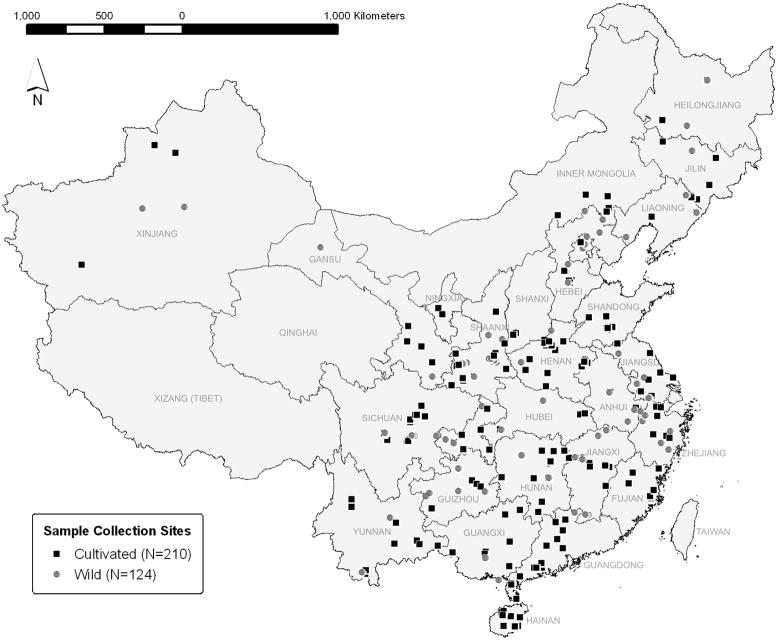
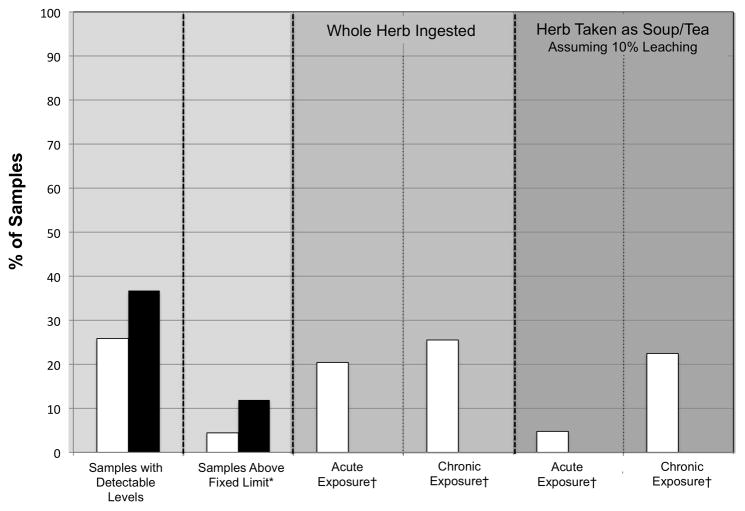
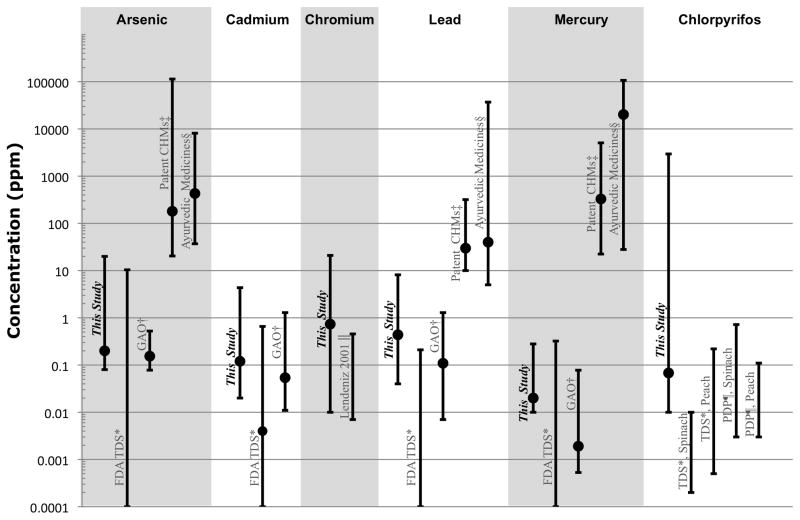
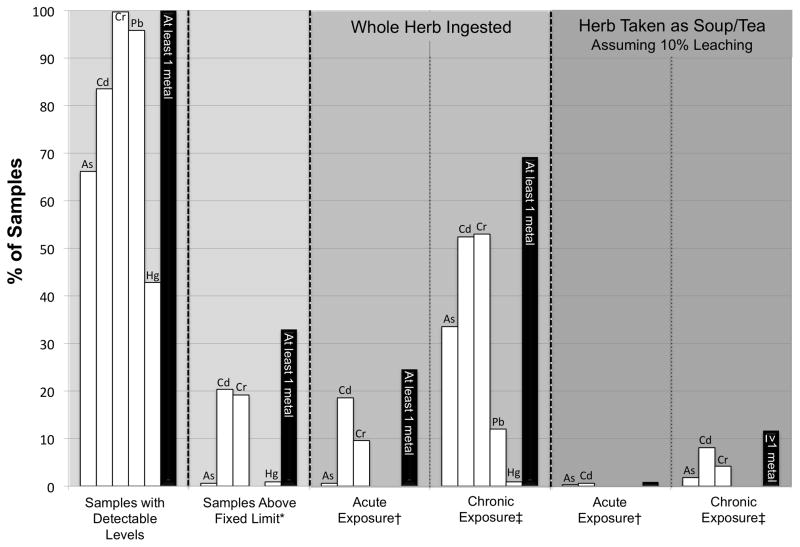
Heavy metal and pesticide contamination has previously been reported in Chinese Herbal Medicines (CHMs), in some cases at potentially toxic levels. This study was conducted to determine general patterns and toxicological significance of heavy metal and pesticide contamination in a broad sample of raw CHMs. Three-hundred-thirty-four samples representing 126 species of CHMs were collected throughout China and examined for arsenic, cadmium, chromium, lead, and mercury. Of the total, 294 samples representing 112 species were also tested for 162 pesticides. At least 1 metal was detected in all 334 samples (100%) and 115 samples (34%) had detectable levels of all metals. Forty-two different pesticides were detected in 108 samples (36.7%), with 1 to 9 pesticides per sample. Contaminant levels were compared to toxicological reference values in the context of different exposure scenarios. According to a likely scenario of CHM consumption, only 3 samples (1%) with heavy metals and 14 samples (5%) with pesticides were found with concentrations that could contribute to elevated background levels of contaminant exposure. According to the most conservative scenario of CHM consumption, 231 samples (69%) with heavy metals and 81 samples (28%) with pesticides had contaminants that could contribute to elevated levels of exposure. Wild collected plants had higher contaminant levels than cultivated samples. Cadmium, chromium, lead, and chlorpyrifos contamination showed weak correlations with geographic location. Based on our assumptions of the likely mode of consumption of raw CHMs, the vast majority (95%) of the 334 samples in this study contained levels of heavy metals or pesticides that would be of negligible concern. However, given the number of samples with detectable contaminants and the range between the more likely and more conservative scenarios of contaminant exposure, more research and monitoring of heavy metals (especially cadmium and chromium) and pesticide residues (especially chlorpyrifos) in raw CHMs are advised.
中药材(CHM)中的重金属和农药污染先前已有报道,某些情况下污染程度可能具有毒性。本研究旨在确定广泛的中药材原材料样本中重金属和农药污染的一般模式和毒理学意义。在中国各地采集了 334 个代表 126 种 CHM 的样本,用于检测砷、镉、铬、铅和汞。其中,294 个代表 112 种 CHM 的样本还检测了 162 种农药。在所有 334 个样本中(100%)均检测到至少 1 种金属,115 个样本(34%)的所有金属均有检出。在 108 个样本(36.7%)中检测到 42 种不同的农药,每个样本有 1 到 9 种农药。在不同的暴露场景下,将污染物水平与毒理学参考值进行了比较。根据 CHM 消费的可能情况,只有 3 个样本(1%)的重金属和 14 个样本(5%)的农药浓度可能导致污染物暴露背景水平升高。根据 CHM 消费最保守的情况,231 个样本(69%)的重金属和 81 个样本(28%)的农药浓度可能导致污染物暴露水平升高。野生采集的植物比栽培样本的污染物含量更高。镉、铬、铅和毒死蜱的污染与地理位置呈弱相关。基于我们对中药材原材料可能消费模式的假设,本研究中 334 个样本中的绝大多数(95%)含有重金属或农药水平,这些水平可以忽略不计。然而,考虑到有检出污染物的样本数量以及更可能和更保守的污染物暴露情景之间的差异,建议对中药材原材料中的重金属(尤其是镉和铬)和农药残留(尤其是毒死蜱)进行更多的研究和监测。