Harvard Medical School and The F. M. Kirby Neurobiology Center, Children's Hospital Boston, Boston, MA 02115, USA.
Neural Plast. 2011;2011:921680. doi: 10.1155/2011/921680. Epub 2011 Aug 3.
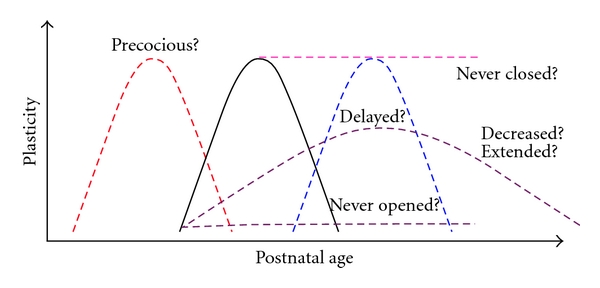
Cortical circuits in the brain are refined by experience during critical periods early in postnatal life. Critical periods are regulated by the balance of excitatory and inhibitory (E/I) neurotransmission in the brain during development. There is now increasing evidence of E/I imbalance in autism, a complex genetic neurodevelopmental disorder diagnosed by abnormal socialization, impaired communication, and repetitive behaviors or restricted interests. The underlying cause is still largely unknown and there is no fully effective treatment or cure. We propose that alteration of the expression and/or timing of critical period circuit refinement in primary sensory brain areas may significantly contribute to autistic phenotypes, including cognitive and behavioral impairments. Dissection of the cellular and molecular mechanisms governing well-established critical periods represents a powerful tool to identify new potential therapeutic targets to restore normal plasticity and function in affected neuronal circuits.
大脑中的皮质电路在出生后生命早期的关键期内通过经验得到完善。关键期受大脑发育过程中兴奋性和抑制性(E/I)神经传递的平衡调节。现在有越来越多的证据表明,自闭症存在 E/I 失衡,自闭症是一种复杂的遗传性神经发育障碍,其特征为社交异常、沟通障碍、重复行为或受限兴趣。其根本原因在很大程度上仍不清楚,也没有完全有效的治疗方法或治愈方法。我们提出,主要感觉脑区关键期电路完善的表达和/或时间的改变可能会显著导致自闭症表型,包括认知和行为障碍。剖析调控已确立的关键期的细胞和分子机制代表了一种强大的工具,可以确定新的潜在治疗靶点,以恢复受影响神经元回路的正常可塑性和功能。