Department of Neurology, University of Göttingen, Göttingen, Germany.
PLoS One. 2011;6(7):e22683. doi: 10.1371/journal.pone.0022683. Epub 2011 Jul 28.
Carotid angioplasty and stenting (CAS) may currently be recommended especially in younger patients with a high-grade carotid artery stenosis. However, evidence is accumulating that in-stent restenosis (ISR) could be an important factor endangering the long-term efficacy of CAS. The aim of this study was to investigate the influence of inflammatory serum markers and procedure-related factors on ISR as diagnosed with duplex sonography.
We analyzed 210 CAS procedures in 194 patients which were done at a single university hospital between May 2003 and June 2010. Periprocedural C-reactive protein (CRP) and leukocyte count as well as stent design and geometry, and other periprocedural factors were analyzed with respect to the occurrence of an ISR as diagnosed with serial carotid duplex ultrasound investigations during clinical long-term follow-up.
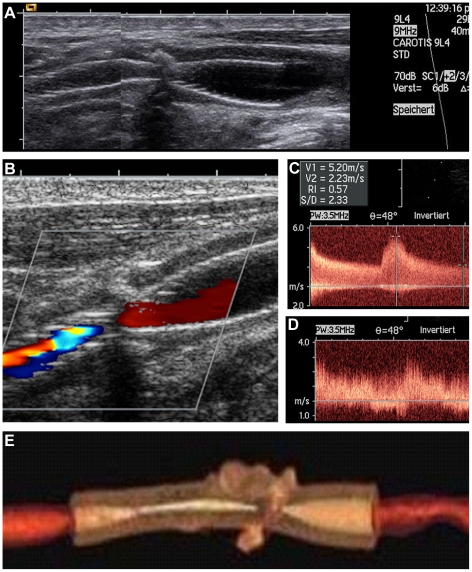
Over a median of 33.4 months follow-up (IQR: 14.9-53.7) of 210 procedures (mean age of 67.9±9.7 years, 71.9% male, 71.0% symptomatic) an ISR of ≥70% was detected in 5.7% after a median of 8.6 months (IQR: 3.4-17.3). After multiple regression analysis, leukocyte count after CAS-intervention (odds ratio (OR): 1.31, 95% confidence interval (CI): 1.02-1.69; p = 0.036), as well as stent length and width were associated with the development of an ISR during follow-up (OR: 1.25, 95% CI: 1.05-1.65, p = 0.022 and OR: 0.28, 95% CI: 0.09-0.84, p = 0.010).
The majority of ISR during long-term follow-up after CAS occur within the first year. ISR is associated with periinterventional inflammation markers and influenced by certain stent characteristics such as stent length and width. Our findings support the assumption that stent geometry leading to vessel injury as well as periprocedural inflammation during CAS plays a pivotal role in the development of carotid artery ISR.
颈动脉血管成形术和支架置入术(CAS)目前可能特别适用于伴有重度颈动脉狭窄的年轻患者。然而,越来越多的证据表明支架内再狭窄(ISR)可能是危及 CAS 长期疗效的重要因素。本研究旨在通过双功能超声检查调查炎症性血清标志物和与操作相关的因素对 ISR 的影响。
我们分析了 2003 年 5 月至 2010 年 6 月在一家大学医院进行的 210 例 CAS 手术的 194 例患者。分析了围手术期 C 反应蛋白(CRP)和白细胞计数,以及支架设计和几何形状以及其他围手术期因素,这些因素与临床长期随访期间的连续颈动脉双功能超声检查诊断的 ISR 发生情况有关。
210 例手术的中位随访时间为 33.4 个月(IQR:14.9-53.7),平均年龄为 67.9±9.7 岁,71.9%为男性,71.0%有症状。在中位时间为 8.6 个月(IQR:3.4-17.3)后,有 5.7%的患者检测到 ISR≥70%。经过多因素回归分析,CAS 干预后的白细胞计数(比值比(OR):1.31,95%置信区间(CI):1.02-1.69;p=0.036)以及支架长度和宽度与随访期间 ISR 的发展相关(OR:1.25,95%CI:1.05-1.65,p=0.022 和 OR:0.28,95%CI:0.09-0.84,p=0.010)。
CAS 后长期随访期间,大多数 ISR 在一年内发生。ISR 与围手术期炎症标志物相关,并受支架特征(如支架长度和宽度)影响。我们的研究结果支持这样一种假设,即导致血管损伤的支架几何形状以及 CAS 期间的围手术期炎症在颈动脉 ISR 的发展中起着关键作用。