Division of Neurology, Department of Internal Medicine, University of Manitoba Winnipeg, MB, Canada.
Front Psychol. 2010 Oct 26;1:168. doi: 10.3389/fpsyg.2010.00168. eCollection 2010.
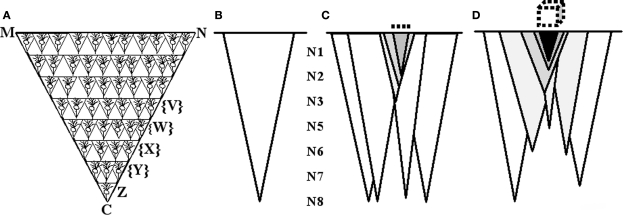
Consciousness is seen as a difficult "binding" problem. Binding, a process where different sensations evoked by an item are associated in the nervous system, can be viewed as a process similar to associative learning. Several reports that consciousness is associated with some form of memory imply that different forms of memories have a common feature contributing to consciousness. Based on a proposed synaptic mechanism capable of explaining different forms of memory, we developed a framework for consciousness. It is based on the formation of semblance of sensory stimulus from (1) synaptic semblances when excitatory postsynaptic potentials arrive at functionally LINKed postsynaptic membranes, and (2) network semblances when these potentials summate to elicit action potential initiating activity in a network of neurons. It is then possible to derive a framework for consciousness as a multi-dimensional semblance. According to this framework, a continuum of semblances formed from background sensory stimuli and oscillating neuronal activities serve to maintain consciousness. Feasibility of this framework to explain various physiological and pathological states of consciousness, its subjective nature and qualia is examined.
意识被视为一个困难的“绑定”问题。绑定是指在神经系统中,将一个物品所引起的不同感觉联系起来的过程,可以看作是一种类似于联想学习的过程。一些报告表明,意识与某种形式的记忆有关,这意味着不同形式的记忆具有共同的特征,有助于意识的产生。基于一种能够解释不同形式记忆的突触机制,我们提出了一个意识框架。它基于从(1)当兴奋性突触后电位到达功能上 LINKed 的突触后膜时形成的感觉刺激的相似性,以及(2)当这些电位总和引起神经元网络中的动作电位起始活动时形成的网络相似性,从突触相似性中形成感觉刺激的相似性。然后,可以将意识框架推导为多维相似性。根据这个框架,由背景感觉刺激和振荡神经元活动形成的连续相似性有助于维持意识。本文还探讨了这个框架解释各种生理和病理意识状态的可行性,以及其主观性和性质。