Stephenson Cardiovascular MR Centre at Libin Cardiovascular Institute of Alberta, Departments of Cardiac Sciences and Radiology, University of Calgary, AB, Canada.
J Cardiovasc Magn Reson. 2011 Aug 11;13(1):40. doi: 10.1186/1532-429X-13-40.
The purpose of the study was to compare the accuracy and evaluation time of quantifying left ventricular (LV), left atrial (LA) volume and LV mass using short axis (SAX) and long axis (LAX) methods when using cardiovascular magnetic resonance (CMR).
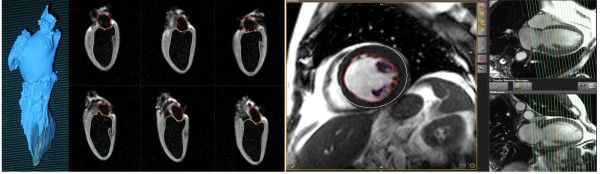
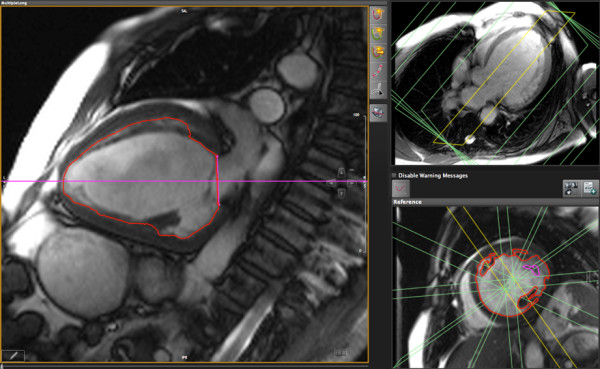
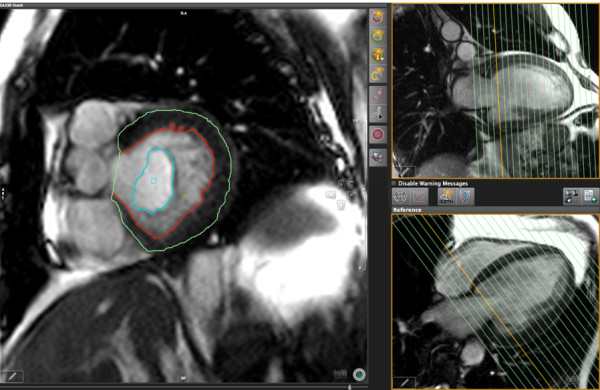
We studied 12 explanted canine hearts and 46 patients referred for CMR (29 male, age 47 ± 18 years) in a clinical 1.5 T CMR system, using standard cine sequences. In standard short axis stacks of various slice thickness values in dogs and 8 mm slice thickness (gap 2 mm) in patients, we measured LV volumes using reference slices in a perpendicular, long axis orientation using certified software. Volumes and mass were also measured in six radial long axis (LAX) views.LV parameters were also assessed for intra- and inter-observer variability. In 24 patients, we also analyzed reproducibility and evaluation time of two very experienced (> 10 years of CMR reading) readers for SAX and LAX.
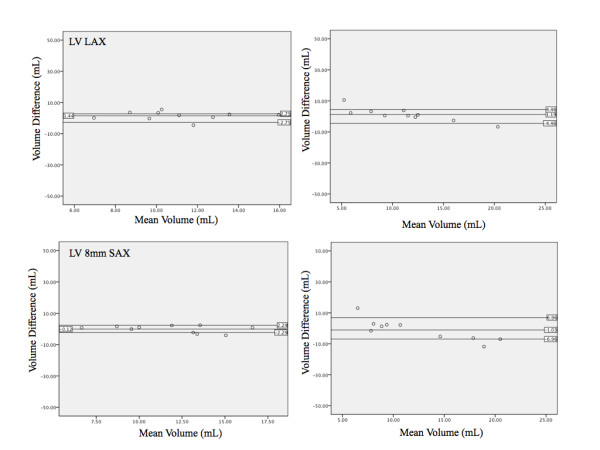
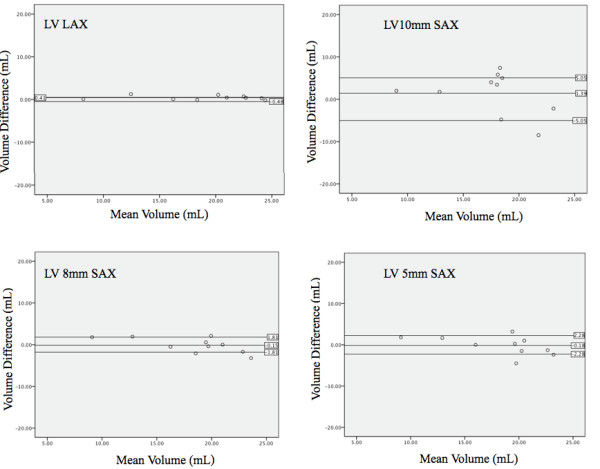
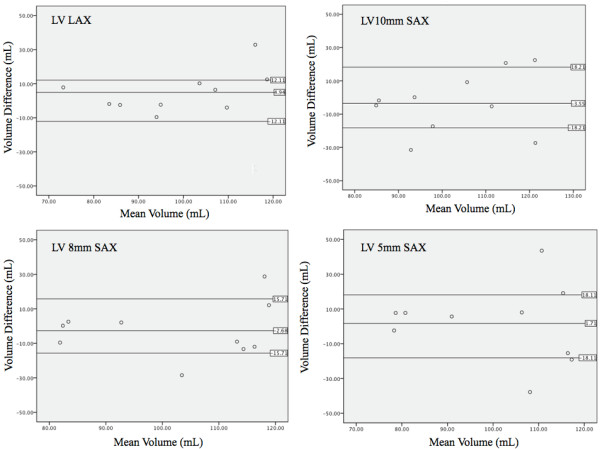
In the explanted dog hearts, there was excellent agreement between ex vivo data and LV mass and volume data as measured by all methods for both, LAX (r² = 0.98) and SAX (r² = 0.88 to 0.98). LA volumes, however, were underestimated by 13% using the LAX views. In patients, there was a good correlation between all three assessed methods (r² ≥ 0.95 for all). In experienced clinical readers, left-ventricular volumes and ejection fraction as measured in LAX views showed a better inter-observer reproducibility and a 27% shorter evaluation time.
When compared to an ex vivo standard, both, short axis and long axis techniques are highly accurate for the quantification of left ventricular volumes and mass. In clinical settings, however, the long axis approach may be more reproducible and more time-efficient. Therefore, the rotational long axis approach is a viable alternative for the clinical assessment of cardiac volumes, function and mass.
本研究旨在比较心血管磁共振(CMR)中使用短轴(SAX)和长轴(LAX)方法定量左心室(LV)、左心房(LA)容积和 LV 质量的准确性和评估时间。
我们在临床 1.5T CMR 系统中研究了 12 个离体犬心和 46 例因 CMR 就诊的患者(29 名男性,年龄 47±18 岁),使用标准电影序列。在犬的不同切片厚度值的标准短轴堆栈和患者的 8mm 切片厚度(间隙 2mm)中,我们使用垂直长轴方向的参考切片,使用认证软件测量 LV 容积。还在六个径向长轴(LAX)视图中测量了容积和质量。还评估了 LV 参数的观察者内和观察者间变异性。在 24 例患者中,我们还分析了两位经验丰富(CMR 阅读超过 10 年)的读者对 SAX 和 LAX 的重复性和评估时间。
在离体犬心,LAX(r²=0.98)和 SAX(r²=0.88 至 0.98)所有方法测量的离体数据与 LV 质量和容积数据之间存在极好的一致性。然而,LAX 视图低估了 LA 容积 13%。在患者中,所有三种评估方法之间存在良好的相关性(r²≥0.95)。在经验丰富的临床读者中,LAX 视图中测量的左心室容积和射血分数具有更好的观察者间可重复性,评估时间缩短了 27%。
与离体标准相比,短轴和长轴技术均高度准确地定量左心室容积和质量。然而,在临床环境中,长轴方法可能更具可重复性和更高效。因此,旋转长轴方法是评估心脏容积、功能和质量的一种可行替代方法。