Department of Laboratory Medicine, University of Washington, Seattle, WA 98195, USA.
J Immunol. 2011 Sep 15;187(6):3391-401. doi: 10.4049/jimmunol.1101421. Epub 2011 Aug 15.
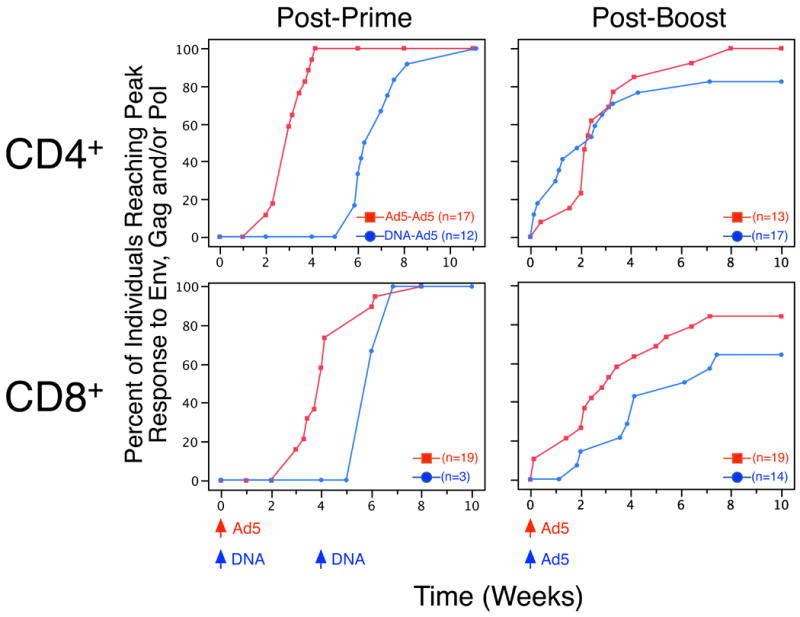
Many candidate HIV vaccines are designed to primarily elicit T cell responses. Although repeated immunization with the same vaccine boosts Ab responses, the benefit for T cell responses is ill defined. We compared two immunization regimens that include the same recombinant adenoviral serotype 5 (rAd5) boost. Repeated homologous rAd5 immunization fails to increase T cell responses, but increases gp140 Ab responses 10-fold. DNA prime, as compared with rAd5 prime, directs long-term memory CD8(+) T cells toward a terminally differentiated effector memory phenotype with cytotoxic potential. Based on the kinetics of activated cells measured directly ex vivo, the DNA vaccination primes for both CD4(+) and CD8(+) T cells, despite the lack of detection of the latter until after the boost. These results suggest that heterologous prime-boost combinations have distinct immunological advantages over homologous prime-boosts and suggest that the effect of DNA on subsequent boosting may not be easily detectable directly after the DNA vaccination.
许多候选 HIV 疫苗主要设计用于引发 T 细胞反应。虽然用相同的疫苗重复免疫会增强 Ab 反应,但 T 细胞反应的益处尚未明确界定。我们比较了两种免疫方案,它们都包含相同的重组腺病毒血清型 5(rAd5)增强剂。重复同源 rAd5 免疫不能增加 T 细胞反应,但会使 gp140 Ab 反应增加 10 倍。与 rAd5 引发相比,DNA 引发将长期记忆 CD8(+)T 细胞定向为具有细胞毒性潜力的终末分化效应记忆表型。基于直接在体外测量的激活细胞的动力学,尽管在增强之前未检测到后者,但 DNA 疫苗可引发 CD4(+)和 CD8(+)T 细胞。这些结果表明,异源初免-增强组合与同源初免-增强相比具有明显的免疫学优势,并表明 DNA 对随后增强的影响可能在 DNA 接种后直接检测不到。