Dept of Public Health and Clinical Medicine, Epidemiology and Global Health, Centre for Global Health Research, Umeå University SE-901 87 Umeå, Sweden.
Int J Equity Health. 2011 Aug 26;10:37. doi: 10.1186/1475-9276-10-37.
Men and women have different patterns of health. These differences between the sexes present a challenge to the field of public health. The question why women experience more health problems than men despite their longevity has been discussed extensively, with both social and biological theories being offered as plausible explanations. In this article, we focus on how gender equality in a partnership might be associated with the respondents' perceptions of health.
This study was a cross-sectional survey with 1400 respondents. We measured gender equality using two different measures: 1) a self-reported gender equality index, and 2) a self-perceived gender equality question. The aim of comparison of the self-reported gender equality index with the self-perceived gender equality question was to reveal possible disagreements between the normative discourse on gender equality and daily practice in couple relationships. We then evaluated the association with health, measured as self-rated health (SRH). With SRH dichotomized into 'good' and 'poor', logistic regression was used to assess factors associated with the outcome. For the comparison between the self-reported gender equality index and self-perceived gender equality, kappa statistics were used.
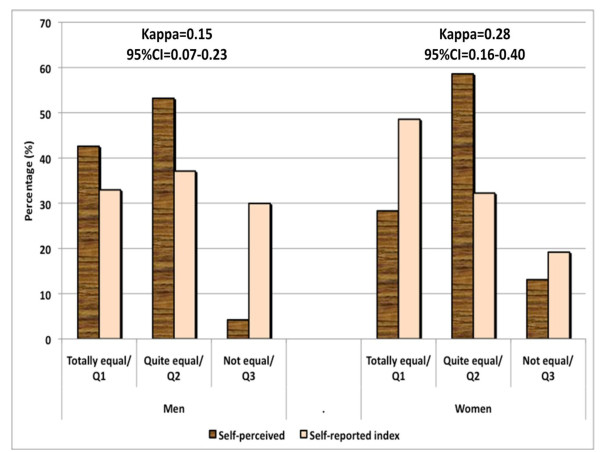
Associations between gender equality and health found in this study vary with the type of gender equality measurement. Overall, we found little agreement between the self-reported gender equality index and self-perceived gender equality. Further, the patterns of agreement between self-perceived and self-reported gender equality were quite different for men and women: men perceived greater gender equality than they reported in the index, while women perceived less gender equality than they reported. The associations to health were depending on gender equality measurement used.
Men and women perceive and report gender equality differently. This means that it is necessary not only to be conscious of the methods and measurements used to quantify men's and women's opinions of gender equality, but also to be aware of the implications for health outcomes.
男性和女性的健康模式不同。这些性别差异给公共卫生领域带来了挑战。尽管女性寿命更长,但她们比男性经历更多健康问题的原因,已经引起了广泛的讨论,社会和生物理论都提出了合理的解释。在本文中,我们专注于伴侣关系中的性别平等如何与受访者对健康的看法相关联。
这是一项横断面调查,共有 1400 名受访者。我们使用两种不同的方法衡量性别平等:1)自我报告的性别平等指数,2)自我感知的性别平等问题。比较自我报告的性别平等指数和自我感知的性别平等问题的目的是揭示性别平等的规范话语与夫妻关系中的日常实践之间可能存在的分歧。然后,我们评估了与健康的关联,健康的衡量标准是自我报告的健康状况(SRH)。将 SRH 分为“良好”和“差”,然后使用逻辑回归评估与结果相关的因素。对于自我报告的性别平等指数和自我感知的性别平等之间的比较,使用 Kappa 统计量。
本研究中发现的性别平等与健康之间的关联因性别平等测量类型而异。总体而言,我们发现自我报告的性别平等指数和自我感知的性别平等之间几乎没有一致性。此外,自我感知和自我报告的性别平等之间的一致性模式在男性和女性之间有很大的不同:男性认为性别平等程度大于他们在指数中报告的程度,而女性则认为性别平等程度小于他们报告的程度。与健康相关的关联取决于所使用的性别平等测量方法。
男性和女性对性别平等的看法和报告方式不同。这意味着,不仅需要意识到用于量化男性和女性对性别平等看法的方法和测量,还需要意识到这些方法和测量对健康结果的影响。