Max Planck Institute of Molecular Cell Biology and Genetics, Dresden, Germany.
EMBO J. 2011 Aug 26;30(19):3928-39. doi: 10.1038/emboj.2011.290.
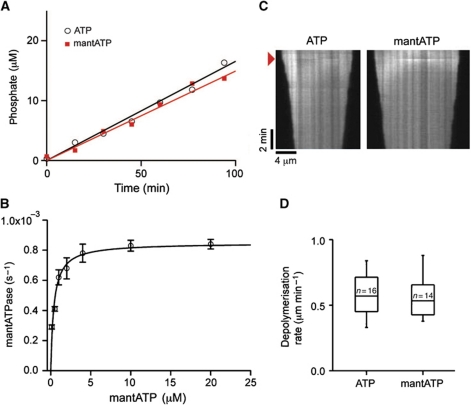
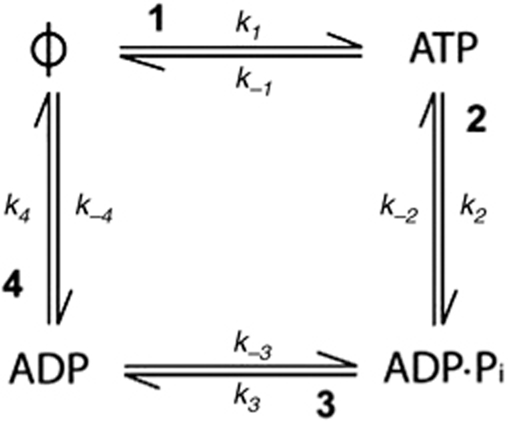
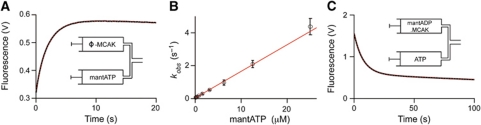
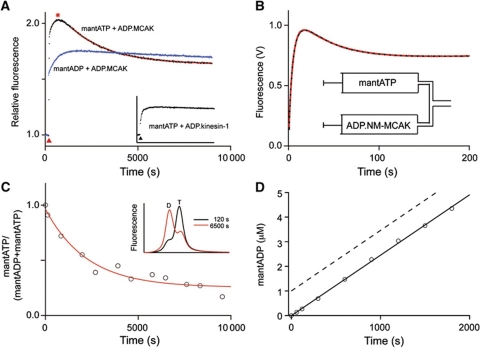
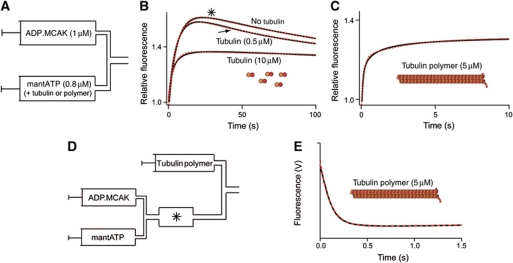
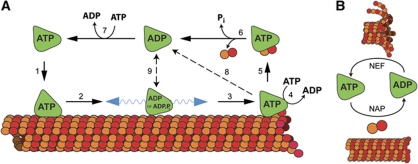
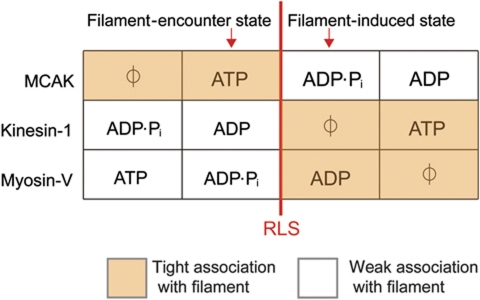
Unlike other kinesins, members of the kinesin-13 subfamily do not move directionally along microtubules but, instead, depolymerize them. To understand how kinesins with structurally similar motor domains can have such dissimilar functions, we elucidated the ATP turnover cycle of the kinesin-13, MCAK. In contrast to translocating kinesins, ATP cleavage, rather than product release, is the rate-limiting step for ATP turnover by MCAK; unpolymerized tubulin and microtubules accelerate this step. Further, microtubule ends fully activate the ATPase by accelerating the exchange of ADP for ATP. This tuning of the cycle adapts MCAK for its depolymerization activity: lattice-stimulated ATP cleavage drives MCAK into a weakly bound nucleotide state that reaches microtubule ends by diffusion, and end-specific acceleration of nucleotide exchange drives MCAK into a strongly bound state that promotes depolymerization. This altered cycle accounts well for the different mechanical behaviour of this kinesin, which depolymerizes microtubules from their ends, compared to translocating kinesins that walk along microtubules. Thus, the kinesin motor domain is a nucleotide-dependent engine that can be differentially tuned for transport or depolymerization functions.
与其他驱动蛋白不同,驱动蛋白-13 亚家族的成员不会沿着微管定向移动,而是使其解聚。为了理解结构相似的马达结构域的驱动蛋白如何具有如此不同的功能,我们阐明了驱动蛋白-13(MCAK)的 ATP 周转循环。与移位驱动蛋白不同,ATP 裂解而不是产物释放是 MCAK 进行 ATP 周转的限速步骤;未聚合的微管蛋白和微管加速了这一步骤。此外,微管末端通过加速 ADP 与 ATP 的交换来完全激活 ATP 酶。这种循环的调节使 MCAK 适应其解聚活性:晶格刺激的 ATP 裂解将 MCAK 驱动到一个弱结合核苷酸状态,通过扩散到达微管末端,末端特异性核苷酸交换的加速将 MCAK 驱动到一个强结合状态,促进解聚。这种改变的循环很好地解释了这种驱动蛋白与沿微管行走的移位驱动蛋白相比,从微管末端解聚微管的不同机械行为。因此,驱动蛋白马达结构域是一种核苷酸依赖性引擎,可以针对运输或解聚功能进行差异调节。