Programa de Pós-Graduação em Ciências Médicas, Faculdade de Medicina, Universidade Federal do Rio Grande do Sul, Ramiro Barcelos 2400, 90035-903 Porto Alegre, RS, Brazil.
Neural Plast. 2011;2011:328602. doi: 10.1155/2011/328602. Epub 2011 Aug 18.
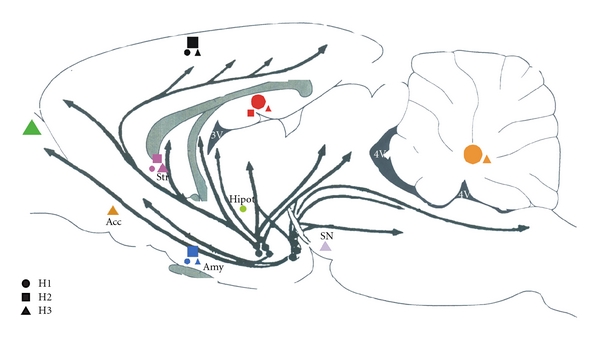
Encoding for several memory types requires neural changes and the activity of distinct regions across the brain. These areas receive broad projections originating in nuclei located in the brainstem which are capable of modulating the activity of a particular area. The histaminergic system is one of the major modulatory systems, and it regulates basic homeostatic and higher functions including arousal, circadian, and feeding rhythms, and cognition. There is now evidence that histamine can modulate learning in different types of behavioral tasks, but the exact course of modulation and its mechanisms are controversial. In the present paper we review the involvement of the histaminergic system and the effects histaminergic receptor agonists/antagonists have on the performance of tasks associated with the main memory types as well as evidence provided by studies with knockout models. Thus, we aim to summarize the possible effects histamine has on modulation of circuits involved in memory formation.
多种记忆类型的编码需要神经变化和大脑中不同区域的活动。这些区域接收来自位于脑干中的核团的广泛投射,这些核团能够调节特定区域的活动。组胺能系统是主要的调制系统之一,它调节基本的稳态和高级功能,包括觉醒、昼夜节律和摄食节律以及认知。现在有证据表明,组胺可以调节不同类型的行为任务中的学习,但确切的调节过程及其机制存在争议。在本文中,我们回顾了组胺能系统的参与情况,以及组胺能受体激动剂/拮抗剂对与主要记忆类型相关的任务表现的影响,并提供了使用基因敲除模型获得的证据。因此,我们旨在总结组胺对参与记忆形成的回路的调制可能产生的影响。