Department of Clinical Biochemistry, of Pharmacy and Pharmaceutical Sciences, Pharmaceutical Sciences Research Centre, Isfahan University of Medical Sciences, Isfahan, Iran.
Clinics (Sao Paulo). 2011;66(7):1129-35. doi: 10.1590/s1807-59322011000700002.
Adiponectin is a circulating hormone that is produced exclusively by adipocytes and has antiinflammatory and anti-atherogenic properties. The hypothesis that there are differences in adiponectin levels between stable and unstable coronary-artery disease patients remains controversial. Furthermore, the potential relationships between the plasma adiponectin level and the inflammatory and non-inflammatory markers (oxidized low density lipoprotein and nitric oxide) in patients with stable and unstable coronary-artery disease relative to normal subjects have not been assessed.
To assess whether plasma adiponectin levels differ among patients with stable and unstable coronary-artery disease and among control subjects, and to correlate plasma adiponectin level with inflammatory and clinical risk factors (such as oxidized-LDL and nitric oxide) in these patients.
This study included 50 control subjects, 50 stable angina patients and 50 unstable angina patients with angiographically documented coronary-artery disease. Plasma adiponectin and oxidized-LDL levels were determined using an enzyme immunoassay. Plasma nitric oxide, high sensitivity C-reactive protein and lipid profile levels were also measured.
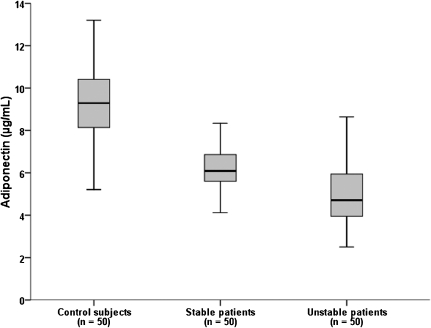
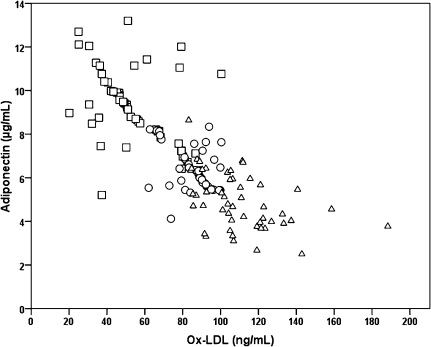
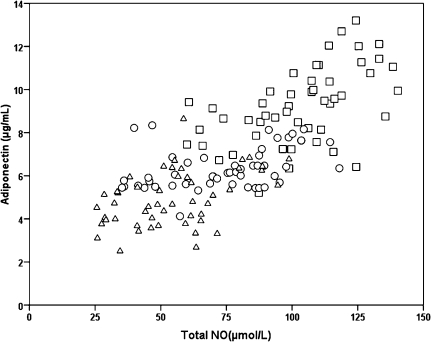
Plasma adiponectin levels were lower in the unstable angina patients (4.9 ± 1.30 µg/mL) than in the stable angina patients (6.34 ± 1.0 µg/mL) or in the controls (9.25 ± 1.8 µg/mL); these levels were also significantly lower in stable angina patients versus controls (p<0.001). Plasma adiponectin levels were negatively correlated with oxidized-LDL, high sensitivity C-reactive protein, lipid profile and other clinical risk factors but positively correlated with nitric oxide.
Plasma adiponectin levels were found to be lower in both stable and unstable angina patients relative to control subjects, and the correlation between plasma adiponectin and cardiovascular markers is weakened in these patients.
脂联素是一种循环激素,仅由脂肪细胞产生,具有抗炎和抗动脉粥样硬化的特性。关于稳定型和不稳定型冠状动脉疾病患者之间脂联素水平存在差异的假说仍存在争议。此外,尚未评估稳定型和不稳定型冠状动脉疾病患者与正常受试者相比,血浆脂联素水平与炎症和非炎症标志物(氧化低密度脂蛋白和一氧化氮)之间的潜在关系。
评估稳定型和不稳定型冠状动脉疾病患者之间以及与正常受试者之间的血浆脂联素水平是否存在差异,并评估这些患者的血浆脂联素水平与炎症和临床危险因素(如氧化低密度脂蛋白和一氧化氮)的相关性。
本研究纳入了 50 名正常对照者、50 名稳定型心绞痛患者和 50 名不稳定型心绞痛患者,所有患者均经冠状动脉造影证实存在冠状动脉疾病。采用酶联免疫吸附法测定血浆脂联素和氧化低密度脂蛋白水平,同时测定血浆一氧化氮、高敏 C 反应蛋白和血脂谱水平。
不稳定型心绞痛患者的血浆脂联素水平(4.9±1.30μg/ml)低于稳定型心绞痛患者(6.34±1.0μg/ml)和正常对照者(9.25±1.8μg/ml);稳定型心绞痛患者的血浆脂联素水平也明显低于正常对照者(p<0.001)。血浆脂联素水平与氧化低密度脂蛋白、高敏 C 反应蛋白、血脂谱和其他临床危险因素呈负相关,与一氧化氮呈正相关。
与正常对照者相比,稳定型和不稳定型心绞痛患者的血浆脂联素水平均较低,且这些患者的血浆脂联素与心血管标志物之间的相关性减弱。