Department of Orthopaedic Surgery, Carolinas Medical Center, PO Box 32861, Charlotte, NC 28232, USA.
Arthritis Res Ther. 2011 Aug 31;13(4):R140. doi: 10.1186/ar3454.
Cathepsin K is a recently discovered cysteine protease which cleaves the triple helical domains of type I to II collagen. It has been shown to be up-regulated in synovial tissue from osteoarthritic and rheumatoid patients, and is a component in normal and nonarthritic cartilage, where it increases with aging. Studies on heart valve development have recently shown that receptor activator of nuclear factor-κB ligand (RANKL) acts during valve remodeling to promote cathepsin K expression. Since extracellular matrix remodeling is a critical component of disc structure and biomechanical function, we hypothesized that cathepsin K and RANKL may be present in the human intervertebral disc.
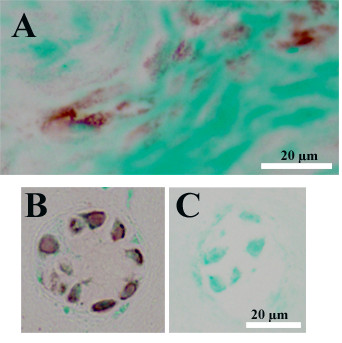
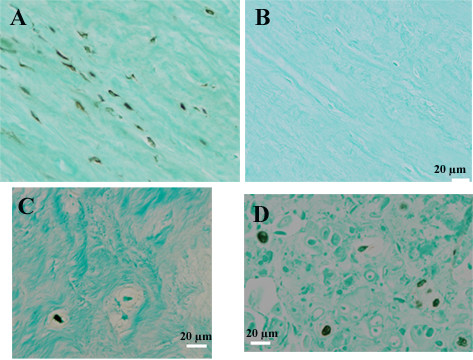
Studies were performed following approval of the authors' Human Subjects Institutional Review Board. Six annulus specimens from healthier Thompson grade I to II discs, and 12 specimens from more degenerate grade III to IV discs were utilized in microarray analysis of RANKL and cathepsin K gene expression. Immunohistochemistry was also performed on 15 additional disc specimens to assess the presence of RANKL and cathepsin K.
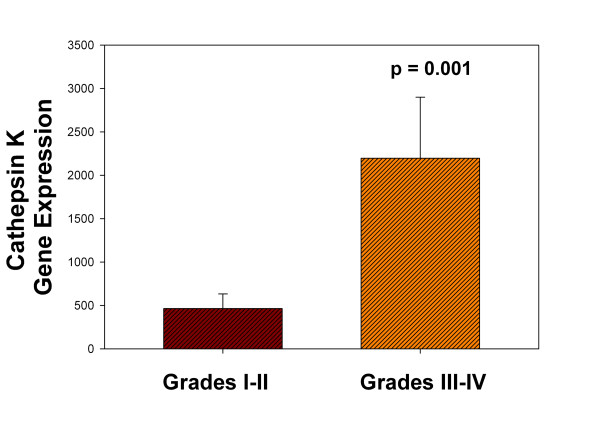
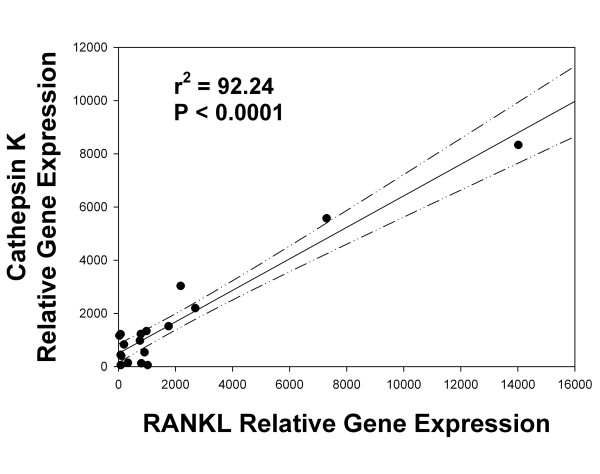
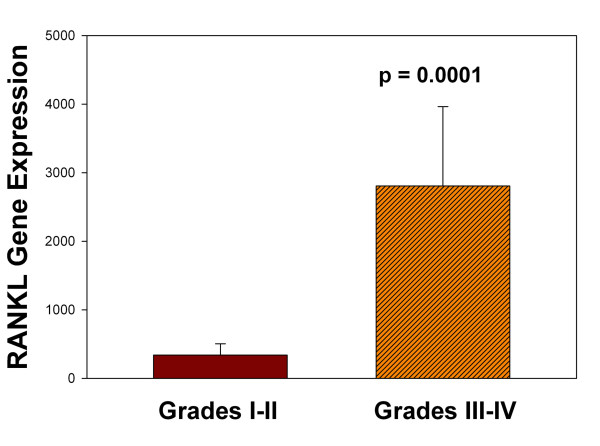
Cathepsin K gene expression was significantly greater in more degenerated grade III to IV discs compared to healthier grade I to II discs (P = 0.001). RANKL was also identified with immunohistochemistry and molecular analyses. RANKL gene expression was also significantly greater in more degenerated discs compared to healthier ones (P = 0.0001). A significant linear positive correlation was identified between expression of cathepsin K and RANKL (r(2) = 92.2; P < 0.0001).
Extracellular matrix remodeling is a key element of disc biology. Our use of an appropriate antibody and gene expression studies showed that cathepsin K is indeed present in the human intervertebral disc. Immunolocalization and molecular analyses also confirmed that RANKL is present in the human disc. Expression of RANKL was found to be significantly greater in more degenerated compared to healthier discs (P = 0.0001). Cathepsin K gene expression levels showed a positive, significant correlation with RANKL expression. Based on these data, we propose that cathepsin K plays a significant role in disc matrix remodeling and in matrix degradation in the proinflammatory cytokine-rich microenvironment of the degenerating disc.
组织蛋白酶 K 是一种新发现的半胱氨酸蛋白酶,可切割 I 型至 II 型胶原蛋白的三螺旋结构域。已经表明它在骨关节炎和类风湿关节炎患者的滑膜组织中上调,并在正常和非关节炎软骨中作为一个组成部分存在,随着年龄的增长而增加。最近关于心脏瓣膜发育的研究表明,核因子-κB 配体受体激活剂(RANKL)在瓣膜重塑过程中发挥作用,以促进组织蛋白酶 K 的表达。由于细胞外基质重塑是椎间盘结构和生物力学功能的关键组成部分,因此我们假设组织蛋白酶 K 和 RANKL 可能存在于人类椎间盘。
在作者的人类受试者机构审查委员会批准后进行了研究。对 6 个来自汤普森 I 级至 II 级更健康的环区样本和 12 个来自更退化的 III 级至 IV 级环区样本进行了 RANKL 和组织蛋白酶 K 基因表达的微阵列分析。还对 15 个额外的椎间盘样本进行了免疫组织化学分析,以评估 RANKL 和组织蛋白酶 K 的存在。
在更退化的 III 级至 IV 级环区样本中,组织蛋白酶 K 基因表达明显高于更健康的 I 级至 II 级环区样本(P = 0.001)。RANKL 也通过分子分析和免疫组织化学进行了鉴定。在更退化的样本中,RANKL 基因表达也明显高于更健康的样本(P = 0.0001)。鉴定出组织蛋白酶 K 和 RANKL 的表达之间存在显著的线性正相关(r²= 92.2;P < 0.0001)。
细胞外基质重塑是椎间盘生物学的关键要素。我们使用适当的抗体和基因表达研究表明,组织蛋白酶 K 确实存在于人类椎间盘。免疫组织化学和分子分析也证实了 RANKL 存在于人类椎间盘。与更健康的椎间盘相比,RANKL 在更退化的椎间盘中的表达明显更高(P = 0.0001)。组织蛋白酶 K 基因表达水平与 RANKL 表达呈正相关,且具有统计学意义。根据这些数据,我们提出组织蛋白酶 K 在椎间盘基质重塑和炎症细胞因子丰富的退化椎间盘的基质降解中发挥重要作用。