Psychology Department, Beckman Institute, University of Illinois at Urbana-Champaign Urbana, IL, USA.
Front Psychol. 2011 Aug 18;2:190. doi: 10.3389/fpsyg.2011.00190. eCollection 2011.
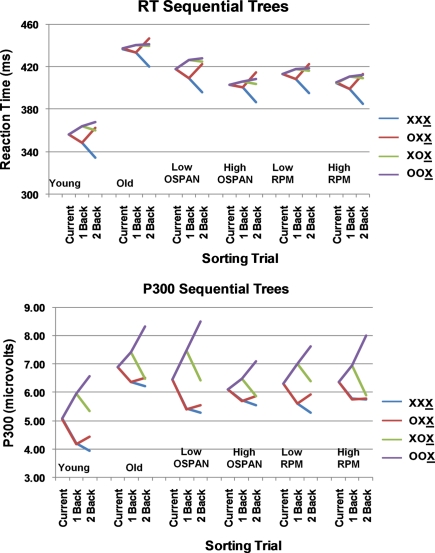
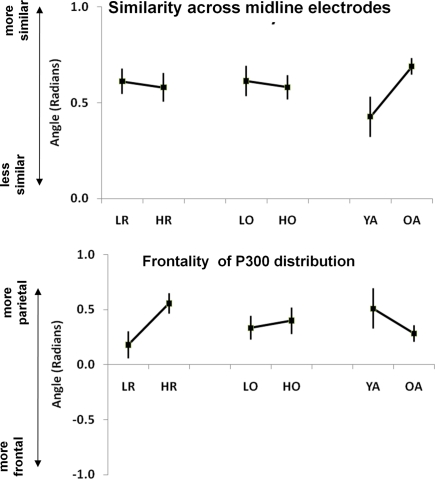
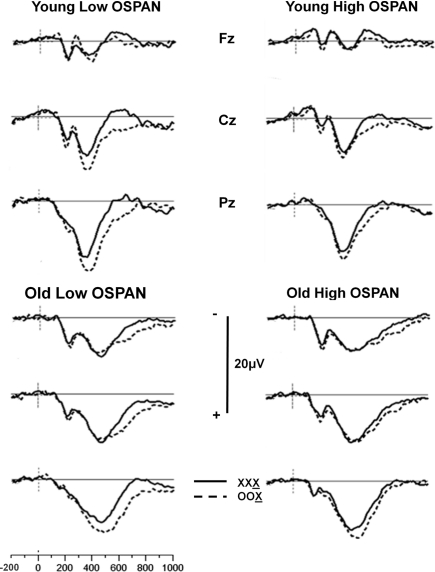
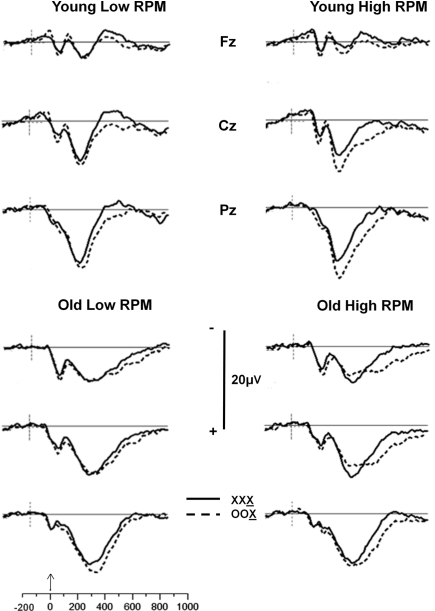
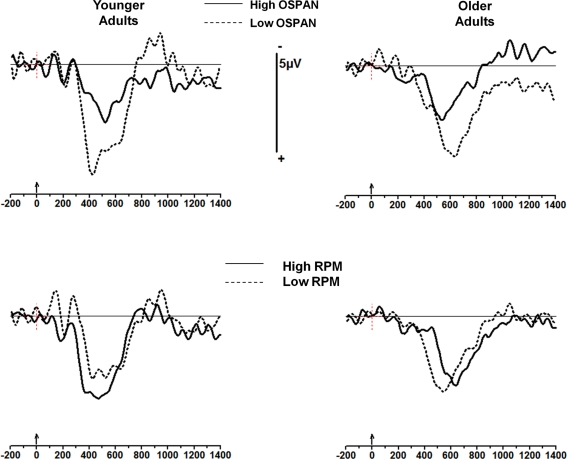
Older adults exhibit great variability in their cognitive abilities, with some maintaining high levels of performance on executive control tasks and others showing significant deficits. Previous event-related potential (ERP) work has shown that some of these performance differences are correlated with persistence of the novelty/frontal P3 in older adults elicited by task-relevant events, presumably reflecting variability in the capacity to suppress orienting to unexpected but no longer novel events. In recent ERP work in young adults, we showed that the operation-span (OSPAN) task (a measure of attention control) is predictive of the ability of individuals to keep track of stimulus sequencing and to maintain running mental representations of task stimuli, as indexed by the parietally distributed P300 (or P3b). Both of these phenomena reflect aspects of frontal function (cognitive flexibility and attention control, respectively). To investigate these phenomena we sorted both younger and older adults into low- and high-working memory spans and low- and high-cognitive flexibility subgroups, and examined ERPs during an equal-probability choice reaction time task. For both age groups (a) participants with high OSPAN scores were better able to keep track of stimulus sequencing, as indicated by their smaller P3b to sequential changes; and (b) participants with lower cognitive flexibility had larger P3a than their high-scoring counterparts. However, these two phenomena did not interact suggesting that they manifest dissociable control mechanisms. Further, the fact that both effects are already visible in younger adults suggests that at least some of the brain mechanisms underlying individual differences in cognitive aging may already operate early in life.
老年人在认知能力方面表现出很大的变异性,有些老年人在执行控制任务上表现出很高的水平,而有些老年人则表现出明显的缺陷。先前的事件相关电位(ERP)研究表明,这些表现差异中的一些与任务相关事件引起的老年人新奇/额部 P3 的持续存在相关,这可能反映了抑制对意外但不再新奇的事件的定向能力的变化。在最近的年轻人 ERP 研究中,我们发现操作跨度(OSPAN)任务(注意力控制的一种衡量标准)可以预测个体跟踪刺激序列和保持任务刺激的运行心理表象的能力,这由顶叶分布的 P300(或 P3b)来表示。这两种现象都反映了额叶功能的不同方面(分别是认知灵活性和注意力控制)。为了研究这些现象,我们将年轻和老年成年人分为低工作记忆跨度和高工作记忆跨度以及低认知灵活性和高认知灵活性亚组,并在等概率选择反应时任务期间检查 ERP。对于两个年龄组(a)OSPAN 得分较高的参与者能够更好地跟踪刺激序列,这表现为他们对序列变化的 P3b 较小;(b)认知灵活性较低的参与者的 P3a 比高分参与者更大。然而,这两个现象并没有相互作用,这表明它们表现出分离的控制机制。此外,这两个效应在年轻人中已经可见,这表明至少一些认知老化个体差异背后的大脑机制可能在生命早期就已经开始运作。