Inserm, U846, Stem Cell and Brain Research Institute, Bron, France.
PLoS One. 2011;6(8):e23952. doi: 10.1371/journal.pone.0023952. Epub 2011 Aug 24.
It is increasingly recognized that non-motor symptoms are a prominent feature of Parkinson's disease and in the case of cognitive deficits can precede onset of the characteristic motor symptoms. Here, we examine in 4 monkeys chronically treated with low doses of the neurotoxin MPTP the early and long-term alterations of rest-activity rhythms in relationship to the appearance of motor and cognitive symptoms.
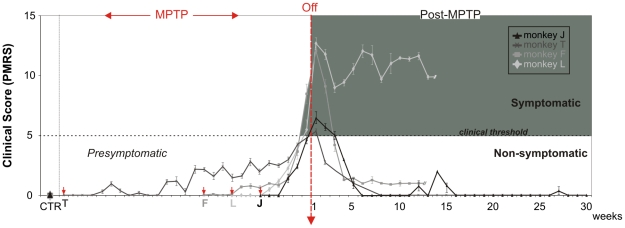
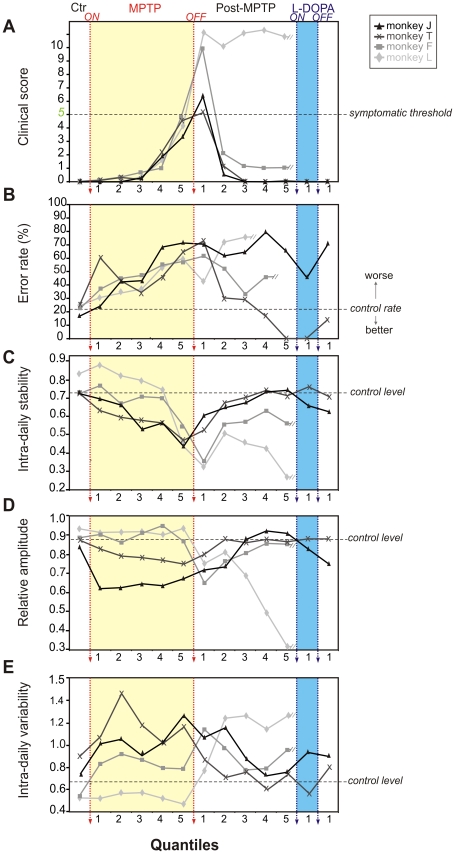
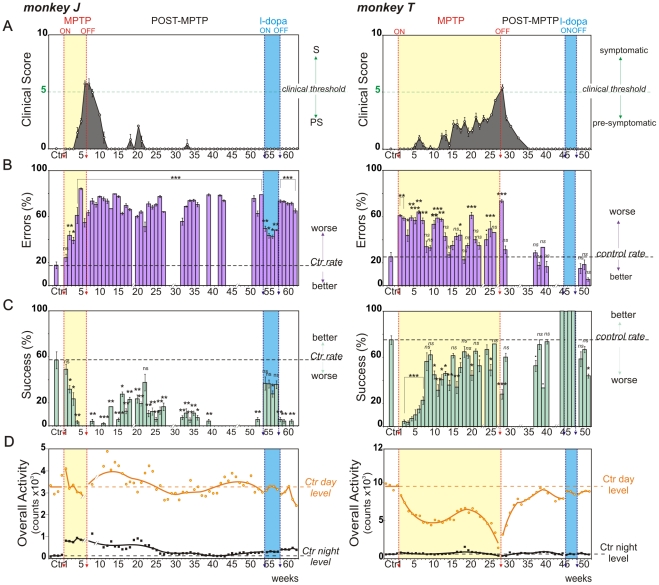
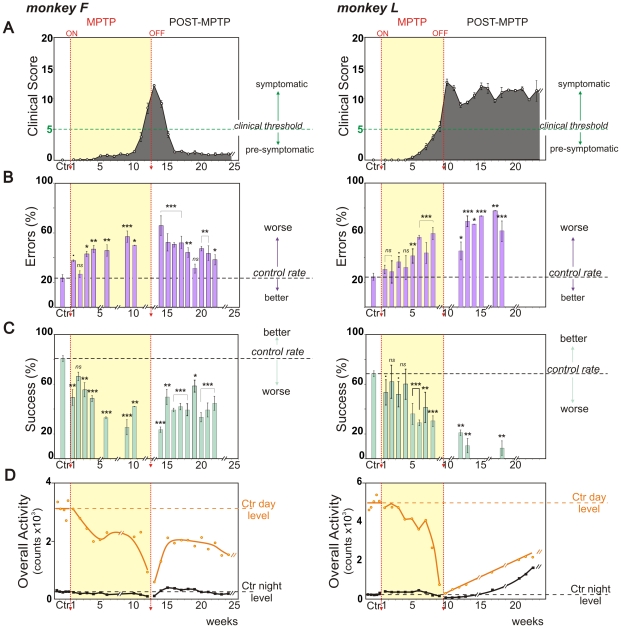
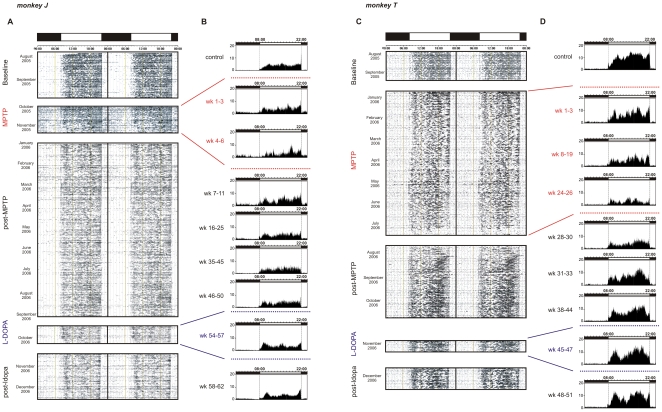
METHODOLOGY/PRINCIPAL FINDINGS: Behavioral activity recordings as well as motor and cognitive assessments were carried out continuously and in parallel before, during and for several months following MPTP-treatment (12-56 weeks). Cognitive abilities were assessed using a task that is dependent on the functional integrity of the fronto-striatal axis. Rest-activity cycles were monitored continuously using infrared movement detectors of locomotor activity. Motor impairment was evaluated using standardized scales for primates. Results show that MPTP treatment led to an immediate alteration (within one week) of rest-activity cycles and cognitive deficits. Parkinsonian motor deficits only became apparent 3 to 5 weeks after initiating chronic MPTP administration. In three of the four animals studied, clinical scores returned to control levels 5-7 weeks following cessation of MPTP treatment. In contrast, both cognitive deficits and chronobiological alterations persisted for many months. Levodopa treatment led to an improvement of cognitive performance but did not affect rest-activity rhythms in the two cases tested.
CONCLUSIONS/SIGNIFICANCE: Present results show that i) changes in the rest activity cycles constituted early detectable consequences of MPTP treatment and, along with cognitive alterations, characterize the presymptomatic stage; ii) following motor recovery there is a long-term persistence of non-motor symptoms that could reflect differential underlying compensatory mechanisms in these domains; iii) the progressive MPTP-monkey model of presymptomatic ongoing parkinsonism offers possibilities for in-depth studies of early non-motor symptoms including sleep alterations and cognitive deficits.
越来越多的人认识到,非运动症状是帕金森病的一个突出特征,在认知缺陷的情况下,它们可能先于特征性运动症状出现。在这里,我们在 4 只慢性接受低剂量神经毒素 MPTP 治疗的猴子中研究了静息-活动节律的早期和长期变化,以及这些变化与运动和认知症状出现之间的关系。
方法/主要发现:在 MPTP 治疗前、治疗期间和治疗后几个月(12-56 周),我们同时进行行为活动记录以及运动和认知评估。使用依赖于额纹状体轴功能完整性的任务来评估认知能力。使用红外运动探测器连续监测静息-活动周期。使用标准化的灵长类动物量表评估运动障碍。结果表明,MPTP 治疗导致静息-活动周期和认知缺陷的即刻改变(在一周内)。帕金森运动障碍仅在慢性 MPTP 给药开始后 3 至 5 周才出现。在研究的四只猴子中,有三只在停止 MPTP 治疗后 5-7 周内临床评分恢复到对照水平。相比之下,认知缺陷和生物节律改变持续了好几个月。左旋多巴治疗改善了认知表现,但在测试的两个病例中都没有影响静息-活动节律。
结论/意义:目前的结果表明:i)静息-活动周期的变化构成了 MPTP 治疗的早期可检测后果,并且与认知改变一起,构成了前驱期的特征;ii)运动恢复后,非运动症状长期持续存在,这可能反映了这些领域中不同的潜在补偿机制;iii)进行性 MPTP-猴前驱期持续帕金森病模型为深入研究早期非运动症状(包括睡眠改变和认知缺陷)提供了可能性。