Department of Anatomy and Neurosciences, Neuroscience Campus Amsterdam, Vrije Universiteit University Medical Center, Van der Boechorststraat 7, 1081 BT, Amsterdam, The Netherlands.
Psychopharmacology (Berl). 2012 Jan;219(2):443-52. doi: 10.1007/s00213-011-2444-8. Epub 2011 Sep 2.
There is growing clinical evidence for a strong relationship between drug addiction and impulsivity. However, it is not fully clear whether impulsivity is a pre-existing trait or a consequence of drug abuse. Recent observations in the animal models show that pre-existing levels of impulsivity predict cocaine and nicotine seeking. Whether such relationships also exist with respect to non-stimulant drugs is largely unknown.
We studied the relationship between impulsive choice and vulnerability to heroin taking and seeking.
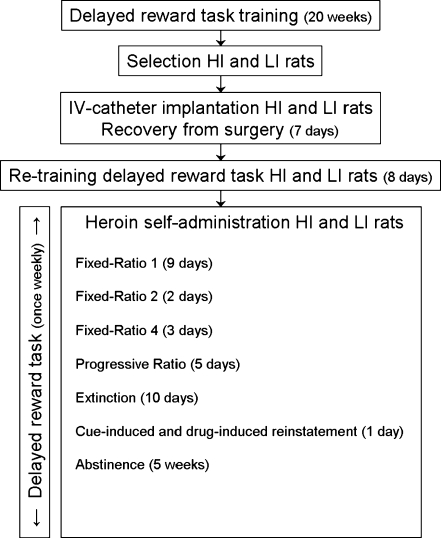
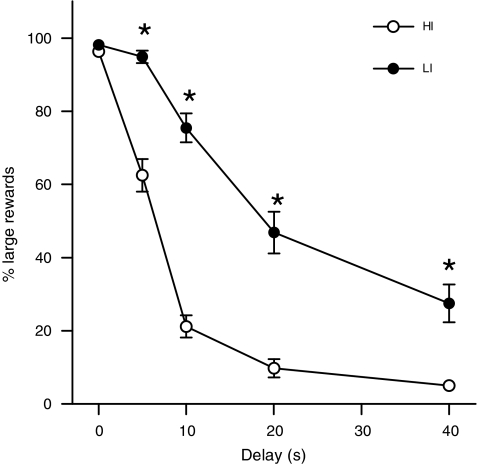
Rats were selected in the delayed reward task based on individual differences in impulsive choice. Subsequently, heroin intravenous self-administration behaviour was analysed, including acquisition of heroin intake, motivation, extinction and drug- and cue-induced reinstatement. Throughout the entire experiment, changes in impulsive choice were monitored weekly.
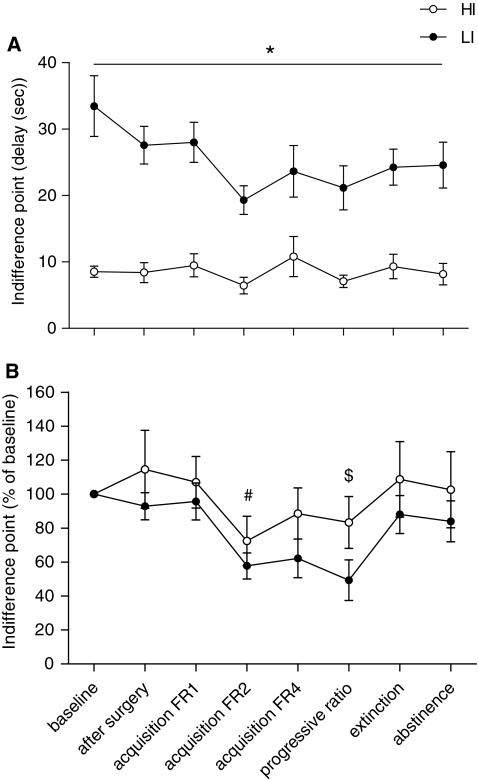
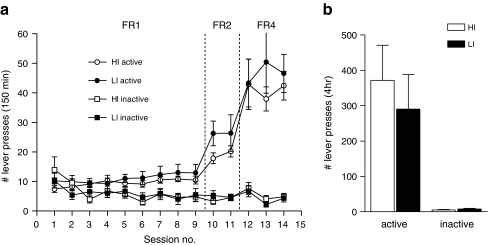
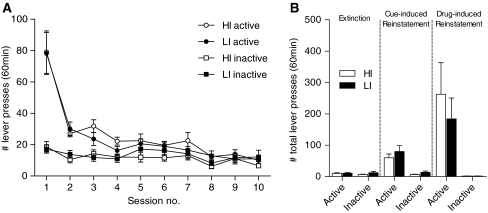
High impulsivity did not predict measures of heroin taking. Moreover, high impulsive rats did not differ from low impulsive rats in extinction rates or heroin- and cue-induced reinstatement. However, both groups became more impulsive as heroin self-administration continued. During abstinence, impulsivity levels returned towards baseline (pre-heroin) levels. Our results indicate that, in contrast to psychostimulants, impulsive choice does not predict vulnerability to heroin seeking and taking.
These data implicate that different neural mechanisms may underlie the vulnerability to opiate and psychostimulant dependence. Moreover, our data suggest that elevated impulsivity levels as observed in heroin-dependent subjects are a consequence of heroin intake rather than a pre-existing vulnerability trait.
越来越多的临床证据表明,药物成瘾与冲动之间存在很强的关系。然而,冲动究竟是一种预先存在的特征,还是药物滥用的后果,还不完全清楚。动物模型的最新观察表明,预先存在的冲动水平可预测可卡因和尼古丁的寻求。关于非兴奋剂药物是否也存在这种关系,目前还知之甚少。
我们研究了冲动选择与海洛因摄取和寻求易感性之间的关系。
根据冲动选择的个体差异,大鼠在延迟奖励任务中进行选择。随后,分析了海洛因静脉自我给药行为,包括海洛因摄入量的获得、动机、消退以及药物和线索诱导的复吸。在整个实验过程中,每周监测冲动选择的变化。
高冲动性并不能预测海洛因摄取的指标。此外,高冲动性大鼠在消退率或海洛因和线索诱导的复吸方面与低冲动性大鼠没有差异。然而,随着海洛因自我给药的持续进行,两组大鼠都变得更加冲动。在禁欲期间,冲动水平恢复到基线(海洛因前)水平。我们的研究结果表明,与精神兴奋剂不同,冲动选择并不能预测对海洛因寻求和摄取的易感性。
这些数据表明,不同的神经机制可能是导致阿片类药物和精神兴奋剂依赖易感性的原因。此外,我们的数据表明,在海洛因依赖者中观察到的冲动水平升高是海洛因摄入的结果,而不是预先存在的易感性特征。