Fan Xingjun, Xiaoqin Liu, Potts Breshey, Strauch Christopher M, Nemet Ina, Monnier Vincent M
Department of Pathology, Case Western Reserve University, Cleveland, OH, USA.
Mol Vis. 2011;17:2221-7. Epub 2011 Aug 18.
Previous experiments from our laboratory showed that the oral intake of selected guanidino compounds could block the formation of crystallin-bound advanced ascorbylation products. Here we tested whether these were also active when applied as eye drops.
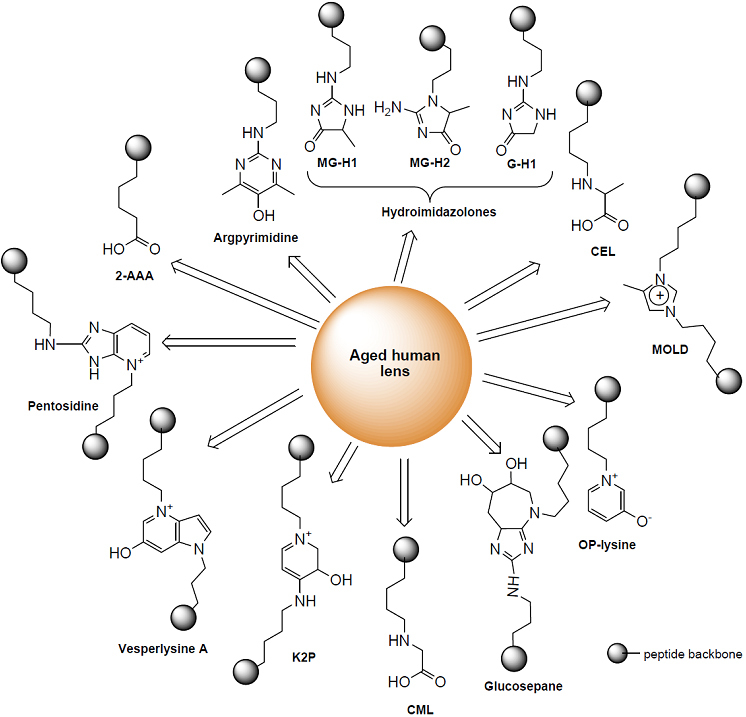
Two month old hSVCT2 transgenic mice (n=10) were treated twice daily with one drop of 0.1% L-arginine, γ-guanidinobutyric acid (GBA), penicillamine (PA) or N-acetylcysteine (NAC) in one eye and vehicle only in the other eye. After seven months, lens crystallins were isolated, dialyzed, and proteolytically digested to determine the protein-bound fluorescence at 335/385 and 370/440 nm excitation/emission and the advanced glycation/ascorbylation endproducts carboxymethyl-lysine (CML), carboxyethyl-lysine (CEL), glucosepane, glyoxal, and methylglyoxal hydroimidazolones G-H1 and MG-H1. The topical uptake of L-arginine and NAC was also evaluated in vitro and in vivo in rabbit lens.
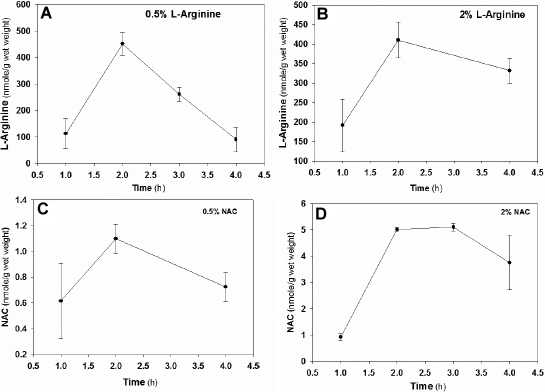
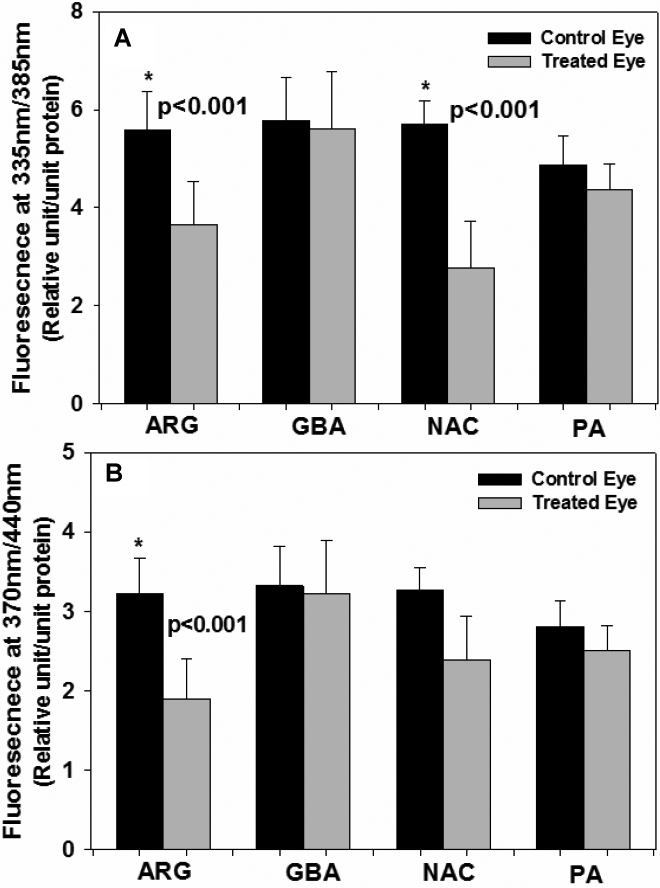
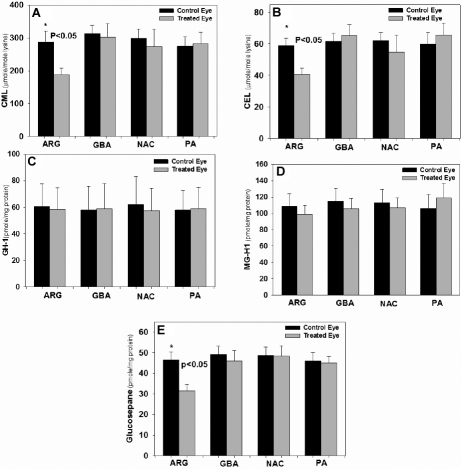
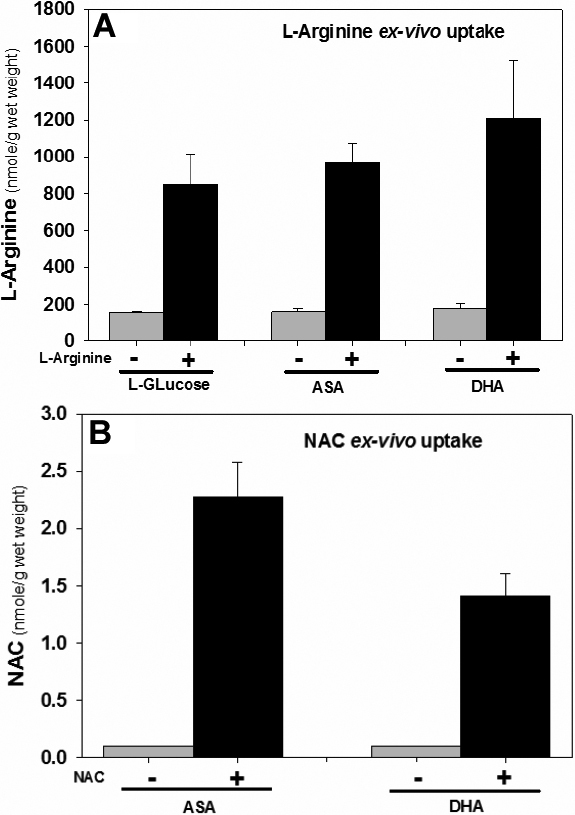
In hSVCT2 mice, L-arginine decreased 335/385 and 370/440 nm fluorescence by 40% (p<0.001), CML, CEL, and glucosepane crystallin crosslinks by 35% (p<0.05), 30% (p<0.05), and 37% (p<0.05), respectively, without affecting MG-H1 and G-H1. NAC decreased 335/385 nm fluorescence by 50% (p<0.001) but, like PA and GBA, had no effect on other modifications. L-Arginine uptake into rabbit eyes treated topically reached identical lenticular plateau levels (~400 nmol/g wet weight) at 0.5% and 2.0% but levels remained three times higher at 5 h at 2% versus 0.5% concentration, respectively. In vitro studies showed a 100 fold higher L-arginine level than NAC levels, implicating high affinity uptake of the former.
L-Arginine when applied both orally and topically is a potent and broad suppressor of advanced ascorbylation in the lens. Its uptake in rabbit lens upon topical application suggests transcorneal uptake into the human lens should be feasible for testing its potential anticataract properties in clinical trials.
我们实验室之前的实验表明,口服特定的胍基化合物可阻止晶状体结合的晚期抗坏血酸产物的形成。在此,我们测试了这些化合物以滴眼液形式应用时是否也具有活性。
对2月龄的hSVCT2转基因小鼠(n = 10),一只眼睛每日两次滴入一滴0.1%的L-精氨酸、γ-胍基丁酸(GBA)、青霉胺(PA)或N-乙酰半胱氨酸(NAC),另一只眼睛仅滴入赋形剂。7个月后,分离、透析晶状体晶状体蛋白,并进行蛋白水解消化,以测定在335/385和370/440 nm激发/发射波长下的蛋白结合荧光,以及晚期糖基化/抗坏血酸产物羧甲基赖氨酸(CML)、羧乙基赖氨酸(CEL)、葡糖醛酮、乙二醛和甲基乙二醛水解咪唑酮G-H1和MG-H1。还在兔晶状体上进行了L-精氨酸和NAC的局部摄取的体外和体内评估。
在hSVCT2小鼠中,L-精氨酸使335/385和370/440 nm荧光分别降低40%(p<0.001),使CML、CEL和葡糖醛酮晶状体交联分别降低35%(p<0.05)、30%(p<0.05)和37%(p<0.05),而不影响MG-H1和G-H1。NAC使335/385 nm荧光降低50%(p<0.001),但与PA和GBA一样,对其他修饰无影响。局部应用于兔眼的L-精氨酸在0.5%和2.0%浓度下达到相同的晶状体平台水平(约400 nmol/g湿重),但在5小时时,2%浓度下的水平分别比0.5%浓度高3倍。体外研究表明,L-精氨酸水平比NAC水平高100倍,这表明前者具有高亲和力摄取。
L-精氨酸口服和局部应用时都是晶状体中晚期抗坏血酸的有效且广泛的抑制剂。其局部应用于兔晶状体时的摄取表明,经角膜摄取进入人晶状体在临床试验中测试其潜在的抗白内障特性应该是可行的。