Center for Infectious Disease Dynamics, Mueller Laboratory, Department of Biology, Penn State University, University Park, Pennsylvania, United States of America.
PLoS One. 2011;6(8):e23591. doi: 10.1371/journal.pone.0023591. Epub 2011 Aug 29.
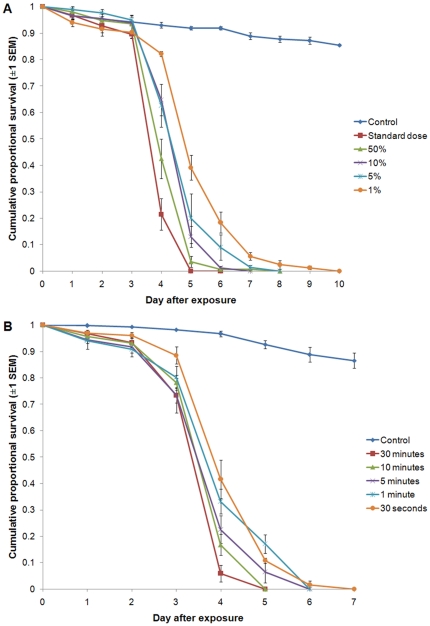
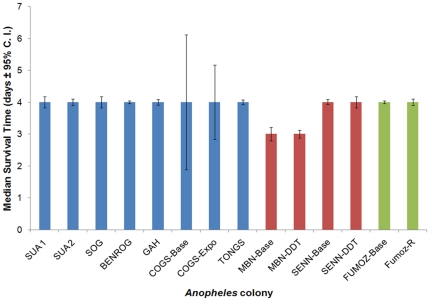
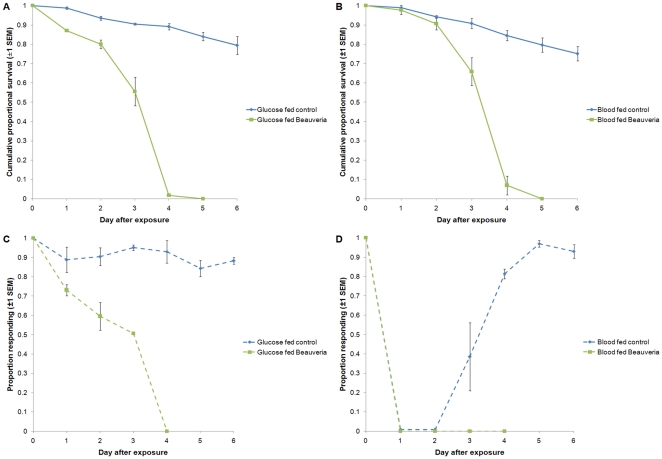
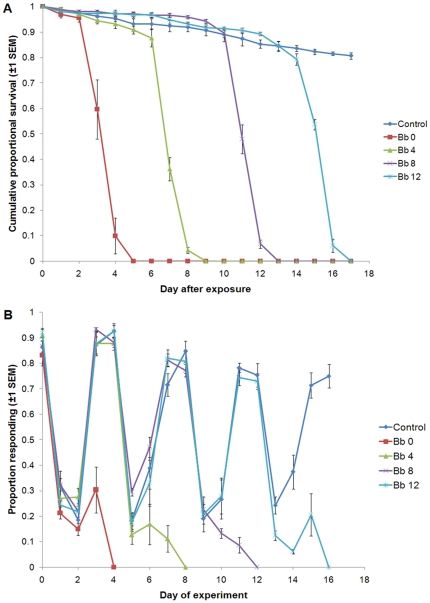
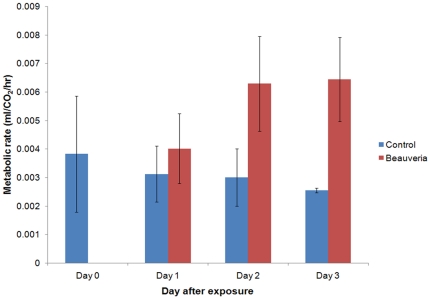
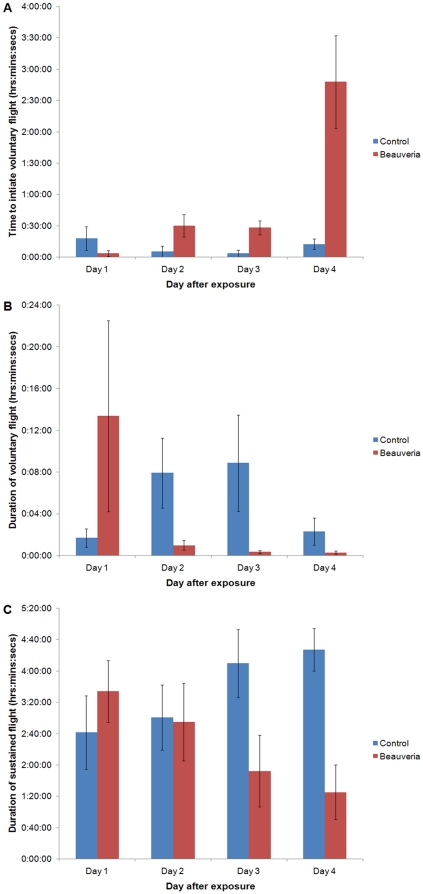
Rapidly emerging insecticide resistance is creating an urgent need for new active ingredients to control the adult mosquitoes that vector malaria. Biopesticides based on the spores of entomopathogenic fungi have shown considerable promise by causing very substantial mortality within 7-14 days of exposure. This mortality will generate excellent malaria control if there is a high likelihood that mosquitoes contact fungi early in their adult lives. However, where contact rates are lower, as might result from poor pesticide coverage, some mosquitoes will contact fungi one or more feeding cycles after they acquire malaria, and so risk transmitting malaria before the fungus kills them. Critics have argued that 'slow acting' fungal biopesticides are, therefore, incapable of delivering malaria control in real-world contexts. Here, utilizing standard WHO laboratory protocols, we demonstrate effective action of a biopesticide much faster than previously reported. Specifically, we show that transient exposure to clay tiles sprayed with a candidate biopesticide comprising spores of a natural isolate of Beauveria bassiana, could reduce malaria transmission potential to zero within a feeding cycle. The effect resulted from a combination of high mortality and rapid fungal-induced reduction in feeding and flight capacity. Additionally, multiple insecticide-resistant lines from three key African malaria vector species were completely susceptible to fungus. Thus, fungal biopesticides can block transmission on a par with chemical insecticides, and can achieve this where chemical insecticides have little impact. These results support broadening the current vector control paradigm beyond fast-acting chemical toxins.
迅速出现的杀虫剂耐药性正在迫切需要新的有效成分来控制传播疟疾的成年蚊子。基于昆虫病原真菌孢子的生物农药显示出了巨大的潜力,在接触后的 7-14 天内就能导致大量死亡。如果蚊子在成虫早期有很大的可能接触真菌,那么这种死亡率将能很好地控制疟疾。然而,在接触率较低的情况下,由于杀虫剂覆盖范围较窄,一些蚊子会在感染疟疾后一个或多个取食周期后接触真菌,因此在真菌杀死它们之前有传播疟疾的风险。批评者认为,“作用缓慢”的真菌生物农药因此无法在现实环境中提供疟疾控制。在这里,我们利用世界卫生组织的标准实验室方案,展示了一种生物农药比以前报道的更快地发挥作用。具体来说,我们表明,短暂接触喷洒了候选生物农药的粘土瓦,该生物农药由天然分离的球孢白僵菌孢子组成,可以在一个取食周期内将疟疾传播的可能性降低到零。这种效果是由高死亡率和真菌引起的快速减少取食和飞行能力共同作用的结果。此外,来自三种关键的非洲疟疾传播媒介物种的多个杀虫剂耐药系对真菌完全敏感。因此,真菌生物农药可以与化学杀虫剂一样阻断传播,并且在化学杀虫剂几乎没有影响的情况下也能做到这一点。这些结果支持将当前的病媒控制模式扩大到快速作用的化学毒素之外。